Kinesin 'chauffeur' helps HIV escape destruction
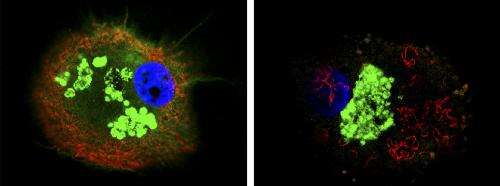
A JCB study identifies a motor protein that ferries HIV to the plasma membrane along microtubules, helping the virus escape from macrophages. In these images of a macrophage, the distribution of virus-containing compartments (green) where HIV assembles changes after microtubules (red) are disrupted (right). Credit: Gaudin, R., et al., 2012. J. Cell Biol. doi:10.1083/jcb.201201144

A study in The Journal of Cell Biology identifies a motor protein that ferries HIV to the plasma membrane, helping the virus escape from macrophages.

HIV reproduces inside disease-fighting T cells, killing them in the process. But the virus can also replicate in macrophages, which survive infection and serve as reservoirs of HIV. In T cells, new are formed at the plasma membrane, but in macrophages the viruses assemble inside cytoplasmic containers called virus-containing compartments (VCCs). To break out of a macrophage, a virus particle therefore has to travel to the .

A group of researchers led by Philippe Benaroch (INSERM, Paris) showed that the virus hitches a ride with the microtubule-based kinesin motor protein KIF3A. The researchers found that reducing the level of KIF3A dramatically reduced the release of HIV particles from macrophages. Yet the procedure did not have any effect on the amount of HIV escaping from T cells. KIF3A drives HIV along microtubules, the researchers discovered; they observed KIF3A proteins and VCCs moving in tandem along the microtubule filaments. Consistent with this, VCCs build up in cells lacking KIF3A, suggesting that their movements stall in the absence of the kinesin. How HIV exits VCCs remains uncertain, but the results indicate that inhibiting KIF3A might offer a new way to combat the virus.

More information: Gaudin, R., et al., 2012. J. Cell Biol. doi:10.1083/jcb.201201144

add to favorites email to friend print save as pdf

Related Stories

3D structure of HIV is discovered

Jan 24, 2006

Scientists say the 3D structure of the human immunodeficiency virus, which causes AIDS, has been determined for the first time.

Exhausted B cells fail to fight HIV

Jul 14, 2008

HIV tires out the cells that produce virus-fighting proteins known as antibodies, according to a human study that will be published online July 14 in the Journal of Experimental Medicine.

HIV-1's 'hijacking mechanism' pinpointed by researchers

Jun 10, 2009

Researchers at McGill University and the affiliated Lady Davis Institute for Medical Research at Montreal's Jewish General Hospital - along with colleagues at the University of Manitoba and the University of British Columbia ...

Scientists find another key to HIV success

Mar 22, 2006

Weill Cornell Medical College scientists say they've determined a protein produced by HIV infected cells prevents immune B cells from producing antibodies.

Recommended for you

Respect may be the key to stopping patient 'no shows'

Jun 18, 2013

People with HIV are more likely to keep their scheduled medical appointments—and their disease under control—if they feel their physician listens, explains things clearly and knows them as a person, not just a "case," ...

Study details age disparities in HIV continuum of care

Jun 17, 2013

Age disparities exist in the continuum of care for patients with the human immunodeficiency virus (HIV) with people younger than 45 years less likely to be aware of their infection or to have a suppressed viral load, according ...

Cost-effective: Universal HIV testing in India

Jun 10, 2013

In India most people who are HIV positive don't know it, yet testing and treatment are relatively cheap and available. It would therefore meet international standards of cost-effectiveness—and save millions of lives for ...

User comments

More news stories

One in four stroke patients suffer PTSD

One in four people who survive a stroke or transient ischemic attack (TIA) suffer from symptoms of post-traumatic stress disorder (PTSD) within the first year post-event, and one in nine experience chronic PTSD more than ...