Researchers discover neurological link to loneliness
October 25, 2012 in Neuroscience

Loneliness? It’s all a state of mind

Enlarge

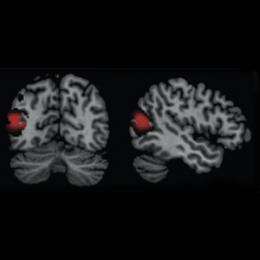
Researchers from UCL have found that lonely people have less grey matter in a part of the brain associated with decoding eye gaze and other social cues.

Published in the journal of , the study also suggests that through training people might be able to improve their social perception and become less lonely.

"What we've found is the neurobiological basis for loneliness," said lead author Dr Ryota Kanai (UCL Institute of Cognitive Neuroscience). "Before conducting the research we might have expected to find a link between lonely people and the part of the brain related to emotions and anxiety, but instead we found a link between loneliness and the amount of grey matter in the part of the brain involved in basic social perception." 

To see how differences in loneliness might be reflected in the structure of the associated with social processes, the team scanned the brains of 108 healthy adults and gave them a number of different tests. Loneliness was self-reported and measured using a UCLA loneliness scale questionnaire. 

When looking at full brain scans they saw that lonely individuals have less greymatter in the left posterior superior temporal sulcus (pSTS)—an area implicated in basic social perception, confirming that loneliness was associated with difficulty in processing .

"The pSTS plays a really important role in social perception, as it's the initial step of understanding other people," said Dr Kanai. "Therefore the fact that lonely people have less grey matter in their pSTS is likely to be the reason why they have poorer ."

In order to gauge social perception, participants were presented with three different faces on a screen and asked to judge which face had misaligned eyes and whether they were looking either right or left. Lonely people found it much harder to identify which way the eyes were looking, confirming the link between loneliness, the size of the pSTS and the perception of

"From the study we can't tell if loneliness is something hardwired or environmental," said co-author Dr Bahador Bahrami (UCL Institute of ). "But one possibility is that people who are poor at reading social cues may experience difficulty in developing social relationships, leading to social isolation and loneliness." 

One way to counter this loneliness could be through social perception training with a smartphone app.

"The idea of training is one way to address this issue, as by maybe using a smartphone app to improve people's basic such as eye gaze, hopefully we can help them to lead less lonely lives," said Dr Kanai.

Journal reference: Current Biology search and more info website

Provided by University College London search and more info website

5 /5 (3 votes)  

Filter


Move the slider to adjust rank threshold, so that you can hide some of the comments.


Display comments: newest first

Sinister1811
Oct 27, 2012

Rank: not rated yet
That's good and everything. But it still doesn't solve my loneliness.
Tausch
Oct 29, 2012

Rank: not rated yet
None of this exists between children at birth (or shortly before and after) and their mothers.
No (definable) cues, lateralization, or loneliness.

Which means this article never appeared.
Rank 5 /5 (3 votes)
Relevant PhysicsForums posts

More news stories

For combat veterans suffering from post-traumatic stress disorder, 'fear circuitry' in the brain never rests

Chronic trauma can inflict lasting damage to brain regions associated with fear and anxiety. Previous imaging studies of people with post-traumatic stress disorder, or PTSD, have shown that these brain regions can over-or ...

Neuroscience created 12 hours ago | popularity 5 / 5 (1) | comments 0 | with audio podcast

Temporal processing in the olfactory system

The neural machinery underlying our olfactory sense continues to be an enigma for neuroscience. A recent review in Neuron seeks to expand traditional ideas about how neurons in the olfactory bulb might encode information about ...

Neuroscience created 23 hours ago | popularity not rated yet | comments 0 | with audio podcast report

Melon focus headband turns to Kickstarter for rollout plans

(Medical Xpress)—What if the quality of your work depends more on your focus on the piano keys or canvas or laptop than your musical or painting or computing skills? If target users can be convinced, they ...

Neuroscience created 23 hours ago | popularity 3.7 / 5 (3) | comments 0 | with audio podcast weblog

Deep brain stimulation: A fix when the drugs don't work

Neurological disorders can have a devastating impact on the lives of sufferers and their families.

Neuroscience created May 17, 2013 | popularity 5 / 5 (1) | comments 0 | with audio podcast

Brain makes call on which ear is used for cell phone

If you're a left-brain thinker, chances are you use your right hand to hold your cell phone up to your right ear, according to a newly published study from Henry Ford Hospital in Detroit.

Neuroscience created May 16, 2013 | popularity 2 / 5 (2) | comments 0 | with audio podcast


US psychiatry gets makeover in new manual

The latest makeover to a massive psychiatric tome honored by some, reviled by others and even called the "Bible" of mental disorders is being released Saturday with a host of new changes.

New case of SARS-like virus in Saudi: ministry

A new case of the deadly coronavirus has been detected in Saudi Arabia where 15 people have already died after contracting it, the health ministry announced on Saturday on its Internet website.

New research identifies risks, interventions for children's GI health

An increasing number of U.S. children are experiencing gastrointestinal issues that require interventions to resolve, according to research presented at Digestive Disease Week (DDW).

New colonoscope provides ground-breaking view of colon

A ground-breaking advance in colonoscopy technology signals the future of colorectal care, according to research presented today at Digestive Disease Week(DDW). Additional research focuses on optimizing the minimal withdrawal ...

AIDS science at 30: 'Cure' now part of lexicon

Big names in medicine are set to give an upbeat assessment of the war on AIDS on Tuesday, 30 years after French researchers identified the virus that causes the disease.

Now we know why old scizophrenia medicine works on antibiotics-resistant bacteria

In 2008 researchers from the University of Southern Denmark showed that the drug thioridazine, which has previously been used to treat schizophrenia, is also a powerful weapon against antibiotic-resistant bacteria such as ...