Neutrons help explain why antibiotics prescribed for chemotherapy cause kidney failure
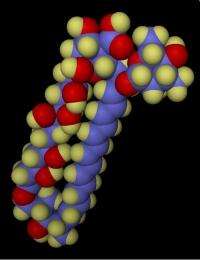
Neutron scattering experiments have provided new insights into the origin of the side effects of an antifungal drug prescribed all over the world. The analysis conducted by scientists at King's College London and the Institut Laue-Langevin in Grenoble, and published in Scientific Reports, follows 40 years of debate and could help drug developers reduce these harmful complications.
Wherever you are in the world, indoors or outdoors, the air you breathe contains fungal spores. Though occasionally linked with allergies, asthma or skin irritations, the majority are easily dealt with by the body's immune system.
A far greater risk is posed to individuals whose immune systems are already compromised such as those infected with HIV, severe burn victims or those having just undergone chemotherapy.
Treatment with AmB
The most successful treatment to date is an antibiotic first developed in the 1950s called Amphotericin B (AmB) which was shown to attack fungal cells. The drug is highly effective. Mortality rates associated with these types of fungal infections in vulnerable patients are about 80% without treatment, yet fall below 30% when treated with AmB.
However in the past 20 years there has been a dramatic rise in cases of the fungi developing antibiotic resistance. This has necessitated the prescription of increased doses of AmB which unexpectedly produced severe and sometimes lethal side effects. Tests have shown that at these heightened doses nearly 50% of patients suffer from some form of kidney poisoning. In one study 15% of patients on the drug were forced to go on kidney dialysis. In less common cases AmB can even lead to complete failure of the kidneys, liver or even the heart.
The accepted explanation of AmB as an antibiotic has been that it combines with molecules found in the membrane to create barrel shaped holes which allow cell material to leak out or harmful material to get in, killing the cell.
Whilst fungal membranes contain called ergosterol, animal cell membranes, including our own, contain the more familiar cholesterol. It is thought that AmB reacts more readily with ergosterol to form these membrane holes than it does with cholesterol. This would explain why at low doses AmB can be used to treat infection without harming the patient, however there has so far been no direct evidence to support this hypothesis.
Structural analysis by neutron diffraction at the ILL
In this new paper, Dr David Barlow and his colleagues from King's College London describe neutron diffraction experiments at the Institut Laue-Langevin, the flag-ship centre for neutron science that reveal how AmB interacts with fungal and animal cell membranes on sub-molecular scales of around 1 millionth the width of a human hair.
Like all particles, neutrons demonstrate some wave like behaviour, and when they encounter obstacles whose size is comparable with their wavelength they scatter along well-defined angles. It is this property which allows scientists at neutron sources such as the ILL to analyse the scattering patterns and infer the structure of the material the neutrons have passed through.
The team modelled the two different membranes with layers of lipids, fatty molecules found in all cells, which were combined with either cholesterol or ergosterol. The team used deuteration techniques where deuterium, a heavier isotope of hydrogen which is easily picked out by neutrons over its lighter cousin, is introduced to either the membrane model or the drug, tagging that part of the system to follow it during the interaction.
The results
Using these techniques the team unveiled the first experimental evidence for the theoretical 'leaky holes' resulting from the development of 'barrel-like' structures which formed in both membranes upon the introduction of AmB.
However, the barrels were found to penetrate more deeply into the fungal membranes than the human membranes at the same relatively low dose. The implication is that at such low doses during treatment, the AmB can open up holes in fungal cells but is unable to do so as readily in the human cells. Only when the dose is increased do you get holes passing right across both types of membranes and the resulting damage to healthy tissue.
The underlying cause of this difference in membrane insertion may be down to differences in the angle of insertion, identified for the first time in this paper. When the AmB inserts into the fungal (ergosterol-containing) membranes, it appears to be less tilted than when it inserts into the human (cholesterol-containing) membranes.
The next step for Dr Barlow is to improve the resolution of the analysis in order to identify the exact part of the drug which forms these barrel structures. It is this part that drug developers would need to play with to improve AmB's specificity to fungal cells, or use to develop a whole new drug with less harmful side effects.
Dr David Barlow from King's said: 'These are particularly harmful and potentially lethal side effects. The problem is, despite being developed in the 50's, no-one up until now has been able to experimentally determine how AmB works. This is vital if we are to reduce its complications or use its therapeutic properties in new less harmful, drugs.'
Dr Bruno Demé, a scientist at the ILL who worked with Dr Barlow on ILL's D16 neutron diffraction instrument said; 'Neutrons are an ideal tool for studying biological materials and their behaviour as proteins, viruses and cell membranes, all of the order of 1 to 10 nanometres, easily fall within the right size scale. Also neutrons are particularly sensitive to lighter atoms such as carbon, hydrogen and oxygen that make up these organic molecules and can distinguish between them very easily. With the world most powerful source of neutrons in the world, the ILL has a long history of significant breakthroughs in understanding and improving drug delivery and treatment mechanisms.'
More information: Scientific Reports, Published 29 October 2012; DOI: 10.1038/srep00778


