Body language, not facial expressions, broadcasts what's happening to us
November 29, 2012 in Psychology & Psychiatry

Body language, not facial expressions, broadcasts what's happening to us

Enlarge

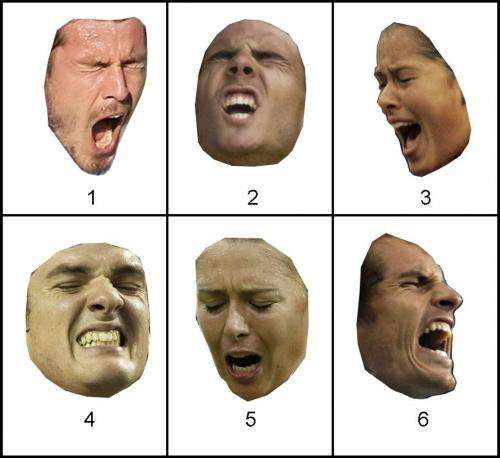
Expressions numbered 1,4,6 show tennis player's face on losing a point; expressions numbered 2,3,5 show a player after winning a point). Tests show that those looking at facial expressions alone cannot determine what the true emotion is. Credit: Reuters: Used with permission

If you think that you can judge by examining someone's facial expressions if he has just hit the jackpot in the lottery or lost everything in the stock market—think again. Researchers at the Hebrew University of Jerusalem and at New York University and Princeton University have discovered that—despite what leading theoretical models and conventional wisdom might indicate—it just doesn't work that way.

Rather, they found that language provides a better cue in trying to judge whether an observed subject has undergone strong positive or .

In a study published this week in the journal Science, the researchers present data showing that viewers in test groups were baffled when shown photographs of people who were undergoing real-life, highly intense positive and negative experiences. When the viewers were asked to judge the emotional valences of the faces they were shown (that is, the positivity or negativity of the faces), their guesses fell within the realm of chance.

The study was led by Dr. Hillel Aviezer of the Psychology Department of the Hebrew University, together with Dr. Yaacov Trope of New York University and Dr. Alexander Todorov of Princeton University.

In setting out to test the perception of highly intense faces, the researchers presented test groups with photos of dozens of highly intense in a variety of real-life emotional situations. For example, in one study they compared of professional tennis players winning or losing a point. These pictures are ideal because the stakes in such games are extremely high from an economic and prestige perspective.

To pinpoint how people recognize such images, Aviezer and his colleagues showed different versions of the pictures to three groups of participants: 1) the full picture with the face and body; 2) the body with the face removed; and 3) the face with the body removed. Remarkably, participants could easily tell apart the losers from winners when they rated the full picture or the body alone, but they were at chance level when rating the face alone.

Ironically, the participants who viewed the full image (face and body) were convinced that it was the face that revealed the emotional impact, not the body. The authors named this effect "illusory valence," reflecting the fact that participants said they saw clear valence (that is, either positive or negative emotion) in what was objectively a non-diagnostic face.

In an additional study, Aviezer and his collaborators asked viewers to examine a more broad range of real-life intense faces. These included intense positive situations, such as joy (seeing one's house after a lavish makeover), pleasure (experiencing an orgasm), and victory (winning a critical tennis point), as well as negative situations, such as grief (reacting at a funeral), pain (undergoing a nipple/naval piercing), and defeat (losing a critical tennis point).

Again, viewers were unable to tell apart the faces occurring in positive vs. negative situations. To further demonstrate how ambiguous these intense faces are, the researchers "planted" faces on bodies expressing positive or negative emotion. Sure enough, the emotional valence of the same face on different bodies was determined by the body, flipping from positive to negative depending on the body with which they appeared.

"These results show that when emotions become extremely intense, the difference between positive and negative facial expression blurs," says Aviezer. "The findings, challenge classic behavioral models in neuroscience, social psychology and economics, in which the distinct poles of positive and negative valence do not converge."

Aviezer adds: "From a practical-clinical perspective, the results may help researchers understand how body/face expressions interact during emotional situations. For example, individuals with autism may fail to recognize facial expressions, but perhaps if trained to process important body cues, their performance may significantly improve."

Journal reference: Science search and more info website

Provided by Hebrew University of Jerusalem search and more info website

4.7 /5 (6 votes)  

Filter


Move the slider to adjust rank threshold, so that you can hide some of the comments.


Display comments: newest first

Tausch
Nov 29, 2012

Rank: not rated yet
Still, the participants saw an 'intensity' (of the 'impact' of emotion') reflecting a fact of what they saw.

Tears are a sign of 'intensity' of 'impact'.
Sometimes begging the question of source:
Joy, pain, anger, sadness, fear etc.

Sometimes you don't know whether to laugh, cry, or to do both.
Tears are a cue too.

Also important are the 'adapted' cues - your conversation partner mirrors the position of your body without awareness until told.

A_Paradox
Nov 30, 2012

Rank: not rated yet
Well, I am most impressed! I was one of the majority who naively thought it was facial expression which conveyed the most information about a person's emotional state. [Note: #6 looks to me like the actor Jack Nicholson, who I can't stand, being his normal, horrible, on screen self! ]
A_Paradox
Dec 01, 2012

Rank: not rated yet
As someone in Facebook Consciousness group just pointed out, all these faces have their eyes shut! If they only used pictures of faces with eyes shut, that makes their conclusions somewhat gratuitous and, well, not so useful by a long shot.
Rank 4.7 /5 (6 votes)
Related Stories
Relevant PhysicsForums posts

More news stories

Motion quotient: IQ predicted by ability to filter motion (w/ video)

A brief visual task can predict IQ, according to a new study. This surprisingly simple exercise measures the brain's unconscious ability to filter out visual movement. The study shows that individuals whose ...

Psychology & Psychiatry created 3 hours ago | popularity 4.8 / 5 (5) | comments 0 | with audio podcast

Anxious men fare worse during job interviews, study finds

Nervous about that upcoming job interview? You might want to take steps to reduce your jitters, especially if you are a man.

Psychology & Psychiatry created 4 hours ago | popularity 5 / 5 (1) | comments 0

Are kids who take music lessons different from other kids?

(Medical Xpress)—Research by U of T Mississauga psychology professor Glenn Schellenberg reveals that two key personality traits – openness-to-experience and conscientiousness—predict better than IQ ...

Psychology & Psychiatry created 6 hours ago | popularity 3 / 5 (2) | comments 0 | with audio podcast

Parents can help preteens with abduction concerns

Parents naturally are concerned for their children's safety, particularly when there is news of a child abduction that happens close to home. Finding the balance between emotions and the "teachable moment" as parents talk ...

Psychology & Psychiatry created 6 hours ago | popularity not rated yet | comments 0

Ireland needs real-time database for teen and young adult suicides

A new report on suicide in Ireland shows that suicide cases experienced a significant number (and intensity) of life events in the 6 months prior to their death.

Psychology & Psychiatry created 6 hours ago | popularity not rated yet | comments 0


Ferrets, pigs susceptible to H7N9 avian influenza virus

Chinese and U.S. scientists have used virus isolated from a person who died from H7N9 avian influenza infection to determine whether the virus could infect and be transmitted between ferrets. Ferrets are often used as a mammalian ...

Scientists discover molecule triggers sensation of itch

Scientists at the National Institutes of Health report they have discovered in mouse studies that a small molecule released in the spinal cord triggers a process that is later experienced in the brain as the sensation of ...

Multiple research teams unable to confirm high-profile Alzheimer's study

Teams of highly respected Alzheimer's researchers failed to replicate what appeared to be breakthrough results for the treatment of this brain disease when they were published last year in the journal Science.

Researchers find common childhood asthma unconnected to allergens or inflammation

Little is known about why asthma develops, how it constricts the airway or why response to treatments varies between patients. Now, a team of researchers at Weill Cornell Medical College, Columbia University Medical Center ...

Drug reverses Alzheimer's disease deficits in mice, research confirms

An anti-cancer drug reverses memory deficits in an Alzheimer's disease mouse model, University of Pittsburgh Graduate School of Public Health researchers confirm in the journal Science.

Economic incentives increase blood donation without negative consequences

Can economic incentives such as gift cards, T-shirts, and time off from work motivate members of the public to increase their donations of blood?