Factors impacting benefit of exercise in knee OA identified
November 2, 2012 in Arthritis & Rheumatism
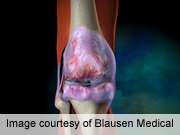
For patients with knee osteoarthritis, self-reported knee instability and fear of physical activity correlate with the likelihood of treatment response following a therapeutic exercise program, according to a study published in the November issue of Arthritis Care & Research.
(HealthDay)—For patients with knee osteoarthritis, self-reported knee instability and fear of physical activity correlate with the likelihood of treatment response following a therapeutic exercise program, according to a study published in the November issue of Arthritis Care & Research.
G. Kelley Fitzgerald, P.T., Ph.D., from the University of Pittsburg, and colleagues evaluated 152 patients with knee osteoarthritis to examine how therapeutic exercise-linked changes in physical and psychological factors correlate with changes in pain and function. Participants completed an exercise program incorporating lower extremity strengthening, stretching, range of motion, balance and agility, and aerobic exercises. The association between change from baseline to two-month follow-up in various factors and treatment response (defined as a minimum of 20 percent improvement from baseline) was assessed, after adjustment for potentially confounding variables.
The researchers found that, after adjustment, the only two factors that were significantly associated with treatment response were change in self-reported knee instability (odds ratio, 1.67) and fear of physical activity (odds ratio, 0.93).
"This finding may suggest that methods to improve self-reported knee instability and fear of physical activity might further enhance the effects of therapeutic exercise for patients with knee osteoarthritis who have these problems," the authors write. "Continued work is needed to confirm the associations between changes in physical and psychological factors and treatment response to therapeutic exercise for people with knee osteoarthritis."
More information: Abstract
Full Text (subscription or payment may be required)
Journal reference:
Arthritis Care & Research
Copyright © 2012 HealthDay. All rights reserved.
-
BMI, post-exercise knee laxity change tied to OA progression
Aug 21, 2012 |
not rated yet |
0
-
Video-based home exercise can minimize osteoarthritis pain, improve mobility
Feb 08, 2012 |
not rated yet |
0
-
New research shows physical therapy as effective as arthroscopic knee surgery
Sep 12, 2008 |
not rated yet |
0
-
Putting your foot in it: but shoes can make a difference
Oct 21, 2011 |
not rated yet |
0
-
Walking speed is a marker for knee osteoarthritis
Mar 20, 2012 |
not rated yet |
0
-
Motion perception revisited: High Phi effect challenges established motion perception assumptions
Apr 23, 2013 |
3 / 5 (2) |
2
-
Anything you can do I can do better: Neuromolecular foundations of the superiority illusion (Update)
Apr 02, 2013 |
4.5 / 5 (11) |
5
-
The visual system as economist: Neural resource allocation in visual adaptation
Mar 30, 2013 |
5 / 5 (2) |
9
-
Separate lives: Neuronal and organismal lifespans decoupled
Mar 27, 2013 |
4.9 / 5 (8) |
0
-
Sizing things up: The evolutionary neurobiology of scale invariance
Feb 28, 2013 |
4.8 / 5 (10) |
14
-
Image of a Convex Lens Cut in Half Horizontally
4 hours ago
-
Ray tracing throught optical system of thick lenses
4 hours ago
-
Faraday's law on circular wire
5 hours ago
-
Specific Exergy vs Specific Flow Exergy
6 hours ago
-
The Durability of Bone: Long Falls
14 hours ago
-
Is energy convertible to matter?
16 hours ago
- More from Physics Forums - Classical Physics
More news stories
Sugar injections for knee arthritis may ease pain
(HealthDay)—Injections of a sugar solution appear to help relieve knee pain and stiffness related to osteoarthritis, a new study suggests.
Arthritis & Rheumatism
May 21, 2013 |
4.5 / 5 (2) |
0
|
Blame your parents for bunion woes
A novel study reports that white men and women of European descent inherit common foot disorders, such as bunions (hallux valgus) and lesser toe deformities, including hammer or claw toe. Findings from the Framingham Foot ...
Arthritis & Rheumatism
May 20, 2013 |
not rated yet |
0
|
New theory on genesis of osteoarthritis comes with successful therapy in mice
Scientists at Johns Hopkins have turned their view of osteoarthritis (OA) inside out. Literally. Instead of seeing the painful degenerative disease as a problem primarily of the cartilage that cushions joints, ...
Arthritis & Rheumatism
May 19, 2013 |
4.9 / 5 (7) |
0
|
Ultrasound findings can improve classification of RA
(HealthDay)—Compared to clinical diagnosis of synovitis, ultrasound-detected synovitis provides either improved sensitivity or specificity when used with the American College of Rheumatology/European League ...
Arthritis & Rheumatism
May 15, 2013 |
not rated yet |
0
Strong genetic component of fibromyalgia suggested
(HealthDay)—A genome-wide linkage scan has identified the chromosome 17p11.2-q11.2 region as the susceptibility locus for fibromyalgia, according to research published in the April issue of Arthritis & ...
Arthritis & Rheumatism
May 11, 2013 |
not rated yet |
0
Researchers complete largest genetic sequencing study of human disease
Researchers from Queen Mary, University of London have led the largest sequencing study of human disease to date, investigating the genetic basis of six autoimmune diseases.
Slowing the aging process—only with antibiotics
Swiss scientists reveal the mechanism responsible for aging hidden deep within mitochondria—and dramatically slow it down in worms by administering antibiotics to the young.
Research shows how immune system peacefully co-exists with 'good' bacteria
The human gut is loaded with commensal bacteria – "good" microbes that, among other functions, help the body digest food. The gastrointestinal tract contains literally trillions of such cells, and yet the ...
Taming suspect gene reverses schizophrenia-like abnormalities in mice
Scientists have reversed behavioral and brain abnormalities in adult mice that resemble some features of schizophrenia by restoring normal expression to a suspect gene that is over-expressed in humans with ...
Scientists uncover molecular roots of cocaine addiction in the brain
Researchers at Johns Hopkins have unraveled the molecular foundations of cocaine's effects on the brain, and identified a compound that blocks cravings for the drug in cocaine-addicted mice. The compound, already proven safe ...
Acne treatment: Natural substance-based formula is more effective than artificial compounds
University of Granada scientists have patented a new treatment for acne that is based on completely natural substances and is much more effective than artificial formulas because it does not create resistance ...