A comparative medicine study identifies new approach to combat viral infections
When a virus such as influenza invades our bodies, interferon proteins are among the first immune molecules produced to fight off the attack. Interferon can also play a role in suppressing tumor growth and the effects of autoimmune diseases, and doctors may use an artificial form of interferon to treat patients with certain cancers or multiple sclerosis. But even this approach sometimes fails when patients' bodies reject the foreign interferon or growing resistant to its effects.
A study by scientists from the University of Pennsylvania School of Veterinary Medicine offers a new strategy for enhancing the effects of interferon in fighting off infection. The research suggests that, by targeting a particular molecule in the interferon signaling pathway, specially designed drugs may be able to boost the activity of a person's own interferon, augmenting the immune system's fight against viruses. It's possible that the same drugs might also be effective against some types of cancer and certain autoimmune conditions.
Serge Fuchs, a professor of cell biology in Penn Vet's Department of Animal Biology and director of the School's Mari Lowe Comparative Oncology Center, was the senior author on the paper published in the Proceedings of the National Academy of Sciences.
"The practical significance of our study is a demonstration of the ability to use emerging pharmaceuticals to reactivate an individual's own interferon or to use a reduced dose to get the same effect," Fuchs said.
Christopher Carbone and Hui Zheng of the Department of Animal Biology and John Lewis and Alexander Reiter of the Department of Clinical Studies played leading roles in the study. Additional Penn Vet collaborators were Sabyasachi Bhattacharya, Paula Henthorn and Kendra Bence. Zhong-Yin Zhang of Indiana University School of Medicine and Darren Baker of Biogen Idec also contributed.
The research would have been impossible without the team's comparative-medicine approach, in which they examined the effects of activating the interferon pathway in both human cells and in cats affected by a naturally occurring disease. Mice would normally be the model organism of choice for such a study, but they lack a molecular element of the interferon pathway that humans and cats share.
"Mice are very convenient, but they may not always recapitulate human diseases that well," Fuchs said. "Veterinary diseases happen naturally, and they provide a less convenient but a more truthful recapitulation of the human situation."
Interferon fights viruses by binding to an interferon receptor on cells, triggering a cascade of other molecular events and leading to the production of proteins that prevent viruses from reproducing or that stimulate other immune responses. But because too much interferon can harm the host's body, this signaling cascade has a built-in brake: Using a separate molecular pathway, interferon triggers the body's cells to remove its own receptor, so the immune system attack doesn't go on indefinitely.
"It's very important to understand what regulates the responsiveness of cells to interferon, and a major factor is the levels of cell-surface receptors," Fuchs said.
Although the researchers' investigations of these pathways led them to identify a target for improving the body's virus-fighting ability, they didn't set out to discover a drug. Rather, they were attempting to solve a paradox of cell biology.
The paradox rests on the fact that many steps in the interferon-signaling pathway involve adding a molecule of phosphate to proteins in the cascade. Interferon itself promotes the addition of phosphate onto the interferon receptor, yet previous evidence suggested that the receptor resisted being removed by the cell if it had phosphate added. Given that interferon does in fact trigger the removal of its own receptor, the research team hypothesized that another enzyme must be at work in the pathway to remove the phosphate molecule from the receptor so it could be consumed by the body's cells to ramp down the immune-system response to viruses.
Performing a screening for this putative enzyme, they identified protein tyrosine phosphatase 1 B (PTP1B) as a likely candidate. In a series of experiments, the researchers confirmed that blocking PTP1B decreased the removal of the interferon receptor. As a result, interferon signaling became enhanced. Using human cells infected with hepatitis C, the researchers found that adding a PTP1B inhibitor allowed smaller doses of interferon to be effective in keeping the virus from reproducing. They demonstrated a similar effect in human cells infected with vesicular stomatitis virus.
Aiding in their work was the fact that pharmaceutical companies have already designed multiple drugs that inhibit the activity of PTP1B but for a completely separate reason than the enzyme's involvement in interferon signaling.
"PTP1B also works on the leptin receptor," Fuchs said. "This is the pathway that regulates satiety, appetite and weight gain. So in the past 10 years there have been massive industrial and academic undertaking to develop PTP1B inhibitors to treat obesity and diabetes."
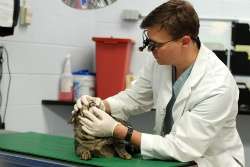
To see how these PTP1B inhibitors would impact viral infections in a living organism, the researchers could not use mice because mice lack a portion of the receptor that PTP1B acts upon, and so blocking PTP1B does not impact interferon signaling in the same way as it does in humans and other mammals. Instead, they examined five cats that had been enrolled by their owners in the study. Each was suffering from chronic stomatitis, a condition that involves substantial inflammation in the mouth and makes it painful for the cats to eat and groom. The cats received a single injection of a PTP1B inhibitor. Two weeks later, all five showed noticeable reductions in redness and inflammation, providing clinical evidence that these drugs could be used to treat infection.
Fuchs said that what seemed like a drawback in the study—that it couldn't be effectively modeled in mice—ended up being a benefit, as naturally occurring diseases in animals such as cat and dogs more closely mimic many human diseases.
Because interferon is known to suppress tumors and help multiple sclerosis patients, the results of this study give the researchers optimism that PTP1B could be a target for anti-cancer and anti-autoimmune disease therapies.
As a next step, they plan to test the PTP1B inhibitors in a model of feline immunodeficiency virus, or the cat version of AIDS, to see if its virus-fighting capabilities can have an effect against that infection.
More information: dx.doi.org/10.1073/pnas.1211491109


