Blind patient reads words stimulated directly onto the retina
November 22, 2012 in Neuroscience
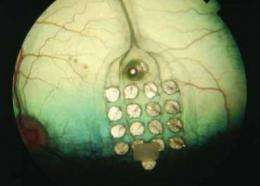
This shows the grid of electrons directly implanted on the retina. Credit: Second Sight
For the very first time researchers have streamed braille patterns directly into a blind patient's retina, allowing him to read four-letter words accurately and quickly with an ocular neuroprosthetic device. The device, the Argus II, has been implanted in over 50 patients, many of who can now see color, movement and objects. It uses a small camera mounted on a pair of glasses, a portable processor to translate the signal from the camera into electrical stimulation, and a microchip with electrodes implanted directly on the retina. The study was authored by researchers at Second Sight, the company who developed the device, and has been published in Frontiers in Neuroprosthetics on November 22.
"In this clinical test with a single blind patient, we bypassed the camera that is the usual input for the implant and directly stimulated the retina. Instead of feeling the braille on the tips of his fingers, the patient could see the patterns we projected and then read individual letters in less than a second with up to 89% accuracy," explains researcher Thomas Lauritzen, lead author of the paper.
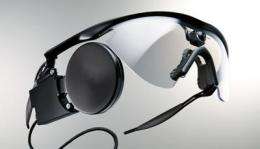
This is the headset for the Argus II retinal implant device from Second Sight. Credit: Second Sight
Similar in concept to successful cochlear implants, the visual implant uses a grid of 60 electrodes—attached to the retina—to stimulate patterns directly onto the nerve cells. For this study, the researchers at Second Sight used a computer to stimulate six of these points on the grid to project the braille letters. A series of tests were conducted with single letters as well as words ranging in length from two letters up to four. The patient was shown each letter for half a second and had up to 80% accuracy for short words."There was no input except the electrode stimulation and the patient recognized the braille letters easily. This proves that the patient has good spatial resolution because he could easily distinguish between signals on different, individual electrodes." says Lauritzen.
This video is not supported by your browser at this time.
In this video, a patient reads words with the Argus II setup using the camera and not the direct braille stimulation. Credit: Second Sight
According to Silvestro Micera at EPFL's Center for Neuroprosthetics and scientific reviewer for the article, "this study is a proof of concept that points to the importance of clinical experiments involving new neuroprosthetic devices to improve the technology and innovate adaptable solutions."Primarily for sufferers of the genetic disease Retinitis Pigmentosa (RP), the implant Argus II has been shown to restore limited reading capability of large conventional letters and short words when used with the camera. While reading should improve with future iterations of the Argus II, the current study shows how the Argus II could be adapted to provide an alternative and potentially faster method of text reading with the addition of letter recognition software. This ability to perform image processing in software prior to sending the signal to the implant is a unique advantage of Argus II.
More information: Reading visual Braille with a retinal prosthesis, DOI: 10.3389/fnins.2012.00168
Provided by Frontiers
-
Eye implants make vision-restoring progress
Jul 18, 2012 |
not rated yet |
0
-
USC researchers begin tests on next generation of retinal implant
Feb 16, 2007 |
not rated yet |
0
-
First in New York: Bionic technology aims to give sight to woman blinded beginning at age 13
Oct 21, 2009 |
not rated yet |
0
-
Researchers' vision: restoring sight through artificial retinas
Dec 30, 2008 |
not rated yet |
0
-
Light fantastic: Retinal implant brightens future for blind
Nov 03, 2010 |
not rated yet |
0
-
Motion perception revisited: High Phi effect challenges established motion perception assumptions
Apr 23, 2013 |
3 / 5 (2) |
2
-
Anything you can do I can do better: Neuromolecular foundations of the superiority illusion (Update)
Apr 02, 2013 |
4.5 / 5 (11) |
5
-
The visual system as economist: Neural resource allocation in visual adaptation
Mar 30, 2013 |
5 / 5 (2) |
9
-
Separate lives: Neuronal and organismal lifespans decoupled
Mar 27, 2013 |
4.9 / 5 (8) |
0
-
Sizing things up: The evolutionary neurobiology of scale invariance
Feb 28, 2013 |
4.8 / 5 (10) |
14
-
How can there be villous adenoma in colon, if there are no villi there
8 hours ago
-
How can there be a term called "intestinal metaplasia" of stomach
May 21, 2013
-
Pressure-volume curve: Elastic Recoil Pressure don't make sense
May 18, 2013
-
If you became brain-dead, would you want them to pull the plug?
May 17, 2013
-
MRI bill question
May 15, 2013
-
Ratio of Hydrogen of Oxygen in Dessicated Animal Protein
May 13, 2013
- More from Physics Forums - Medical Sciences
More news stories
Researchers analyse hunting behaviour of fish larvae in virtual reality
Moving objects attract greater attention – a fact exploited by video screens in public spaces and animated advertising banners on the Internet. For most animal species, moving objects also play a major ...
Neuroscience
2 hours ago |
not rated yet |
0
|
Signs of motor disorders can appear years before disease manifestation
It is known that signs of neurological disorders such as Alzheimer's and Huntington's disease can appear years before the disease becomes manifest; these signs take the form of subtle changes in the brain and behavior of ...
Neuroscience
2 hours ago |
not rated yet |
0
Taming suspect gene reverses schizophrenia-like abnormalities in mice
Scientists have reversed behavioral and brain abnormalities in adult mice that resemble some features of schizophrenia by restoring normal expression to a suspect gene that is over-expressed in humans with ...
Neuroscience
3 hours ago |
5 / 5 (1) |
0
|
Scientists uncover molecular roots of cocaine addiction in the brain
Researchers at Johns Hopkins have unraveled the molecular foundations of cocaine's effects on the brain, and identified a compound that blocks cravings for the drug in cocaine-addicted mice. The compound, already proven safe ...
Neuroscience
3 hours ago |
not rated yet |
0
|
Addiction as a disorder of decision-making
New research shows that craving drugs such as nicotine can be visualized in specific regions of the brain that are implicated in determining the value of actions, in planning actions and in motivation. Dr. Alain Dagher, from ...
Neuroscience
5 hours ago |
not rated yet |
0
Novel approach for influenza vaccination shows promise in early animal testing
A new approach for immunizing against influenza elicited a more potent immune response and broader protection than the currently licensed seasonal influenza vaccines when tested in mice and ferrets. The vaccine ...
Good marriage can buffer effects of dad's depression on young children
What effect does a father's depression have on his young son or daughter? When fathers report a high level of emotional intimacy in their marriage, their children benefit, said a University of Illinois study.
Hospitals profit when patients develop bloodstream infections
Johns Hopkins researchers report that hospitals may be reaping enormous income for patients whose hospital stays are complicated by preventable bloodstream infections contracted in their intensive care units.
Alleviating hunger in the US, it's a SNAP, researcher says
A University of Illinois researcher says that the cornerstone of our efforts to alleviate food insecurity should be to encourage more people to participate in the Supplemental Nutrition Assistance Program (SNAP) "because ...
Survey points out deficiencies in addictions training for medical residents
A 2012 survey of internal medicine residents at Massachusetts General Hospital (MGH) – one of the nation's leading teaching hospitals – found that more than half rated the training they had received in addiction and other ...
Obstructive sleep apnea associated with less visceral fat accumulation in women than men
A new study from researchers in Japan indicates that obstructive sleep apnea (OSA) is independently associated with visceral (abdominal) fat accumulation only in men, perhaps explaining gender differences in the impact of ...

Nov 22, 2012
Rank: 5 / 5 (1)
Nov 22, 2012
Rank: 5 / 5 (2)