Study: To get the best look at a person's face, look just below the eyes
November 26, 2012 in Psychology & Psychiatry
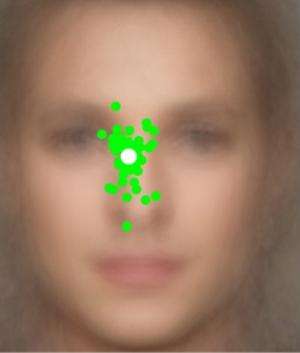
These are places within a face (green circles) where, on average, each of 50 participants first looked at when trying to identify faces of famous people. A white circle corresponds to the average across all participants. The background is an averaged face across 120 celebrity faces. Credit: UCSB
They say that the eyes are the windows to the soul. However, to get a real idea of what a person is up to, according to UC Santa Barbara researchers Miguel Eckstein and Matt Peterson, the best place to check is right below the eyes. Their findings are published in the Proceedings of the National Academy of Sciences.
"It's pretty fast, it's effortless –– we're not really aware of what we're doing," said Miguel Eckstein, professor of psychology in the Department of Psychological & Brain Sciences. Using an eye tracker and more than 100 photos of faces and participants, Eckstein and graduate research assistant Peterson followed the gaze of the experiment's participants to determine where they look in the first crucial moment of identifying a person's identity, gender, and emotional state.
"For the majority of people, the first place we look at is somewhere in the middle, just below the eyes," Eckstein said. One possible reason could be that we are trained from youth to look there, because it's polite in some cultures. Or, because it allows us to figure out where the person's attention is focused.
However, Peterson and Eckstein hypothesize that, despite the ever-so-brief –– 250 millisecond –– glance, the relatively featureless point of focus, and the fact that we're usually unaware that we're doing it, the brain is actually using sophisticated computations to plan an eye movement that ensures the highest accuracy in tasks that are evolutionarily important in determining flight, fight, or love at first sight.
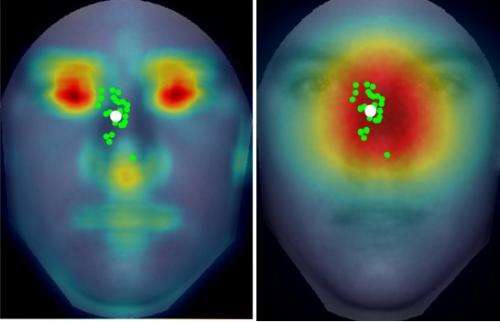
Left: This side shows predictions of a model which looks at the most informative features in the display for a person identification task (darker red areas at the center of the eyes are the predicted looking location); Right: This side shows predictions of an optimal gaze model that takes into account the varying spatial detail of human visual processing across the visual field (darker red areas are the predicted looking location). Green circles are where, on average, each of the participants first looked at when identifying the face. White circle corresponds to the average across all participants. Credit: UCSB
"When you look at a scene, or at a person's face, you're not just using information right in front of you," said Peterson. The place where one's glance is aimed is the place that corresponds to the highest resolution in the eye –– the fovea, a slight depression in the retina at the back of the eye –– while regions surrounding the foveal area –– the periphery –– allow access to less spatial detail.However, according to Peterson, at a conversational distance, faces tend to span a larger area of the visual field. There is information to be gleaned, not just from the face's eyes, but also from features like the nose or the mouth. But when participants were directed to try to determine the identity, gender, and emotion of people in the photos by looking elsewhere –– the forehead, the mouth, for instance –– they did not perform as well as they would have by looking close to the eyes.
Using a sophisticated algorithm, which mimics the varying spatial detail of human processing across the visual field and integrates all information to make decisions, allowed Peterson and Eckstein to predict what would be the best place within the faces to look for each of these perceptual tasks. They found that these predicted places varied moderately across tasks, and closely corresponded to where humans actually do look.
At least for the three important tasks investigated –– identity, emotion, and gender –– below the eyes is the optimal place to look, say the scientists, because it allows one to read information from as many features of the face as possible.
"What the visual system is adept at doing is taking all those pieces of information from your face and combining them in a statistical manner to make a judgment about whatever task you're doing," said Eckstein. The area around the eyes contains minute bits of important information, which require the high resolution processing close to the fovea, whereas features like the mouth are larger and can be read without a direct gaze.
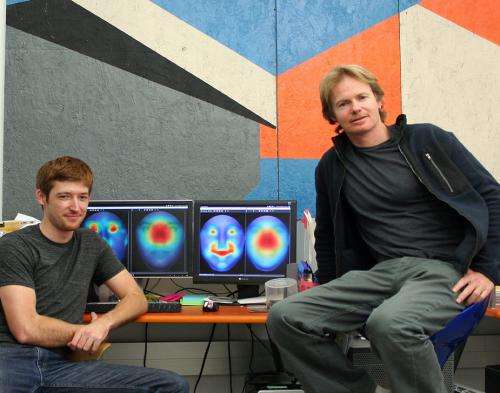
Pictured are graduate student Matt Peterson (left) and professor Eckstein (right) at the Vision & Image Understanding Laboratory. Images displayed on computer displays are predictions of computational models tested in the PNAS paper: 2nd and 4th images from the left correspond to the optimal gaze model that best predicts (darker red areas) where a majority of humans look at. In the background: Art by Santa Barbara artist Zack Paul in display at VIU lab. Credit: UCSB
The study shows that the ability to learn optimal rapid eye movement for evolutionarily important perceptual tasks is inherent in humans; however, say the scientists, it is not necessarily consistent behavior for everybody. Eckstein's lab is currently involved in studying a small subset of people who do not look just below the eyes to identify a person. Other researchers have shown that East Asians, for instance, tend look lower on the face when identifying a person's face.The research by Peterson and Eckstein has resulted in sophisticated new algorithms to model optimal gaze patterns when looking at faces. The algorithms could potentially be used to provide insight into conditions like schizophrenia and autism, which are associated with uncommon gaze patterns, or prosopagnosia –– an inability to recognize someone by his or her face.
Journal reference:
Proceedings of the National Academy of Sciences
Provided by
University of California - Santa Barbara
-
Here's looking at you, fellow!
Mar 02, 2009 |
not rated yet |
0
-
Study reveals brain functions during visual searches
Jul 17, 2012 |
not rated yet |
0
-
The nose knows: 2 fixation points needed for face recognition
Oct 20, 2008 |
not rated yet |
0
-
How Do We Recognize Faces?
Jun 21, 2011 |
not rated yet |
0
-
I recognize you! But how did I do it?
Jan 13, 2012 |
not rated yet |
0
-
Motion perception revisited: High Phi effect challenges established motion perception assumptions
Apr 23, 2013 |
3 / 5 (2) |
2
-
Anything you can do I can do better: Neuromolecular foundations of the superiority illusion (Update)
Apr 02, 2013 |
4.5 / 5 (11) |
5
-
The visual system as economist: Neural resource allocation in visual adaptation
Mar 30, 2013 |
5 / 5 (2) |
9
-
Separate lives: Neuronal and organismal lifespans decoupled
Mar 27, 2013 |
4.9 / 5 (8) |
0
-
Sizing things up: The evolutionary neurobiology of scale invariance
Feb 28, 2013 |
4.8 / 5 (10) |
14
-
Why is zone 1 in liver more prone to ischemic injury?
May 23, 2013
-
How can there be villous adenoma in colon, if there are no villi there
May 22, 2013
-
How can there be a term called "intestinal metaplasia" of stomach
May 21, 2013
-
Pressure-volume curve: Elastic Recoil Pressure don't make sense
May 18, 2013
-
If you became brain-dead, would you want them to pull the plug?
May 17, 2013
-
MRI bill question
May 15, 2013
- More from Physics Forums - Medical Sciences
More news stories
Storm chasers: born to be wild?
(HealthDay)—We've all seen them: the surfers who race to the beach when a hurricane hits, the guy who decides to ride out the storm in his overmatched boat, the tornado chasers who fearlessly steer their ...
Psychology & Psychiatry
1 hour ago |
not rated yet |
0
Hormone levels may provide key to understanding psychological disorders in women
Women at a particular stage in their monthly menstrual cycle may be more vulnerable to some of the psychological side-effects associated with stressful experiences, according to a study from UCL.
Psychology & Psychiatry
2 hours ago |
not rated yet |
0
|
Are there atheists in foxholes? Study says they're the minority
Ernie Pyle – an iconic war correspondent in World War II – reportedly said "There are no atheists in foxholes." A new joint study between two brothers at Cornell and Virginia Wesleyan found that only ...
Psychology & Psychiatry
5 hours ago |
2.5 / 5 (4) |
1
Breathing exercises help veterans find peace after war, scholar says
(Medical Xpress)—Research by Stanford scholar Emma Seppala at the Center for Compassion and Altruism Research and Education found that post-traumatic stress disorder decreased in veterans who participated ...
Psychology & Psychiatry
5 hours ago |
not rated yet |
0
Depression raises diabetics' risk of severe low blood sugar episodes
(Medical Xpress)—Patients with diabetes who are depressed are much more likely to develop episodes of dangerously low blood sugars, or hypoglycemia, than are those who are not depressed, a new study has ...
Psychology & Psychiatry
6 hours ago |
not rated yet |
0
|
Comorbidities common with alopecia areata
(HealthDay)—Comorbid conditions often accompany alopecia areata, according to a study published online May 22 in JAMA Dermatology.
Pollen count apps for smartphones are nothing to sneeze at
Kate O'Reilly's spring allergy survival kit includes the usual stuff - nasal sprays, allergy pills and a box of tissues. This season, she's added a new weapon to her line of defense: an app on her smartphone.
Engineered cytomegalovirus protects monkeys from HIV equivalent
(Medical Xpress)—A new study by researchers in the US has shown that an ancient virus can be modified to help in the fight against the simian immunodeficiency virus SIV, which is the equivalent in monkeys ...
Going live: Immune cell activation in multiple sclerosis
Biological processes are generally based on events at the molecular and cellular level. To understand what happens in the course of infections, diseases or normal bodily functions, scientists would need to ...
About one in four uninsured could be excluded from ACA
(HealthDay)—More than one in four of those eligible for new premium assistance tax credits under the Affordable Care Act (ACA) do not have a checking account and will not be able to receive premiums from ...
ACOG: Hormone therapy not recommended to prevent CHD
(HealthDay)—Menopausal hormone therapy should not be used for prevention of coronary heart disease, according to a Committee Opinion from the American College of Obstetricians and Gynecologists (ACOG) published ...

