Scientists testing improved early warning system for West Nile virus
(Medical Xpress)—When weather radar shows a funnel cloud, the tornado sirens howl, and folks run for cover. With outbreaks of West Nile virus, it's not that simple.
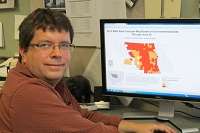
Michael Wimberly, senior scientist at the Geographic Information Science Center of Excellence at South Dakota State University, has begun testing an early warning system for West Nile virus. Through a grant from the National Institute of Allergy and Infectious Diseases, Wimberly has analyzed satellite imaging data from 2000 to the present day to build a store of information to predict the future.
Key collaborators in this interdisciplinary effort include professor Mike Hildreth in biology and microbiology, associate professor Yi Liu in electrical engineering and computer science, and Ting-Wu Chuang, a former postdoctoral researcher now at Taiwan Medical University. Wimberly and Chuang recently published their findings on climatic variability and West Nile virus outbreaks in the northern Great Plains in the journal PLOS ONE.
"My first forecast in 2010 was completely wrong," he said. An early spring led to a prediction of an active year for West Nile virus, but the opposite was true.
"What we're doing is unique," Wimberly said. "We are trying to make a much tighter link from research to application." To do this, he has been working closely with the S.D. Department of Health and the state epidemiologist.
After his first attempt, Wimberly developed more sophisticated models and predicted a low risk of West Nile infections for 2011. This time he was right.
"Our research has shown if we look broadly at a regional level, temperature is an extremely strong driver," he said.
Wimberly found associations between West Nile virus and temperature at two different times of the year. First, an earlier spring green up, like this past year with the warm April, gives the virus a longer amplification period, he said. "In general, mosquitos develop more rapidly, are more active and tend to bite more when it's hotter."
Since the virus originates in the bird population but is transmitted to humans through a mosquito, an early spring alone is not a sufficient predictor. Wimberly explained that the Culex tarsalis mosquito must first bite an infected bird to acquire West Nile, and then the virus must incubate in the mosquito.
"The blood goes into the stomach," he said, but in order for the mosquito to transmit the disease, the virus must reach its salivary glands. This process is also temperature dependent.
"The warmer it gets, the shorter the amount of time it takes for the mosquitos to become infectious," Wimberly said. Consequently, a warmer than normal summer will accelerate the transmission from mosquitoes to humans.
In 2010, the population of the West Nile-carrying mosquitos was high, Wimberly explained. Yet the expected outbreak never occurred because of the cooler temperatures that summer. Despite the high mosquito numbers, very few were infected with the West Nile virus.
Determining the virus' relationship with moisture and rainfall is more complicated, Wimberly said. Mosquitoes need water to breed; therefore, people assume that areas experiencing a drought will have a reduced risk of West Nile virus.
"There is a tendency to assume a linear relationship with rainfall and mosquitos," Wimberly said, but it's more complex than that.
"Culex tarsalis are not flood water mosquitoes, so they don't respond to rainfall with a huge breeding generation," he said. The West Nile carriers are selective, preferring grass in roadside ditches, wheel ruts in a pasture, and irrigated alfalfa as a breeding ground. Wimberly called it the "Goldilocks effect—the water needs to be just right."
After dramatic declines in the incidence of West Nile in 2010 and 2011, some researchers thought the virus had become less virulent and was fading away, Wimberly explained. Others believed that the bulk of the population had already been infected without having major symptoms and were already immune.
Enter 2012, the deadliest West Nile season ever.
Wimberly submitted his forecast for 2012 before the season began, and using a temperature-driven model, he predicted a high risk for West Nile outbreaks in South Dakota.
"You don't hope you're right; you don't want a disease outbreak," Wimberly said.
But he was right.
Wimberly explained, "You fit a model, use it to make a forecast and put it out there and then evaluate the forecast and see where it's right and wrong." But to perfect the model, he said, "you have to be in the game for the long term."
To do this, Wimberly has applied to the National Institutes of Health for an extension of the four-year grant which began in 2008. His next step will be to incorporate more information to do risk mapping, identifying places where transmission risk is highest.
"Over time, we get better," Wimberly said, and as a result, the public health community will begin to trust the forecasts.
Though sirens might not sound to warn about West Nile virus, Wimberly's forecasts may one day offer a warning to take precautions to avoid contracting the disease.


