For many, 'Superstorm' sandy could take toll on mental health
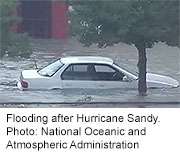
November 1, 2012 by Steven Reinberg, Healthday Reporter in Psychology & Psychiatry
People who were impacted by the event will have symptoms, but they should fade, experts say.
(HealthDay)—Some of the numbers are staggering: more than 75 Americans dead, thousands evacuated from their homes, millions left without power for days and billions of dollars in damage from "superstorm" Sandy.
Psychologists say the effect of all this sudden, violent loss on people's psyches will be powerful.
Not only those who suffered the loss of a loved one or a beloved home, but also people who just watched the constant storm coverage may be scared and unsettled, experts say.
"Sandy, like all natural disasters, is considered a criterion 'A1' stressor in the diagnoses of Acute Stress Disorder in the first month after the event and Post-Traumatic Stress Disorder (PTSD), at least a month after the event," said Simon Rego, director, of psychology training at Montefiore Medical Center/Albert Einstein College of Medicine in New York City.
"I'd expect many people to display symptoms of Acute Stress Disorder even if they did not directly experience effects of Sandy," he added. That's particularly true for people who had a loved one in danger or even just watched it on television, he said.
"This includes symptoms of anxiety, such as irritability, insomnia, restlessness, and dissociation such as feeling numb or detached from others, or feeling as if in a daze," Rego said.
In addition, "re-experiencing" symptoms, such as flashbacks and intrusive images, might occur for some who were closest to the destruction. Others may display symptoms of avoidance—trying to avoid thinking or talking about the hurricane and avoiding certain people or places that remind them of the events.
Still, many of these effects are transient. "Fortunately, people are quite resilient and for many of these people, the symptoms will begin to abate on their own over time, as long as they have a healthy support system that enables them to talk about what happened and how they feel about it and do their best to return to as close to as normal routine as they can manage, under the circumstances," Rego said.
Sara Rivero-Conil, a child psychologist at Children's Hospital of Miami, also stressed that "events such as Sandy can be traumatic for children."
For youngsters directly affected by the storm, reassurance from parents is crucial, she said. "Tell them they needn't worry, there is a plan in place and these events don't happen every day," Rivero-Conil said.
Children are also very sensitive to their parents' behavior, she added, and if parent is anxious or depressed kids will feel that tension and become anxious, too, she said.
"Parents are their children's heroes," she said, so it is important that parents try to keep a positive attitude and reassure their children.
Even for children who didn't experience the storm directly, seeing images on the TV can be disturbing. "Parents shouldn't let their children watch TV coverage of the storm," she said. Moms and dads should also stress that events such as Sandy are rare, and not every storm should be a source of fear.
More information: For more information on stress reactions, visit the U.S. Department of Health and Human Services.
Copyright © 2012 HealthDay. All rights reserved.
-
Storm-related stress? Five self-help tips
Aug 30, 2012 |
not rated yet |
0
-
Evaluate children's stress after natural disasters
Aug 28, 2012 |
not rated yet |
0
-
How children cope with the aftermath of a hurricane
Jan 12, 2011 |
not rated yet |
0
-
Don't be afraid to talk to your kids about Colorado killings
Jul 20, 2012 |
not rated yet |
0
-
Stressed parents may affect preemie behavior later
Mar 16, 2012 |
not rated yet |
0
-
Motion perception revisited: High Phi effect challenges established motion perception assumptions
Apr 23, 2013 |
3 / 5 (2) |
2
-
Anything you can do I can do better: Neuromolecular foundations of the superiority illusion (Update)
Apr 02, 2013 |
4.5 / 5 (11) |
5
-
The visual system as economist: Neural resource allocation in visual adaptation
Mar 30, 2013 |
5 / 5 (2) |
9
-
Separate lives: Neuronal and organismal lifespans decoupled
Mar 27, 2013 |
4.9 / 5 (8) |
0
-
Sizing things up: The evolutionary neurobiology of scale invariance
Feb 28, 2013 |
4.8 / 5 (10) |
14
-
Why is zone 1 in liver more prone to ischemic injury?
May 23, 2013
-
How can there be villous adenoma in colon, if there are no villi there
May 22, 2013
-
How can there be a term called "intestinal metaplasia" of stomach
May 21, 2013
-
Pressure-volume curve: Elastic Recoil Pressure don't make sense
May 18, 2013
-
If you became brain-dead, would you want them to pull the plug?
May 17, 2013
-
MRI bill question
May 15, 2013
- More from Physics Forums - Medical Sciences
More news stories
Storm chasers: born to be wild?
(HealthDay)—We've all seen them: the surfers who race to the beach when a hurricane hits, the guy who decides to ride out the storm in his overmatched boat, the tornado chasers who fearlessly steer their ...
Psychology & Psychiatry
23 hours ago |
not rated yet |
0
Hormone levels may provide key to understanding psychological disorders in women
Women at a particular stage in their monthly menstrual cycle may be more vulnerable to some of the psychological side-effects associated with stressful experiences, according to a study from UCL.
Psychology & Psychiatry
23 hours ago |
3.7 / 5 (3) |
4
|
Are there atheists in foxholes? Study says they're the minority
Ernie Pyle – an iconic war correspondent in World War II – reportedly said "There are no atheists in foxholes." A new joint study between two brothers at Cornell and Virginia Wesleyan found that only ...
Psychology & Psychiatry
May 24, 2013 |
2.5 / 5 (4) |
2
Breathing exercises help veterans find peace after war, scholar says
(Medical Xpress)—Research by Stanford scholar Emma Seppala at the Center for Compassion and Altruism Research and Education found that post-traumatic stress disorder decreased in veterans who participated ...
Psychology & Psychiatry
May 24, 2013 |
5 / 5 (1) |
1
Depression raises diabetics' risk of severe low blood sugar episodes
(Medical Xpress)—Patients with diabetes who are depressed are much more likely to develop episodes of dangerously low blood sugars, or hypoglycemia, than are those who are not depressed, a new study has ...
Psychology & Psychiatry
May 24, 2013 |
not rated yet |
0
|
First drug to improve heart failure mortality in over a decade
Coenzyme Q10 decreases all cause mortality by half, according to the results of a multicentre randomised double blind trial presented today at Heart Failure 2013 congress. It is the first drug to improve heart failure mortality ...
Heart failure accelerates male 'menopause'
Heart failure accelerates the aging process and brings on early andropausal syndrome (AS), according to research presented today at the Heart Failure Congress 2013. AS, also referred to as male 'menopause', was four times ...
Researchers identify first drug targets in childhood genetic tumor disorder
Two mutations central to the development of infantile myofibromatosis (IM)—a disorder characterized by multiple tumors involving the skin, bone, and soft tissue—may provide new therapeutic targets, according to researchers ...
Feds fight morning-after pill age ruling in NY
(AP)—Department of Justice lawyers have again asked a federal appeals court in New York to delay lifting age restrictions and prescription requirements on an emergency contraceptive popularly known as the morning-after ...
Death highest in heart failure patients admitted in January, on Friday, and overnight
Mortality and length of stay are highest in heart failure patients admitted in January, on Friday, and overnight, according to research presented today at the Heart Failure Congress 2013. The analysis of nearly 1 million ...
Driving and hands-free talking lead to spike in errors, study shows
Talking on a hands-free device while behind the wheel can lead to a sharp increase in errors that could imperil other drivers on the road, according to new research from the University of Alberta.