Ukraine fights spreading HIV epidemic

(AP)—Andrei Mandrykin, an inmate at Prison No. 85 outside Kiev, has HIV. He looks ghostly and much older than his 35 years. But Mandrykin is better off than tens of thousands of his countrymen, because is he receiving treatment amid what the World Health Organization says is the worst AIDS epidemic in Europe.
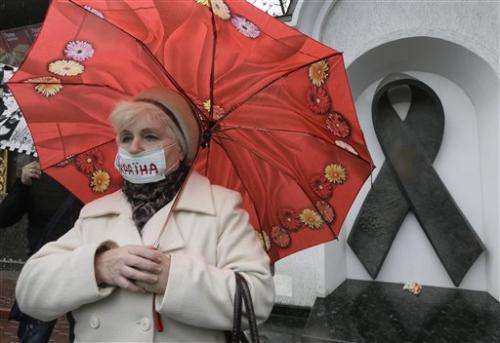
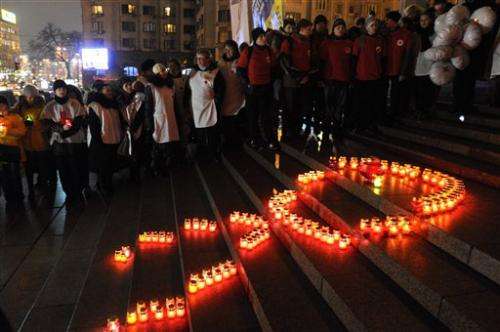
Ahead of World AIDS Day on Saturday, international organizations have urged the Ukrainian government to increase funding for treatment and do more to prevent HIV from spreading from high-risk groups into the mainstream population, where it is even harder to manage and control.
An estimated 230,000 Ukrainians, or about 0.8 percent of people aged 15 to 49, are living with HIV, the virus that causes AIDS. Some 120,000 are in urgent need of anti-retroviral therapy, which can greatly prolong and improve the quality of their lives. But due to a lack of funds, fewer than a quarter are receiving the drugs—one of the lowest levels in the world.
Ukraine's AIDS epidemic is still concentrated among high-risk groups such as intravenous drug users, sex workers, homosexuals and prisoners. But nearly half of new cases registered last year were traced to unprotected heterosexual contact.
"Slowly but surely the epidemic is moving from the most-at-risk, vulnerable population to the general population," said Nicolas Cantau of The Global Fund to Fight AIDS, Tuberculosis and Malaria, who manages work in Eastern Europe and Central Asia. "For the moment there is not enough treatment in Ukraine."
Stigma is also a big problem for those with HIV in Ukraine. Liliya, a 65-year-old woman who would give only her first name, recently attended a class on how to tell her 9-year-old great-granddaughter that she has HIV. The girl, who contacted HIV at birth from her drug-abusing mother, has been denied a place in preschool because of her diagnosis.
"People are like wolves, they don't understand," said Liliya. "If any of the parents found out, they would eat the child alive."
While the AIDS epidemic has plateaued elsewhere in the world, it is still progressing in Eastern Europe and Central Asia, according to Cantau. Nearly 21,200 new cases were reported in Ukraine in 2011, the highest number since the former Soviet republic registered its first case in 1987, and a 3 percent increase over 2010. As a result of limited and often delayed treatment, the number of AIDS-related deaths grew 17 percent last year to about 3,800.
Two years ago, Mandrykin, the prisoner, was on the verge of becoming part of that statistic, with his level of crucial CD4 immune cells—a way to measure the strength of the immune system—dropping to 11. In a healthy person, the CD4 count is usually over 600.
"I was lying in the hospital, I was dying," said Mandrykin, who is serving seven years for robbery, his fourth stint in jail. "It's a scary disease."
After two years of treatment in a small prison clinic, his CD4 count has risen to 159 and he feels much better, although he looks exhausted and is still too weak to work in the workshop of the medium-security prison.
The Ukrainian government currently focuses on testing and treating standard cases among the general population. The anti-retroviral treatment of more than 1,000 inmates, as well as some 10,000 HIV patients across Ukraine who also require treatment for tuberculosis and other complications and all prevention and support activities, are paid for by foreign donors, mainly the Global Fund.
The Global Fund is committed to spending $640 million through 2016 to fight AIDS and tuberculosis in Ukraine and then hopes to hand over most of its programs to the Ukrainian government.
Advocacy groups charge that corruption and indifference by government officials help fuel the epidemic.
During the past two years, Ukrainian authorities have seized vital AIDS drugs at the border due to technicalities, sent prosecutors to investigate AIDS support groups sponsored by the Global Fund and harassed patients on methadone substitution therapy, prompting the Global Fund to threaten to freeze its prevention grant.
Most recently, Ukraine's parliament gave initial approval to a bill that would impose jail terms of up to five years for any positive public depiction of homosexuality. Western organizations say it would make the work of AIDS prevention organizations that distribute condoms and teach safe homosexual sex illegal and further fuel the epidemic. It is unclear when the bill will come up for a final vote.
AIDS drug procurement is another headache, with Ukrainian health authorities greatly overpaying for AIDS drugs. Advocacy groups accuse health officials of embezzling funds by purchasing drugs at inflated prices and then pocketing kickbacks.
Officials deny those allegations, saying their tender procedures are transparent.
Much also remains to be done in Ukraine to educate people about AIDS.
Oksana Golubova, a 40-year-old former drug user, infected her daughter, now 8, with HIV and lost her first husband to AIDS. But she still has unprotected sex with her new husband, saying his health is in God's hands.
"Those who are afraid get infected," Golubova said.
Copyright 2012 The Associated Press. All rights reserved. This material may not be published, broadcast, rewritten or redistributed.


