DARPA foam could increase survival rate for victims of internal hemorrhaging
December 11, 2012 in Medical research
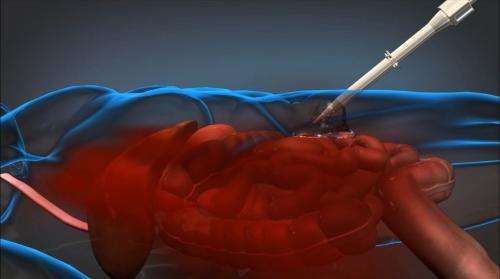
The foam-based product developed by Arsenal Medical for DARPA can be injected into a wounded servicemember on the battlefield to slow blood loss until the patient can be transported to an appropriate medical facility.
The Department of Defense's medical system aspires to a standard known as the "Golden Hour" that dictates that troops wounded on the battlefield are moved to advanced-level treatment facilities within the first 60 minutes of being wounded. In advance of transport, initial battlefield medical care administered by first responders is often critical to injured servicemembers' survival. In the case of internal abdominal injuries and resulting internal hemorrhaging, however, there is currently little that can be done to stanch bleeding before the patients reach necessary treatment facilities; internal wounds cannot be compressed the same way external wounds can, and tourniquets or hemostatic dressings are unsuitable because of the need to visualize the injury. The resulting blood loss often leads to death from what would otherwise be potentially survivable wounds.
DARPA launched its Wound Stasis System program in 2010 in the hopes of finding a technological solution that could mitigate damage from internal hemorrhaging. The program sought to identify a biological mechanism that could discriminate between wounded and healthy tissue, and bind to the wounded tissue. As the program evolved, an even better solution emerged: Wound Stasis performer Arsenal Medical, Inc. developed a foam-based product that can control hemorrhaging in a patient's intact abdominal cavity for at least one hour, based on swine injury model data. The foam is designed to be administered on the battlefield by a combat medic, and is easily removable by doctors during surgical intervention at an appropriate facility, as demonstrated in testing.
This video is not supported by your browser at this time.
Wound Stasis performers presented pre-clinical data on the foam treatment at the 2012 Annual Meeting of the American Association for the Surgery of Trauma in Kauai, Hawaii. These data demonstrated the ability of the foam to treat severe hemorrhage for up to three hours in a model of lethal liver injury. During testing, minimally invasive application of the product reduced blood loss six-fold and increased the rate of survival at three hours post-injury to 72 percent from the eight percent observed in controls."Potentially, Wound Stasis provides an important addition to our ability to save life and limb. Getting after these heretofore difficult-to-stabilize, if not untreatable wounds, expands our options and effectively extends the 'Golden Hour,'" said Maj. Gen. Bill Hix, Director of Concept Development for the Army Capability Integration Center at Training and Doctrine Command. "A capability like this is important in any operation, but would prove vital during operations in austere areas where military resources and infrastructure are at a premium," he said.
"Wound Stasis has been an exciting program because we were able to move unexpectedly from fundamental research to a pre-clinical proof-of-concept based on the strength of our findings," said Brian Holloway, DARPA program manager. "According to the U.S. Army Institute of Surgical Research, internal hemorrhage is the leading cause of potentially survivable deaths on the battlefield, so the Wound Stasis effort should ultimately translate into an increased rate of survival among warfighters. If testing bears out, the foam technology could affect up to 50 percent of potentially survivable battlefield wounds. We look forward to working with the U.S. Food and Drug Administration on future regulatory submission of this device, and with our partners, the Army Institute of Surgical Research and Special Operations Command, on getting this technology to where it's desperately needed on the front lines."
The foam is actually a polyurethane polymer that forms inside a patient's body upon injection of two liquid phases, a polyol phase and an isocyanate phase, into the abdominal cavity. As the liquids mix, two reactions are triggered. First, the mixed liquid expands to approximately 30 times its original volume while conforming to the surfaces of injured tissue. Second, the liquid transforms into solid foam capable of providing resistance to intra-abdominal blood loss. The foam can expand through pooled and clotted blood and despite the significant hydrostatic force of an active hemorrhage.
In tests, removal of the foam took less than one minute following incision by a surgeon. The foam was removed by hand in a single block, with only minimal amounts remaining in the abdominal cavity, and with no significant adherence of tissue to the foam. Features appearing in relief on the extracted foam showed conformal contact with abdominal tissues and partial encapsulation of the small and large bowels, spleen, and liver. Blood absorption was limited to near the surface of the foam; the inside of the foam block remained almost uniformly free of blood.
Provided by
DARPA
-
Do-it-yourself battlefield medicine saves lives
Aug 15, 2011 |
not rated yet |
0
-
NASA's Statement on Foam Shedding From External Tank
Jul 28, 2005 |
not rated yet |
0
-
NASA: progress studying shuttle tank foam
Oct 17, 2005 |
not rated yet |
0
-
A heady discovery for beer fans: The first gene for beer foam could improve froth
Oct 31, 2012 |
not rated yet |
0
-
Discovery debris may have struck wing
Jul 29, 2005 |
not rated yet |
0
-
Motion perception revisited: High Phi effect challenges established motion perception assumptions
Apr 23, 2013 |
3 / 5 (2) |
2
-
Anything you can do I can do better: Neuromolecular foundations of the superiority illusion (Update)
Apr 02, 2013 |
4.5 / 5 (11) |
5
-
The visual system as economist: Neural resource allocation in visual adaptation
Mar 30, 2013 |
5 / 5 (2) |
9
-
Separate lives: Neuronal and organismal lifespans decoupled
Mar 27, 2013 |
4.9 / 5 (8) |
0
-
Sizing things up: The evolutionary neurobiology of scale invariance
Feb 28, 2013 |
4.8 / 5 (10) |
14
-
Pressure-volume curve: Elastic Recoil Pressure don't make sense
3 hours ago
-
If you became brain-dead, would you want them to pull the plug?
19 hours ago
-
MRI bill question
May 15, 2013
-
Ratio of Hydrogen of Oxygen in Dessicated Animal Protein
May 13, 2013
-
Alcohol and acetaminophen
May 13, 2013
-
Marie Curie's leukemia
May 13, 2013
- More from Physics Forums - Medical Sciences
More news stories
Now we know why old scizophrenia medicine works on antibiotics-resistant bacteria
In 2008 researchers from the University of Southern Denmark showed that the drug thioridazine, which has previously been used to treat schizophrenia, is also a powerful weapon against antibiotic-resistant bacteria such as ...
Medical research
14 hours ago |
3.7 / 5 (3) |
0
|
SUMO wrestling cells reveal new protective mechanism target for stroke
Scientists investigating the interaction of a group of proteins in the brain responsible for protecting nerve cells from damage have identified a new target that could increase cell survival.
Medical research
19 hours ago |
5 / 5 (1) |
0
How serotonin receptors can shape drug effects, from LSD to migraine medication
New findings by researchers carrying out experiments at the U.S. Department of Energy Office of Science's Advanced Photon Source (APS) help explain why some drugs that interact with two kinds of human serotonin ...
Medical research
21 hours ago |
not rated yet |
0
|
Preventing blood poisoning
Peptide molecules derived from the body's natural immune system can help boost the body's defence against life-threatening blood poisoning, joint University research has uncovered.
Medical research
22 hours ago |
4 / 5 (1) |
0
|
New mechanism to prevent type 2 diabetes in obese individuals
A new Montréal study conducted by Dr. May Faraj, associate research professor at the Université de Montréal and invited scientist at the IRCM, along with her research team and medical collaborators, shows ...
Medical research
22 hours ago |
not rated yet |
0
|
AIDS science at 30: 'Cure' now part of lexicon
Big names in medicine are set to give an upbeat assessment of the war on AIDS on Tuesday, 30 years after French researchers identified the virus that causes the disease.
For combat veterans suffering from post-traumatic stress disorder, 'fear circuitry' in the brain never rests
Chronic trauma can inflict lasting damage to brain regions associated with fear and anxiety. Previous imaging studies of people with post-traumatic stress disorder, or PTSD, have shown that these brain regions can over-or ...
Melon focus headband turns to Kickstarter for rollout plans
(Medical Xpress)—What if the quality of your work depends more on your focus on the piano keys or canvas or laptop than your musical or painting or computing skills? If target users can be convinced, they ...
Temporal processing in the olfactory system
The neural machinery underlying our olfactory sense continues to be an enigma for neuroscience. A recent review in Neuron seeks to expand traditional ideas about how neurons in the olfactory bulb might encode information about ...
Individuals who drink heavily and smoke may show 'early aging' of the brain
Treatment for alcohol use disorders works best if the patient actively understands and incorporates the interventions provided in the clinic. Multiple factors can influence both the type and degree of neurocognitive abnormalities ...
College women exceed NIAAA drinking guidelines more frequently than college men
In order to avoid harms associated with alcohol consumption, in 2009 the National Institute on Alcohol Abuse and Alcoholism issued guidelines that define low-risk drinking. These guidelines differ for men and women: no more ...