Could high insulin make you fat? Mouse study says yes
December 4, 2012 in Medical research

Could high insulin make you fat? Mouse study says yes

Enlarge

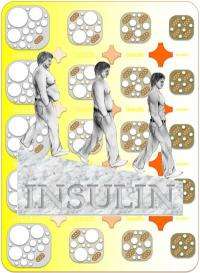
When we eat too much, obesity may develop as a result of chronically high insulin levels, not the other way around. That's according to new evidence in mice reported in the December 4th Cell Metabolism, a Cell Press publication, which challenges the widespread view that rising insulin is a secondary consequence of obesity and insulin resistance. Credit: Mehran et al., Current Biology

When we eat too much, obesity may develop as a result of chronically high insulin levels, not the other way around. That's according to new evidence in mice reported in the December 4th Cell Metabolism, a Cell Press publication, which challenges the widespread view that rising insulin is a secondary consequence of obesity and insulin resistance.

The new study helps to solve this chicken-or-the-egg dilemma by showing that animals with persistently lower insulin stay trim even as they indulge themselves on a high-fat, all-you-can-eat buffet. The findings come as some of the first direct evidence in mammals that circulating insulin itself drives obesity, the researchers say.

The results are also consistent with clinical studies showing that long-term insulin use by people with diabetes tends to come with , says James Johnson of the University of British Columbia.

"We are very inclined to think of insulin as either good or bad, but it's neither," Johnson said. "This doesn't mean anyone should stop taking insulin; there are nuances and ranges at which insulin levels are optimal."

Johnson and his colleagues took advantage of a genetic quirk in mice: that they have two insulin genes. Insulin1 shows up primarily in the pancreas and insulin2 in the brain, in addition to the . By eliminating insulin2 altogether and varying the number of good copies of insulin1, the researchers produced mice that varied only in their fasting blood insulin levels. When presented with high-fat food, those with one copy and lower fasting insulin were completely protected from even without any loss of appetite. They also enjoyed lower levels of inflammation and less fat in their livers, too.

Those differences traced to a "reprogramming" of the animals' fat tissue to burn and waste more energy in the form of heat. In other words, the mice had white fat that looked and acted more like the coveted, calorie-burning brown fat most familiar for keeping babies warm.

Johnson says it isn't clear what the findings might mean in the clinic just yet, noting that drugs designed to block insulin have been shown to come with unwanted side effects. But, he added, "there are ways to eat and diets that keep insulin levels lower or that allow to return to a healthy baseline each day."

Unfortunately, constant snacking is probably not the answer.

More information: Mehran et al.: "Hyperinsulinemia drives diet-induced obesity independently of brain insulin production." Cell Metabolism, DOI: 10.1016/j.cmet.2012.10.019

Journal reference: Current Biology search and more info website Cell Metabolism search and more info website

Provided by Cell Press search and more info website

4.7 /5 (3 votes)  

Rank 4.7 /5 (3 votes)
Relevant PhysicsForums posts

More news stories

Study reveals new mechanism for estrogen suppression of liver lipid synthesis

By discovering the new mechanism by which estrogen suppresses lipid synthesis in the liver, UC Irvine endocrinologists have revealed a potential new approach toward treating certain liver diseases.

Medical research created 18 hours ago | popularity not rated yet | comments 0 | with audio podcast

MRI-based measurement helps predict vascular disease in the brain

Aortic arch pulse wave velocity, a measure of arterial stiffness, is a strong independent predictor of disease of the vessels that supply blood to the brain, according to a new study published in the June issue the journal ...

Medical research created 18 hours ago | popularity not rated yet | comments 0

Antibiotics: A new understanding of sulfonamide nervous system side effects

Since the discovery of Prontosil in 1932, sulfonamide antibiotics have been used to combat a wide spectrum of bacterial infections, from acne to chlamydia and pneumonia. However, their side effects can include serious neurological ...

Medical research created 19 hours ago | popularity not rated yet | comments 0 | with audio podcast

Scientists discover molecule triggers sensation of itch

Scientists at the National Institutes of Health report they have discovered in mouse studies that a small molecule released in the spinal cord triggers a process that is later experienced in the brain as ...

Medical research created 19 hours ago | popularity 5 / 5 (2) | comments 0 | with audio podcast

Discarded immune cells induce the relocation of stem cells

Spanish researchers have discovered that the daily clearance of neutrophils from the body stimulates the release of hematopoietic stem cells from the bone marrow into the bloodstream, according to a report published today ...

Medical research created 21 hours ago | popularity 5 / 5 (2) | comments 0


Engineered cytomegalovirus protects monkeys from HIV equivalent

(Medical Xpress)—A new study by researchers in the US has shown that an ancient virus can be modified to help in the fight against the simian immunodeficiency virus SIV, which is the equivalent in monkeys ...

Help at hand for people with schizophrenia

How can healthy people who hear voices help schizophrenics? Finding the answer for this is at the centre of research conducted at the University of Bergen.

Scientists put bowel cancer under the microscope

Researchers from London's Kingston University have begun a two-year study which could help prolong the lives of people with colorectal tumours.

New neuron formation could increase capacity for new learning, at the expense of old memories

New research presented today shows that formation of new neurons in the hippocampus - a brain region known for its importance in learning and remembering - could cause forgetting of old memories by causing a reorganization ...

Are there atheists in foxholes? Study says they're the minority

Ernie Pyle – an iconic war correspondent in World War II – reportedly said "There are no atheists in foxholes." A new joint study between two brothers at Cornell and Virginia Wesleyan found that only ...

Breathing exercises help veterans find peace after war, scholar says

(Medical Xpress)—Research by Stanford scholar Emma Seppala at the Center for Compassion and Altruism Research and Education found that post-traumatic stress disorder decreased in veterans who participated ...