Study: Infants process faces long before they recognize other objects
December 11, 2012 by Max Mcclure in Neuroscience

Infants process faces long before they recognize other objects

Enlarge

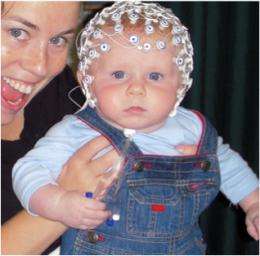
Using a net of electroencephalographic sensors, the researchers noninvasively measured the electrical activity of participants' brains. Credit: Stanford Vision and NeuroDevelopment Lab

(Medical Xpress)—Using brain-monitoring technology, Stanford psychology researchers have discovered that infant brains respond to faces in much the same way as adult brains do, even while the rest of their visual system lags behind.

Any mother will tell you that love staring at . It isn't just parental wishful thinking, either; studies show that babies, even those less than an hour old, tend to stare at face-like images longer than at any other pattern.

But this preference is a little surprising – newborns' visual systems aren't yet fully developed, and infants often have trouble distinguishing between basic shapes. How can they zero in on something as complex as a face?

New research from Professor Anthony Norcia and postdoctoral fellow Faraz Farzin, both of the Stanford Vision and NeuroDevelopment Lab, suggests a physical basis for infants' ogling. At as early as four months, babies' brains already process faces at nearly adult levels, even while other images are still being analyzed in lower levels of the visual system.

The results fit, Farzin pointed out, with the prominent role human faces play in a baby's world.

"If anything's going to develop earlier it's going to be face recognition," she said.

The paper appeared in the online Journal of Vision.

The researchers noninvasively measured generated in the infants' brains with a net of sensors placed over the scalp – a sort of electroencephalographic skullcap.

The sensors were monitoring what are called steady state visual potentials – spikes in brain activity elicited by . By flashing photographs at infants and adults and measuring their at the same steady rhythm – a technique Norcia has pioneered for over three decades – the researchers were able to "ask" the participants' brains what they perceived.

When the experiment is conducted on adults, faces and objects (like a telephone or an apple) light up similar areas of the temporal lobe – a region of the brain devoted to higher-level visual processing.

Infants' neural responses to faces were similar to those of adults, showing activity over a part of the temporal lobe researchers think is devoted to face processing.

Infants were "not yet face experts like adults," Farzin said, "but well on their way."

Objects, on the other hand, lit up a lower-level area of the visual system – a part of the occipital lobe devoted to processing more basic visual features such as contrast or orientation.

The researchers can't yet say, however, whether this early jump on is intrinsic or the result of infants encountering faces over and over again in their daily life.

The context in which babies encounter faces is very different than it is for objects, Norcia pointed out. "When you see a face, you're looking at your mom, you're interacting," he said. "It's associated with a reward."

The findings may also have significance for a class of neurological and neurodevelopmental conditions that cause lifelong struggles with facial recognition. The difficulties are associated with restricted oxygen flow or trauma to the brain shortly after birth or atypical early development of the face-specific brain region.

Journal reference: Journal of Vision search and more info website

Provided by Stanford University Medical Center search and more info website

not rated yet  

Rank not rated yet
Relevant PhysicsForums posts

More news stories

Researchers analyse hunting behaviour of fish larvae in virtual reality

Moving objects attract greater attention – a fact exploited by video screens in public spaces and animated advertising banners on the Internet. For most animal species, moving objects also play a major ...

Neuroscience created 1 minute ago | popularity not rated yet | comments 0 | with audio podcast

Signs of motor disorders can appear years before disease manifestation

It is known that signs of neurological disorders such as Alzheimer's and Huntington's disease can appear years before the disease becomes manifest; these signs take the form of subtle changes in the brain and behavior of ...

Neuroscience created 5 minutes ago | popularity not rated yet | comments 0

Taming suspect gene reverses schizophrenia-like abnormalities in mice

Scientists have reversed behavioral and brain abnormalities in adult mice that resemble some features of schizophrenia by restoring normal expression to a suspect gene that is over-expressed in humans with ...

Neuroscience created 1 hour ago | popularity not rated yet | comments 0 | with audio podcast

Scientists uncover molecular roots of cocaine addiction in the brain

Researchers at Johns Hopkins have unraveled the molecular foundations of cocaine's effects on the brain, and identified a compound that blocks cravings for the drug in cocaine-addicted mice. The compound, already proven safe ...

Neuroscience created 1 hour ago | popularity not rated yet | comments 0 | with audio podcast

Addiction as a disorder of decision-making

New research shows that craving drugs such as nicotine can be visualized in specific regions of the brain that are implicated in determining the value of actions, in planning actions and in motivation. Dr. Alain Dagher, from ...

Neuroscience created 3 hours ago | popularity not rated yet | comments 0


Researchers complete largest genetic sequencing study of human disease

Researchers from Queen Mary, University of London have led the largest sequencing study of human disease to date, investigating the genetic basis of six autoimmune diseases.

Slowing the aging process—only with antibiotics

Swiss scientists reveal the mechanism responsible for aging hidden deep within mitochondria—and dramatically slow it down in worms by administering antibiotics to the young.

Research shows how immune system peacefully co-exists with 'good' bacteria

The human gut is loaded with commensal bacteria – "good" microbes that, among other functions, help the body digest food. The gastrointestinal tract contains literally trillions of such cells, and yet the ...

Study details genes that control whether tumors adapt or die when faced with p53 activating drugs

When turned on, the gene p53 turns off cancer. However, when existing drugs boost p53, only a few tumors die – the rest resist the challenge. A study published in the journal Cell Reports shows how: tumors that live even i ...

AIDS scientists optimistic of AIDS cure, for some

Top AIDS scientists were optimistic Wednesday of finding a cure for the disease that has claimed 30 million lives—but said it might not work for all people.

Study shows that insomnia may cause dysfunction in emotional brain circuitry

A new study provides neurobiological evidence for dysfunction in the neural circuitry underlying emotion regulation in people with insomnia, which may have implications for the risk relationship between insomnia and depression.