'Resistance' to low-dose aspirin therapy extremely rare, study finds
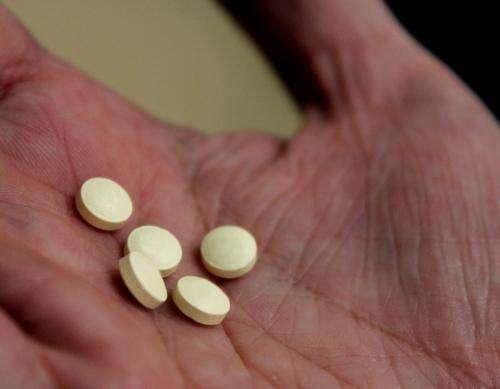
(Medical Xpress)—Roughly one-fifth of Americans take low-dose aspirin every day for heart-healthy benefits. But, based on either urine or blood tests of how aspirin blocks the stickiness of platelets – blood cells that clump together in the first stages of forming harmful clots – up to one third of patients are deemed unlikely to benefit from daily use. Such patients are called "aspirin resistant." Clots are the main cause of most heart attacks and strokes.
In people who have suffered a heart attack, low-dose aspirin reduces the chances of a second event by about one fifth, making it perhaps one of the most cost-effective drugs currently prescribed. Although consumed widely by the worried well, the relative usefulness of low-dose aspirin in patients who have never had a heart attack is more controversial. According to previous primary prevention studies, low-dose aspirin reduces this group's very low risk of a first attack by about the same number of serious stomach bleeds it causes.
In a study of 400 healthy volunteers published online this week in Circulation, the journal of the American Heart Association, scientists from the Perelman School of Medicine at the University of Pennsylvania, went looking for people who are truly resistant to the benefits of aspirin, such as might result from a particular genetic makeup. They failed to find one case of aspirin resistance; rather, they found "pseudoresistance," due to the coating found on most brands of aspirin, often preferred by patients for the protection it is claimed to provide the stomach. What's more, a urine biomarker of platelet stickiness was not able to find which volunteers were even pseudoresistant.
The study was led by Tilo Grosser MD, research assistant professor of Pharmacology, Susanne Fries, MD, research assistant professor of Pharmacology, and Garret FitzGerald, MD, FRS, director of the Institute for Translational Medicine and Therapeutics.
"When we looked for aspirin resistance using the platelet test, it detected it in about one-third of our volunteers," said Grosser. "But, when we looked a second time at the incidence of aspirin resistance in the volunteers, the one-third that we measured who was now resistant was mostly different people. Nobody had a stable pattern of resistance that was specific to coated aspirin."
Presently a blood test using a specific device can be used in the doctor's office to diagnose "aspirin resistance." Alternatively, an FDA-approved urine test is available for an indirect marker of platelet stickiness. Either can be used to determine if a patient is likely to benefit from aspirin. However, neither approach was supported by the Penn study. The blood test picked up pseudoresistance, while the urine test failed even to segregate these individuals from those clearly responsive to aspirin.
To address the reason for this pseudoresistance, the researchers compared test results of coated aspirin with the same dose of regular uncoated aspirin in volunteer subgroups for coated versus immediate-release, uncoated aspirin. Resistance was absent in the group that took the uncoated aspirin.
The coating delayed absorption compared to immediate-release, uncoated aspirin. This led to a false impression of aspirin resistance in people taking coated aspirin. Platelets of such patients remained sensitive to aspirin when examined in a test tube, so they were not truly resistant to the action of aspirin.
Uncoated, immediate-release aspirin is generic and cheap - less than 1 cent per pill – but most low-dose aspirin taken in the U.S. is the more expensive, coated, branded variety. Although supposedly easier on the stomach, coating of aspirin has never been shown to reduce the likelihood of serious stomach bleeds compared to the same dose of uncoated aspirin.
"These studies question the value of coated, low-dose aspirin," notes FitzGerald. "This product adds cost to treatment, without any clear benefit. Indeed, it may lead to the false diagnosis of aspirin resistance and the failure to provide patients with an effective therapy. Our results also call into question the value of using office tests to look for such resistance."


