Study reveals autism treatment clues
December 4, 2012 by Sunanda Creagh in Autism spectrum disorders
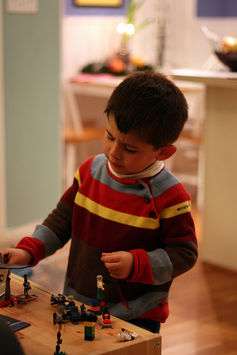
Using objects like Lego for the purpose for which they were designed was a key clue, the study found. Credit: http://www.flickr.com/photos/24732687@N00
Young autistic children who can spontaneously imitate adults and use objects in a functional way may be more likely to respond well to a therapy called the Early Start Denver Model, new research shows.
The Early Start Denver Model uses play to teach social skills like taking turns to autistic pre-school children but its success varies greatly from child to child.
In an effort to unpack why some children do better than others, a research team that included La Trobe University scientists studied a group of 21 autistic children aged between two and five years as they progressed through an Early Start Denver Model program.
"These are very early results but all the children did better after 12 months than they did before the treatment and we saw some children doing way better than other children," said lead researcher, Dr Giacomo Vivanti, from La Trobe University's School of Psychological Science.
Further tests revealed that those children who did better were the ones who were able to use objects for their designed purpose.
"For example, a child who sees pieces of Lego and will use those pieces to build something—who uses the objects in a direct functional way—were doing better than children who will start banging the Lego against the wall," he said.
Another clue that a child was likely to respond well to the treatment was their ability to spontaneously imitate adult behaviour as part of a game.
The study was also the first time researchers showed that the Early Start Denver Model, which is normally administered one-on-one with children, could work in a group setting.
"One-on-one has proved to be effective but it's a very expensive model. We wanted to know if there was a way to replicate it in a community based setting," said Dr Vivanti.
"There needs to be caution around the fact that we still need more detail about the efficacy of the program. These are encouraging results but we need to replicate the results with a control group."
A better understanding of how different treatments affect different children could help children get the therapies best suited to their needs, he said.
Dr Vivanti's findings, which were published in the Journal of Autism and Developmental Disorders, will be presented this week at the Australasian Society for Autism Research conference underway in Sydney this week.
Dr Jon Brock, an autism expert from the Centre of Excellence in Cognition and its Disorders and one of the conference organisers, described Dr Vivanti's findings as very interesting.
"The study shows that kids do vary a huge amount in how much they improve over the year they're in the Early Start Denver Model program and it suggests that there might be ways of predicting in advance which kids are likely to improve," he said.
"However, the findings are quite preliminary. It's difficult to know how much of the improvement a child shows is directly due to the intervention. And we don't know whether the kids who showed less improvement would have been better off with a different intervention."
"These are really important questions to answer because this kind of intervention is a huge commitment for everyone involved – so we need to know that kids are getting the intervention that is most appropriate for them as individuals."
More information: link.springer.com/… 3-012-1705-7
Journal reference:
Journal of Autism and Developmental Disorders
Provided by
The Conversation
This story is published courtesy of the The Conversation (under Creative Commons-Attribution/No derivatives).
-
Interest in toys predicts effectiveness of autism treatment in toddlers
Mar 22, 2011 |
not rated yet |
0
-
Earlier autism diagnosis could mean earlier interventions
Oct 13, 2011 |
not rated yet |
0
-
Early treatment sparks striking brain changes in autism
Nov 06, 2012 |
not rated yet |
0
-
Early intervention for toddlers with autism highly effective, study finds
Nov 30, 2009 |
not rated yet |
0
-
Two-Thirds of kids with autism have been bullied: study
Mar 30, 2012 |
not rated yet |
0
-
Motion perception revisited: High Phi effect challenges established motion perception assumptions
Apr 23, 2013 |
3 / 5 (2) |
2
-
Anything you can do I can do better: Neuromolecular foundations of the superiority illusion (Update)
Apr 02, 2013 |
4.5 / 5 (11) |
5
-
The visual system as economist: Neural resource allocation in visual adaptation
Mar 30, 2013 |
5 / 5 (2) |
9
-
Separate lives: Neuronal and organismal lifespans decoupled
Mar 27, 2013 |
4.9 / 5 (8) |
0
-
Sizing things up: The evolutionary neurobiology of scale invariance
Feb 28, 2013 |
4.8 / 5 (10) |
14
-
Question in reflection and transmission at oblique incidence.
3 hours ago
-
Is this plasma (picture in thread)
3 hours ago
-
Basic physics understanding. Could someone explain?
5 hours ago
-
Change in flux of a transformer
5 hours ago
-
Electric field between parallel plate capacitor
6 hours ago
-
Why angle of projectile has 2 solutions?
7 hours ago
- More from Physics Forums - Classical Physics
More news stories
Enrichment therapy effective among children with autism, study finds
Children with autism showed significant improvement after six months of simple sensory exercises at home using everyday items such as scents, spoons and sponges, according to UC Irvine neurobiologists.
Autism spectrum disorders
May 21, 2013 |
3 / 5 (1) |
0
|
Researcher helps give children with autism the chance to communicate
Research by Victoria University PhD education graduand Larah van der Meer highlights the importance of understanding the communication preferences of children with developmental disabilities such as autism.
Autism spectrum disorders
May 14, 2013 |
3.3 / 5 (3) |
1
Developers dive in to create a wealth of autism apps
At times, Andy Shih still finds himself overwhelmed by the groundswell of interest in autism applications he's seen in the three years since Apple Inc. released the first iPad.
Autism spectrum disorders
May 09, 2013 |
2 / 5 (1) |
0
Enhanced motion perception in autism may point to an underlying cause of the disorder
Children with autism see simple movement twice as quickly as other children their age, and this hypersensitivity to motion may provide clues to a fundamental cause of the developmental disorder, according ...
Autism spectrum disorders
May 08, 2013 |
not rated yet |
0
|
Autism scientists seek more brains to aid research
(AP)—Autism scientists are seeking more brain samples for research.
Autism spectrum disorders
May 02, 2013 |
5 / 5 (1) |
0
Researchers identify first drug targets in childhood genetic tumor disorder
Two mutations central to the development of infantile myofibromatosis (IM)—a disorder characterized by multiple tumors involving the skin, bone, and soft tissue—may provide new therapeutic targets, according to researchers ...
Engineered cytomegalovirus protects monkeys from HIV equivalent
(Medical Xpress)—A new study by researchers in the US has shown that an ancient virus can be modified to help in the fight against the simian immunodeficiency virus SIV, which is the equivalent in monkeys ...
Hormone levels may provide key to understanding psychological disorders in women
Women at a particular stage in their monthly menstrual cycle may be more vulnerable to some of the psychological side-effects associated with stressful experiences, according to a study from UCL.
Going live: Immune cell activation in multiple sclerosis
Biological processes are generally based on events at the molecular and cellular level. To understand what happens in the course of infections, diseases or normal bodily functions, scientists would need to ...
Driving and hands-free talking lead to spike in errors, study shows
Talking on a hands-free device while behind the wheel can lead to a sharp increase in errors that could imperil other drivers on the road, according to new research from the University of Alberta.
Pollen count apps for smartphones are nothing to sneeze at
Kate O'Reilly's spring allergy survival kit includes the usual stuff - nasal sprays, allergy pills and a box of tissues. This season, she's added a new weapon to her line of defense: an app on her smartphone.