Runners benefit from new spin-out
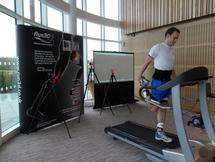
A runner put through their paces with a Run3D assessment
Run3D Ltd, a new Oxford University spin-out company, provides a pioneering service to help runners avoid a common form of injury.
The firm offers Europe's first computerised three-dimensional assessment for preventing the types of overuse injuries that affect 50% of runners. Run3D's service uses 3D motion analysis checked against the world's largest biomechanical database to identify any abnormal patterns in a runner's gait. These abnormal patterns are often the root cause of an injury which once corrected can prevent any recurrence.
At the heart of the Run3D service is a multiple infrared camera system linked to a sophisticated data acquisition system, which has been developed by Professor Reed Ferber at the Running Injury Clinic, University of Calgary. A full assessment takes two hours and is backed by expert advice from a team headed by Dr Jessica Leitch, CEO of Run3D. Dr Leitch began working on the service after completing her doctoral studies in running injury biomechanics at Oxford University's Department of Engineering.
'An accurate analysis of a runner's biomechanics is fundamental to understanding the root-cause of a musculoskeletal overuse injury and to delivering a long-term solution to optimal running,' said Dr Leitch.
'Conventional video based systems are subjective and not sensitive enough to detect the subtle abnormalities that can lead to injury. Run3D measures a runner's joint angles in the three planes of human motion. The results are then compared to a biomechanical database in order to identify any abnormal patterns in the runner's gait to improve performance and prevent injury.
'Run3D's unique and rigorous approach provides an objective and scientific service, which delivers an effective and evidence-based programme that is tailored very specifically to that individual.'
Coming out of a joint research initiative at the Oxford Gait Laboratory at the Nuffield Orthopaedic Centre and the University's Engineering Department, the company will be based at the historic Roger Bannister Running Track in Oxford. Run3D offers a range of services that include the only mobile service of the kind, going out to running tracks and playing fields to assess athletes across the country. The cost of the full analysis will be £295, with discounted rates available for sports teams and running clubs.
Isis Innovation, the technology transfer office of the University of Oxford, managed the spin-out. Andrea Alunni, Seed Investment Manager at Isis said: 'Isis was happy to see this company through the incorporation process, providing support on all levels and access to investment.'
The spin-out comes from an initial investment from a new fund managed by Oxford Technology Management Ltd. The Oxford Technology Combined Seed Enterprise Investment and Enterprise Investment Scheme Fund targets start-up technology companies near Oxford.
Lucius Cary, founder of Oxford Technology Management said: 'We are delighted to be investing in Run3D Ltd, a spin-out from Oxford University. There are now 2m people who run regularly in the UK, and statistically, 1m of these will develop running-related injuries in the course of the next 12 months. Jessica Leitch, who as well as having a DPhil in the biomechanics of running, is also an international runner, having represented Wales, and is the perfect person to provide a service to runners which, by analysing their gait in never-before-achieved 3D detail, will be able to help them to run better and to avoid injury.'
Partnering Run3D in this new venture is the Running Injury Clinic, at the University of Calgary, where the gait analysis system was developed. Other stakeholders include the Oxford University Hospitals NHS trust, following the incubation of the Run3D service at the Nuffield Orthopedic Centre, and Technikos LLP, a venture fund with a long term commercial partnership with the University of Oxford's Institute of Bio-medical engineering. Run3D is the third University of Oxford bio-engineering spin-out this year.
Provided by
Oxford University
-
Ultrasound software spin-out to save NHS millions
Aug 03, 2012 |
not rated yet |
0
-
Spin-out targets better cancer treatment
Jan 25, 2012 |
not rated yet |
0
-
Stretching before a run does not prevent injury
Feb 18, 2011 |
not rated yet |
0
-
Light electric motor spins out
Sep 10, 2009 |
not rated yet |
0
-
Oxford spin-out is energy-saver for business
Nov 08, 2011 |
not rated yet |
0
-
Motion perception revisited: High Phi effect challenges established motion perception assumptions
Apr 23, 2013 |
3 / 5 (2) |
2
-
Anything you can do I can do better: Neuromolecular foundations of the superiority illusion (Update)
Apr 02, 2013 |
4.5 / 5 (11) |
5
-
The visual system as economist: Neural resource allocation in visual adaptation
Mar 30, 2013 |
5 / 5 (2) |
9
-
Separate lives: Neuronal and organismal lifespans decoupled
Mar 27, 2013 |
4.9 / 5 (8) |
0
-
Sizing things up: The evolutionary neurobiology of scale invariance
Feb 28, 2013 |
4.8 / 5 (10) |
14
-
Classical and Quantum Mechanics via Lie algebras
Apr 15, 2011
- More from Physics Forums - Independent Research
More news stories
Do doctors understand the individualisation of treatments?
The individualisation of drug treatments to support patients to self-manage their conditions is a concept that sits at the heart of policy, but a recent study in BMJ Open shows that there is no concrete defini ...
Health
1 hour ago |
not rated yet |
0
Keep summer water fun safe with training and supervision
Fun in the summer often means kids spending time in the water, whether at a pool, the beach, a lake or river. A pediatric safety expert at the University of Alabama at Birmingham (UAB) stresses proper training ...
Health
2 hours ago |
not rated yet |
0
Pregnant bellies: Updating the tape measure technique
A new way of interpreting information from a low-tech, age-old method used in pregnancy care is expected to more accurately identify potential health issues for mothers and babies.
Health
2 hours ago |
not rated yet |
1
Obesity weighs down on top soda guzzler Mexico
Artemio Martinez balanced his corpulent frame on a stool in a Mexico City street taco stand, downing a sweet soda and eating a final pork-filled corn tortilla.
Health
4 hours ago |
not rated yet |
0
Consumers largely underestimating calorie content of fast food
People eating at fast food restaurants largely underestimate the calorie content of meals, especially large ones, according to a paper published today in BMJ.
Health
16 hours ago |
not rated yet |
0
Saudi to send animal samples to US in coronavirus probe
Saudi Arabia said Friday it would send samples taken from animals possibly infected with a deadly SARS-like virus to the United States for testing in a bid to find the source of disease.
Engineered cytomegalovirus protects monkeys from HIV equivalent
(Medical Xpress)—A new study by researchers in the US has shown that an ancient virus can be modified to help in the fight against the simian immunodeficiency virus SIV, which is the equivalent in monkeys ...
New neuron formation could increase capacity for new learning, at the expense of old memories
New research presented today shows that formation of new neurons in the hippocampus - a brain region known for its importance in learning and remembering - could cause forgetting of old memories by causing a reorganization ...
Are there atheists in foxholes? Study says they're the minority
Ernie Pyle – an iconic war correspondent in World War II – reportedly said "There are no atheists in foxholes." A new joint study between two brothers at Cornell and Virginia Wesleyan found that only ...
Controlling mood through the motions of mitochondria
(Medical Xpress)—Regulating the distribution of power in neurons is done by a system that makes the national electric grid look simple by comparison. Each neuron has several thousand mitochondria confined ...
Scientists put bowel cancer under the microscope
Researchers from London's Kingston University have begun a two-year study which could help prolong the lives of people with colorectal tumours.