Study: Even the smallest stroke can damage brain tissue, impair cognitive function
December 16, 2012 in Neuroscience
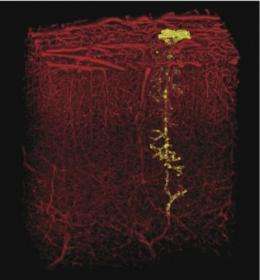
A single arteriole, highlighted in yellow, dives from the surface of the brain at the top of the image to penetrate a column of brain tissue. Blocking just one such vessel can damage the brain and lead to a focused cognitive defect, a new study has shown. Credit: David Kleinfeld Lab, UC San Diego
Blocking a single tiny blood vessel in the brain can harm neural tissue and even alter behavior, a new study from the University of California, San Diego has shown. But these consequences can be mitigated by a drug already in use, suggesting treatment that could slow the progress of dementia associated with cumulative damage to miniscule blood vessels that feed brain cells. The team reports their results in the December 16 advance online edition of Nature Neuroscience.
"The brain is incredibly dense with vasculature. It was surprising that blocking one small vessel could have a discernable impact on the behavior of a rat," said Andy Y. Shih, lead author of the paper who completed this work as a postdoctoral fellow in physics at UC San Diego. Shih is now an assistant professor at the Medical University of South Carolina.
Working with rats, Shih and colleagues used laser light to clot blood at precise points within small blood vessels that dive from the surface of the brain to penetrate neural tissue. When they looked at the brains up to a week later, they saw tiny holes reminiscent of the widespread damage often seen when the brains of patients with dementia are examined as a part of an autopsy.
These micro-lesions are too small to be detected with conventional MRI scans, which have a resolution of about a millimeter. Nearly two dozen of these small vessels enter the brain from a square millimeter area of the surface of the brain.
"It's controversial whether that sort of damage has consequences, although the tide of evidence has been growing as human diagnostics improve," said David Kleinfeld, professor of physics and neurobiology, who leads the research group.
To see whether such minute damage could change behavior, the scientists trained thirsty rats to leap from one platform to another in the dark to get water.
The rats readily jump if they can reach the second platform with a paw or their snout, or stretch farther to touch it with their whiskers. Many rats can be trained to rely on a single whisker if the others are clipped, but if they can't feel the far platform, they won't budge.
"The whiskers line up in rows and each one is linked to a specific spot in the brain," Shih said. "By training them to use just one whisker, we were able to distill a behavior down to a very small part of the brain."
When Shih blocked single microvessels feeding a column of brain cells that respond to signals from the remaining whisker, the rats still crossed to the far platform when the gap was small. But when it widened beyond the reach of their snouts, they quit.
The FDA-approved drug memantine, prescribed to slow one aspect of memory decline associated with Alzheimer's disease, ameliorated these effects. Rats that received the drug jumped whisker-wide gaps, and their brains showed fewer signs of damage.
"This data shows us, for the first time, that even a tiny stroke can lead to disability," said Patrick D. Lyden, a co-author of the study and chair of the department of neurology at Cedars-Sinai Medical Center in Los Angeles. "I am afraid that tiny strokes in our patients contribute—over the long term—to illness such as dementia and Alzheimer's disease," he said, adding that "better tools will be required to tell whether human patients suffer memory effects from the smallest strokes."
"We used powerful tools from biological physics, many developed in Kleinfeld's laboratory at UC San Diego, to link stroke to dementia on the unprecedented small scale of single vessels and cells," Shih said. "At my new position at MUSC, I plan to work on ways to improve the detection of micro-lesions in human patients with MRI. This way clinicians may be able to diagnose and treat dementia earlier." —Susan Brown
Journal reference:
Nature Neuroscience
Provided by
University of California - San Diego
-
Mesh-like network of arteries adjusts to restore blood flow to stroke-injured brain
Jan 30, 2009 |
not rated yet |
0
-
Bottleneck in blood supply makes brain vulnerable to strokes
Jan 04, 2007 |
not rated yet |
0
-
Laser sheds light on stroke patients
Jan 04, 2006 |
not rated yet |
0
-
Exercise may aid in stroke recovery
Apr 25, 2006 |
not rated yet |
0
-
Whisker stimulation prevents strokes in rats, study finds
Jul 13, 2010 |
not rated yet |
0
-
Motion perception revisited: High Phi effect challenges established motion perception assumptions
Apr 23, 2013 |
3 / 5 (2) |
2
-
Anything you can do I can do better: Neuromolecular foundations of the superiority illusion (Update)
Apr 02, 2013 |
4.5 / 5 (11) |
5
-
The visual system as economist: Neural resource allocation in visual adaptation
Mar 30, 2013 |
5 / 5 (2) |
9
-
Separate lives: Neuronal and organismal lifespans decoupled
Mar 27, 2013 |
4.9 / 5 (8) |
0
-
Sizing things up: The evolutionary neurobiology of scale invariance
Feb 28, 2013 |
4.8 / 5 (10) |
14
-
Why is zone 1 in liver more prone to ischemic injury?
May 23, 2013
-
How can there be villous adenoma in colon, if there are no villi there
May 22, 2013
-
How can there be a term called "intestinal metaplasia" of stomach
May 21, 2013
-
Pressure-volume curve: Elastic Recoil Pressure don't make sense
May 18, 2013
-
If you became brain-dead, would you want them to pull the plug?
May 17, 2013
-
MRI bill question
May 15, 2013
- More from Physics Forums - Medical Sciences
More news stories
New neuron formation could increase capacity for new learning, at the expense of old memories
New research presented today shows that formation of new neurons in the hippocampus - a brain region known for its importance in learning and remembering - could cause forgetting of old memories by causing a reorganization ...
Neuroscience
May 24, 2013 |
4 / 5 (4) |
0
Help at hand for people with schizophrenia
How can healthy people who hear voices help schizophrenics? Finding the answer for this is at the centre of research conducted at the University of Bergen.
Neuroscience
May 24, 2013 |
4 / 5 (2) |
2
Japanese research organizations contribute to Human Brain Project
One of the major frontiers of modern science is a comprehensive understanding of the human brain and its functions to guide the development of new technologies in information and communication. In a major announcement for ...
Neuroscience
May 24, 2013 |
3.7 / 5 (3) |
0
Controlling mood through the motions of mitochondria
(Medical Xpress)—Regulating the distribution of power in neurons is done by a system that makes the national electric grid look simple by comparison. Each neuron has several thousand mitochondria confined ...
Neuroscience
May 23, 2013 |
4.9 / 5 (10) |
0
|
Brain uses internal 'average voice' prototype to identify who is talking
(Medical Xpress)—The human brain is able to identify individuals' voices by comparing them against an internal 'average voice' prototype, according to neuroscientists.
Neuroscience
May 23, 2013 |
3.7 / 5 (3) |
3
|
First drug to improve heart failure mortality in over a decade
Coenzyme Q10 decreases all cause mortality by half, according to the results of a multicentre randomised double blind trial presented today at Heart Failure 2013 congress. It is the first drug to improve heart failure mortality ...
Seniors more likely to crash when driving with pet, study finds
(HealthDay)—Animals make great companions for senior citizens, but elderly people who always drive with a pet in the car are far more likely to crash than those who never drive with a pet, researchers have ...
Heart failure accelerates male 'menopause'
Heart failure accelerates the aging process and brings on early andropausal syndrome (AS), according to research presented today at the Heart Failure Congress 2013. AS, also referred to as male 'menopause', was four times ...
Death highest in heart failure patients admitted in January, on Friday, and overnight
Mortality and length of stay are highest in heart failure patients admitted in January, on Friday, and overnight, according to research presented today at the Heart Failure Congress 2013. The analysis of nearly 1 million ...
Feds fight morning-after pill age ruling in NY
(AP)—Department of Justice lawyers have again asked a federal appeals court in New York to delay lifting age restrictions and prescription requirements on an emergency contraceptive popularly known as the morning-after ...
New immune system discovered
(Medical Xpress)—A research team, led by Jeremy Barr, a biology post-doctoral fellow, unveils a new immune system that protects humans and animals from infection.
Dec 17, 2012
Rank: not rated yet
Whilst the objective of this research is indisputable, the methods of proof are naive at best, and the use of "powerful tools from biological physics" hardly makes the "discovery" more convincing.