No training means spiritual care lacking in advanced cancer
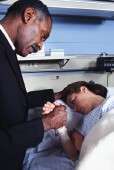
Although oncology nurses and physicians feel that spiritual care is an important, appropriate, and beneficial component of end-of-life care for patients with advanced cancer, it is infrequently offered, primarily due to a lack of training, according to research published online Dec. 17 in the Journal of Clinical Oncology.
(HealthDay)—Although oncology nurses and physicians feel that spiritual care (SC) is an important, appropriate, and beneficial component of end-of-life (EOL) care for patients with advanced cancer, it is infrequently offered, primarily due to a lack of training, according to research published online Dec. 17 in the Journal of Clinical Oncology.
Michael J. Balboni, Ph.D., of Harvard Medical School in Boston, and colleagues surveyed 75 patients with advanced cancer receiving palliative radiation therapy and 339 oncology nurses and physicians. The authors sought to examine factors that contribute to the infrequent provision of SC for patients at the EOL.
The researchers found that, although most patients with advanced cancer indicated that SC was an important component of cancer care from nurses (86 percent) and physicians (87 percent), the majority never received any form of SC from their oncology nurses (87 percent) or physicians (94 percent). Most nurses (87 percent) and physicians (80 percent) believed that SC should be provided at least sometimes. In eight examples of SC, the appropriateness was endorsed by the majority of patients (78 percent), nurses (93 percent), and physicians (87 percent). Reception of SC training was the strongest predictor of SC provision by nurses and doctors (odds ratios, 11.20 and 7.22, respectively), in adjusted analyses. The majority of nurses (88 percent) and physicians (86 percent) had not received training.
"In conclusion, patients with advanced cancer, nurses, and physicians recognize the importance, appropriateness, and beneficial impact of SC," the authors write. "The rarity of SC may be primarily due to the frequent lack of SC training."
More information: Abstract
Full Text (subscription or payment may be required)
Journal reference:
Journal of Clinical Oncology
Copyright © 2012 HealthDay. All rights reserved.
-
Short-, long-course therapy comparable in T3 rectal cancer
Sep 27, 2012 |
not rated yet |
0
-
Themes identified for improving end-of-life care in ER
Sep 05, 2012 |
not rated yet |
0
-
Perception of inappropriate care frequent among ICU workers
Dec 27, 2011 |
not rated yet |
0
-
Calling nurses to exercise as role models for their patients
Aug 30, 2011 |
not rated yet |
0
-
Future labor shortfalls of medical professionals predicted due to new demands of health-care reform
Jul 06, 2011 |
not rated yet |
0
-
Motion perception revisited: High Phi effect challenges established motion perception assumptions
Apr 23, 2013 |
3 / 5 (2) |
2
-
Anything you can do I can do better: Neuromolecular foundations of the superiority illusion (Update)
Apr 02, 2013 |
4.5 / 5 (11) |
5
-
The visual system as economist: Neural resource allocation in visual adaptation
Mar 30, 2013 |
5 / 5 (2) |
9
-
Separate lives: Neuronal and organismal lifespans decoupled
Mar 27, 2013 |
4.9 / 5 (8) |
0
-
Sizing things up: The evolutionary neurobiology of scale invariance
Feb 28, 2013 |
4.8 / 5 (10) |
14
-
Why is zone 1 in liver more prone to ischemic injury?
8 hours ago
-
How can there be villous adenoma in colon, if there are no villi there
May 22, 2013
-
How can there be a term called "intestinal metaplasia" of stomach
May 21, 2013
-
Pressure-volume curve: Elastic Recoil Pressure don't make sense
May 18, 2013
-
If you became brain-dead, would you want them to pull the plug?
May 17, 2013
-
MRI bill question
May 15, 2013
- More from Physics Forums - Medical Sciences
More news stories
Frequent heartburn may predict cancers of the throat and vocal cord
Frequent heartburn was positively associated with cancers of the throat and vocal cord among nonsmokers and nondrinkers, and the use of antacids, but not prescription medications, had a protective effect, according to data ...
Cancer
26 minutes ago |
not rated yet |
0
Key find for early bladder cancer treatment
Aggressive forms of bladder cancer involve the protein PODXL – a discovery that could hold the key to improved treatment, according to researchers at Lund University, Uppsala University and KTH in Sweden.
Cancer
2 hours ago |
5 / 5 (1) |
0
Cold plasma successful against brain cancer cells
For the first time, physicists from the Max Planck Institute for Extraterrestrial Physics (MPE), biologists and physicians demonstrated the synergistic effect of cold atmospheric plasma - a partly ionized ...
Cancer
3 hours ago |
5 / 5 (1) |
0
|
Non-Hodgkin lymphoma survival doubles since early 1970s
More than half of patients diagnosed with Non-Hodgkin Lymphoma (NHL) are now surviving the disease thanks to improved diagnosis and treatment, according to a new report1 from Cancer Research UK.
Cancer
3 hours ago |
5 / 5 (1) |
0
Researchers find possible 'master switch' in deadly brain cancer
(Medical Xpress)—Researchers at the University of Virginia School of Medicine have identified a promising target for treating glioblastoma, one that appears to avoid many of the obstacles that typically frustrate efforts ...
Cancer
4 hours ago |
3.5 / 5 (2) |
0
|
Researchers suggest boosting body's natural flu killers
A known difficulty in fighting influenza (flu) is the ability of the flu viruses to mutate and thus evade various medications that were previously found to be effective. Researchers at the Hebrew University of Jerusalem have ...
Regenerating spinal cord fibers may be treatment for stroke-related disabilities
A study by researchers at Henry Ford Hospital found "substantial evidence" that a regenerative process involving damaged nerve fibers in the spinal cord could hold the key to better functional recovery by most stroke victims.
The secret lives, and deaths, of neurons
As the human body fine-tunes its neurological wiring, nerve cells often must fix a faulty connection by amputating an axon—the "business end" of the neuron that sends electrical impulses to tissues or other ...
Anxious men fare worse during job interviews, study finds
Nervous about that upcoming job interview? You might want to take steps to reduce your jitters, especially if you are a man.
Breakthrough on Huntington's disease
Researchers at Lund University have succeeded in preventing very early symptoms of Huntington's disease, depression and anxiety, by deactivating the mutated huntingtin protein in the brains of mice.
Second-generation TAVI device—Lotus Valve—shows good performance in REPRISE II
22 May 2013, Paris, France: The Lotus Valve, a second-generation transcatheter aortic valve implantation (TAVI) device, was successfully implanted in all of the first 60 patients in results from REPRISE II reported at EuroPCR ...