Terbium: A new 'Swiss Army knife' for cancer diagnosis and treatment
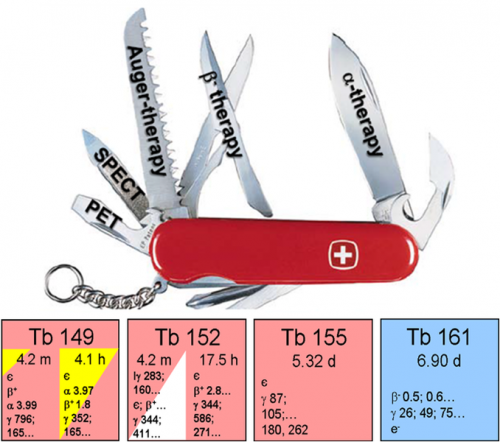
A collaboration between the Paul Scherrer Institute, CERN's ISOLDE facility, and the Institut Laue-Langevin, has published preclinical study results for a newly developed set of tumour-targeting radiopharmaceuticals. The results, published in The Journal of Nuclear Medicine, are a significant success for this group of nuclear medicine specialists and radiochemists, demonstrating the potential to provide a new generation of radioisotopes with excellent properties for the diagnosis and treatment of cancer.
'Receptor-targeted' radiopharmaceuticals consist of a radioactive isotope which is attached to a carrier that selectively delivers it to tumour cells. They are used in two ways.
• Nuclear medical imaging - involves injecting a positron or gamma-ray-emitting radiopharmaceutical into the bloodstream as a marker. Once bound to the target (e.g. a tumour), the gamma-ray emissions of the radioisotope or the positron annihilation allow diagnosis and possibly the determination of the severity of a variety of diseases, including many types of cancers.
• Targeted radionuclide therapy – makes use of short-range particle-emitting radioisotopes with the ability to destroy tumour cells.
Traditional radioisotopes (such as iodine-131 and yttrium-90), employed in the first generation of radiopharmaceuticals do not offer ideal nuclear properties for all therapeutic applications. As a result more recent developments of radiopharmaceuticals make use of emerging radioisotopes with more favourable decay properties such as lutetium-177, which reduces both collateral damage to healthy tissue and the need to isolate the patient during treatment.
The ideal situation would be to select the most suitable radioisotopes at an early stage in drug development, allowing an overall optimization of the radiopharmaceutical. However, such innovative radioisotopes are often not commercially available and dedicated production methods are often lacking.
Recently a method for large-scale production of one such new generation radioisotope, terbium-161, has been developed by radiochemists from TU Munich and PSI Villigen working with samples irradiated at the ILL in Grenoble and at FRM2. They were successful in supplying this isotope in the quality and quantity needed for clinical applications.
In this latest study terbium-161 has been complemented by three other terbium isotopes, produced by high-energy proton-induced reactions at ISOLDE-CERN, which together have the potential to both diagnose and treat cancer. Having so-called 'matched pairs' of isotopes (based on the same chemical element) is particularly valuable and opens up the opportunity for personalised, patient-specific treatment to increase efficiency and reduce side effects.
Terbium (Tb) is the only element in the periodic table offering not only a matched pair but four clinically interesting radioisotopes with complementary nuclear decay characteristics which between them could be used in the full range of procedures in nuclear medicine. Thus, terbium can serve as the "Swiss Army knife of Nuclear Medicine", for fundamental studies of new radiopharmaceuticals and for detailed comparisons of targeted therapy options.
The trials
In a new joint article, scientists from the PSI, ILL and CERN reported on the first comprehensive preclinical study of this new range of terbium radiopharmaceuticals. The radioisotopes were combined with a newly developed delivery agent called 'cm09' and then administered to tumour-bearing mice. For the imaging isotopes, the scientists applied two common diagnostic techniques to study its uptake by cancer cells. Positron emission tomography (PET) and single-photon emission computed tomography (SPECT) were applied to the mice 24 hours after the injection of terbium-152, terbium-155 and terbium-161 respectively. Terbium-161 and terbium-149 were investigated with regard to their therapeutic efficacy by comparing tumour growth and survival rates in the mice under treatment with an untreated control group.
Key findings
• PET/CT and SPECT/CT studies using both diagnostic isotopes terbium-152 and terbium-155 and the gamma-emitting therapeutic isotope terbium-161 provided excellent tumour visualization 24 hours after injection
• Both therapeutic isotopes provided a significant inhibition to tumour growth in mice, resulting in a marked delay in tumour growth or even complete remission. In particular therapy with terbium-161 resulted in complete remission in 80% of cases.
The performance of terbium-161 was particularly encouraging as previous work by TUM, PSI and the ILL, published in 2011, demonstrated that this isotope could be produced in the quantity and quality required for clinical routine application.
Prof. Cristina Müller (PSI) said: "In this study, we designed new diagnostic and therapeutic radiopharmaceuticals by combining the vitamin folic acid as a tumor-targeting agent and four different terbium isotopes that have unique nuclear properties for different applications in nuclear medicine. Excellent results were obtained in tumor-bearing mice which raise hopes for future development of such radiopharmaceuticals for clinical use in cancer patients".
More information: Journal of Nuclear Medicine, 2012 53:1951-1959, jnm.snmjournals.org/content/53/12/1951.abstract


