Diabetic fruit flies support buzz about dietary sugar dangers
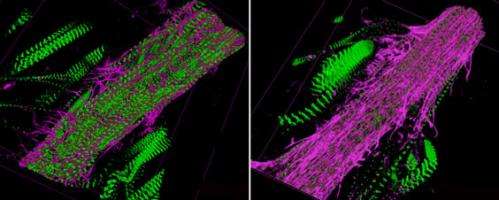
Cardiac fibrosis (shown in purple), a hallmark of heart disease, is clearly increased in fruit flies on a high-sugar diet (right), as compared to flies on a normal diet (left). Credit: Sanford-Burnham Medical Research Institute
Regularly consuming sucrose—the type of sugar found in many sweetened beverages—increases a person's risk of heart disease. In a study published January 10 in the journal PLOS Genetics, researchers at Sanford-Burnham Medical Research Institute and Mount Sinai School of Medicine used fruit flies, a well-established model for human health and disease, to determine exactly how sucrose affects heart function. In addition, the researchers discovered that blocking this cellular mechanism prevents sucrose-related heart problems.
"Our study reveals a number of specific sugar-processing enzymes that could be targeted with therapies aimed at reducing sucrose's unhealthy effects on the heart," said Karen Ocorr, Ph.D., research assistant professor at Sanford-Burnham and the study's corresponding author.
Diabetic fruit flies with heart problems
The research team was the first to model heart disease caused by type 2 diabetes in fruit flies. They achieved this simply by feeding the flies a diet high in sucrose. High-sucrose flies showed many classic signs of human type 2 diabetes, including high blood sugar and insulin signaling defects. The team also saw signs of diabetes-induced heart malfunction in these flies—deteriorating heart function, cardiac arrhythmia and fibrosis.
Next the researchers wanted to know exactly what sucrose is doing inside the flies' cells that makes it harmful to hearts. To answer this question, they looked for molecular networks that are triggered or altered by sucrose.
The team eventually pinpointed one particular biochemical system, called the hexosamine pathway. This series of biochemical reactions normally plays only a minor role in the way cells process sugar to produce energy. But some research also suggests that the hexosamine pathway is linked to diabetes in humans.
"It's remarkable that we're able to use the fruit fly as a discovery tool for elucidating basic molecular mechanisms, not only of many types of heart disease, but also dietary influences that help us understand what happens in human hearts," added Rolf Bodmer, Ph.D., professor at Sanford-Burnham and a senior author of the study.
Dampening sugar's negative effect on the heart
The researchers further probed the hexosamine pathway in their new diabetes model. They found that artificially increasing sucrose-processing via the hexosamine pathway harms the heart. In contrast, when they specifically blocked this pathway, they prevented some of the high-sucrose induced heart defects, such as cardiac arrhythmias.
"Diet-induced heart damage is one of our society's most serious health issues. Our flies now give us a tool to explore the role of high dietary sugar, and the means to identify treatments in the context of the whole body," said Ross Cagan, Ph.D., professor at Mount Sinai School of Medicine and a senior author of this study.
Journal reference:
PLoS Genetics
Provided by
Sanford-Burnham Medical Research Institute
-
Fruit fly research may lead to better understanding of human heart disease
Dec 02, 2008 |
not rated yet |
0
-
Fly study uncovers molecular link between obesity and heart disease
Nov 02, 2010 |
not rated yet |
0
-
A different path to fat-related heart disease
Jan 18, 2011 |
not rated yet |
0
-
Mapping heart disease: Researchers uncover genes that may dramatically affect heart health
Apr 01, 2010 |
not rated yet |
0
-
Carrot cake study on sugar in type 2 diabetes
Jan 08, 2008 |
not rated yet |
0
-
Motion perception revisited: High Phi effect challenges established motion perception assumptions
Apr 23, 2013 |
3 / 5 (2) |
2
-
Anything you can do I can do better: Neuromolecular foundations of the superiority illusion (Update)
Apr 02, 2013 |
4.5 / 5 (11) |
5
-
The visual system as economist: Neural resource allocation in visual adaptation
Mar 30, 2013 |
5 / 5 (2) |
9
-
Separate lives: Neuronal and organismal lifespans decoupled
Mar 27, 2013 |
4.9 / 5 (8) |
0
-
Sizing things up: The evolutionary neurobiology of scale invariance
Feb 28, 2013 |
4.8 / 5 (10) |
14
-
Classical and Quantum Mechanics via Lie algebras
Apr 15, 2011
- More from Physics Forums - Independent Research
More news stories
Researchers develop model for better testing, targeting of malignant peripheral nerve sheath tumors
University of Minnesota Medical School researchers from the Masonic Cancer Center, University of Minnesota, in partnership with the University's Brain Tumor Program, have developed a new mouse model of malignant peripheral ...
Genetics
19 hours ago |
5 / 5 (1) |
0
|
Researchers identify new circadian clock component
Northwestern University scientists have shown a gene involved in neurodegenerative disease also plays a critical role in the proper function of the circadian clock.
Genetics
May 16, 2013 |
3 / 5 (1) |
1
|
Returning genetic incidental findings without patient consent violates basic rights, experts say
Informed consent is the backbone of patient care. Genetic testing has long required patient consent and patients have had a "right not to know" the results. However, as 21st century medicine now begins to use the tools of ...
Genetics
May 16, 2013 |
5 / 5 (1) |
3
|
Ethicists provide framework supporting new recommendations on reporting incidental findings in gene sequencing
In a paper published in Science Express, a group of experts led by bioethicists in the Center for Medical Ethics and Health Policy at Baylor College of Medicine provide a framework for the new American College of Medical Geneti ...
Genetics
May 16, 2013 |
not rated yet |
0
Experts urge caution over use of new genetic sequencing techniques
The use of genome-wide analysis (GWA), where the entirety of an individual's DNA is examined to look for the genomic mutations or variants which can cause health problems is a massively useful technology for diagnosing disease. ...
Genetics
May 16, 2013 |
not rated yet |
0
Waiting for a sign? Researchers find potential brain 'switch' for new behavior
You're standing near an airport luggage carousel and your bag emerges on the conveyor belt, prompting you to spring into action. How does your brain make the shift from passively waiting to taking action when ...
Common food supplement fights degenerative brain disorders
Widely available in pharmacies and health stores, phosphatidylserine is a natural food supplement produced from beef, oysters, and soy. Proven to improve cognition and slow memory loss, it's a popular treatment for older ...
Aggressive behavior linked specifically to secondhand smoke exposure in childhood
Children who are exposed to secondhand smoke in early childhood are more likely to grow up to physically aggressive and antisocial, regardless of whether they were exposed during pregnancy or their parents have a history ...
Teens exposed to schoolmate's death by suicide much more likely to consider or attempt suicide
Youth who had a schoolmate die by suicide are significantly more likely to consider or attempt suicide, according to a study in published in CMAJ (Canadian Medical Association Journal). This effect can last 2 years or mo ...
Most elite athletes believe doping substances are effective in improving performance
Most elite athletes consider doping substances "are effective" in improving performance, while recognising that they constitute cheating, can endanger health and entail the obvious risk of sanction. At the same time, the ...
If you can remember it, you can remember it wrong
(Medical Xpress)—Native peoples in regions where cameras are uncommon sometimes react with caution when their picture is taken. The fear that something must have been stolen from them to create the photo ...