Estrogen fights urinary infection in mouse study
January 23, 2013 by Michael C. Purdy in Immunology
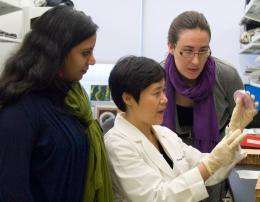
Researchers at Washington University School of Medicine have found new evidence that estrogen levels may affect risk of urinary tract infections. From left are Indira Mysorekar, PhD; Caihong Wang, DVM, PhD; and MD/PhD student Jane Symington. Credit: Michael C. Purdy
(Medical Xpress)—Estrogen levels drop dramatically in menopause, a time when the risk of urinary tract infections increases significantly.
Researchers at Washington University School of Medicine in St. Louis have found new evidence in mice that the two phenomena are connected by more than just timing. If further research confirms these links, boosting estrogen levels may get a second look as an approach for reducing urinary infections in menopausal women.
"Scientists tested estrogen as a treatment for post-menopausal women with urinary tract infections in the 1990s, but the results were either ambiguous or negative," says senior author Indira Mysorekar, PhD, assistant professor of obstetrics and gynecology and of pathology and immunology. "With the mouse model of menopause that we've created, we can more completely understand how estrogen levels affect infection susceptibility, bladder health and the inflammatory response to infection. That should point the way to better treatment strategies."
The findings appear online in Infection and Immunity.
Urinary infections are a significant cause of illness in many women throughout their lives and are particularly prevalent after menopause. The bacteria that cause these infections can spread to the kidney and bloodstream, with the potential for serious complications.
To simulate menopause in mice, scientists surgically remove their ovaries. Like menopausal women, the mice no longer make estrogen.
To rule out the possibility that the stress of surgery affects the risk of urinary tract infections, the researchers conducted the same surgery in other mice but put the ovaries back in, maintaining their ability to make estrogen.
When researchers gave both groups of mice urinary tract infections, the menopausal mice had higher levels of infectious bacteria in their urine. Most of the bacteria came from barrier cells, which line the interior of the bladder. These cells are the first to be infected by the bacteria.
"When the barrier cells are lost, they need to be replaced immediately," Mysorekar says. "In the menopausal mice, we found that this replacement process was stopping short of completion. That left cells under barrier cells exposed, and they are much more vulnerable to infection."
The menopausal mice had more bacterial reservoirs, which are pockets of infection that may provide a place for the bacteria to hide during antibiotic treatment. After treatment stops, the reservoirs can reseed the infection.
In earlier research, Mysorekar had identified an important regulator of the barrier cell repair process. In the new study, she showed that low estrogen levels disable this regulator.
The bladders of the menopausal mice also had higher levels of immune inflammatory compounds known as cytokines.
"The cytokines caused inflammation that left the bladder in bad shape," Mysorekar says. "It's possible that damage caused by inflammation increases the bacteria's ability to break into bladder tissue and create reservoirs of infection."
In the control mice, which had normal estrogen levels, cytokine levels and inflammatory damage were both significantly lower. When researchers gave the menopausal mice estrogen, their cytokine levels and inflammatory damage also decreased significantly, as did reservoirs of infectious bacteria.
Mysorekar notes that earlier clinical trials of estrogen's usefulness against urinary infection evaluated the treatment's success by tracking levels of bacteria in the urine. The researchers say their new results suggest that bacteria levels alone may not provide a complete picture of estrogen's effectiveness against the infections.
"If we can find ways to look at other aspects of the infectious process in humans, we may find that estrogen is more helpful than we previously realized," Mysorekar says. "We need to look for other indicators, such as cytokines in the urine, to more fully assess estrogen's potential role in treatment."
More information: Wang C, Symington JW, Ma E, Cao B, Mysorekar IU. Estrogenic modulation of uropathogenic Escherichia coli pathogenesis in a murine menopause model. Infection and Immunity, March 2013.
Journal reference:
Infection and Immunity
Provided by
Washington University School of Medicine in St. Louis
-
Discovery helps mice beat urinary tract infections
Jun 18, 2012 |
not rated yet |
0
-
Experimental drug clears chronic urinary infections in mice
Nov 16, 2011 |
not rated yet |
0
-
Study examines new treatment for recurrent urinary tract infections
Apr 15, 2011 |
not rated yet |
0
-
Strep steps up in urinary tract infections
Apr 23, 2010 |
not rated yet |
0
-
Immune overreaction may enable recurrent urinary tract infections
Aug 12, 2010 |
not rated yet |
0
-
Motion perception revisited: High Phi effect challenges established motion perception assumptions
Apr 23, 2013 |
3 / 5 (2) |
2
-
Anything you can do I can do better: Neuromolecular foundations of the superiority illusion (Update)
Apr 02, 2013 |
4.5 / 5 (11) |
5
-
The visual system as economist: Neural resource allocation in visual adaptation
Mar 30, 2013 |
5 / 5 (2) |
9
-
Separate lives: Neuronal and organismal lifespans decoupled
Mar 27, 2013 |
4.9 / 5 (8) |
0
-
Sizing things up: The evolutionary neurobiology of scale invariance
Feb 28, 2013 |
4.8 / 5 (10) |
14
-
Question of reflection and transmission of TEM wave in normal incidenc
6 hours ago
-
the rudyak-krasnolutski effective potencial
7 hours ago
-
Normal force for a lever model
8 hours ago
-
gravity is std. therefore can we rate a 'mass at height' by watts?
13 hours ago
-
Calculating on-axis elements of a solenoid
May 22, 2013
-
latitude & longitude & air pressure
May 22, 2013
- More from Physics Forums - Classical Physics
More news stories
Vaccine blackjack: IL-21 critical to fight against viral infections
(Medical Xpress)—Scientists at Emory Vaccine Center have shown that an immune regulatory molecule called IL-21 is needed for long-lasting antibody responses in mice against viral infections.
Immunology
14 hours ago |
5 / 5 (1) |
0
|
Fast-acting mothers' milk for healthier babies
Human breastmilk responds quickly to protect the child when there is an infection in mothers or babies, according to new international research led by The University of Western Australia.
Immunology
15 hours ago |
5 / 5 (1) |
0
New immune system discovered
(Medical Xpress)—A research team, led by Jeremy Barr, a biology post-doctoral fellow, unveils a new immune system that protects humans and animals from infection.
Immunology
May 20, 2013 |
4.8 / 5 (26) |
8
|
Vitamin D could provide new and effective treatments for asthma
(Medical Xpress)—Scientists at King's College London have discovered that Vitamin D has the potential to significantly reduce the symptoms of asthma. The study, led by Professor Catherine Hawrylowicz from ...
Immunology
May 20, 2013 |
5 / 5 (1) |
0
|
Immune protein could stop diabetes in its tracks
Melbourne researchers have identified an immune protein that has the potential to stop or reverse the development of type 1 diabetes in its early stages, before insulin-producing cells have been destroyed.
Immunology
May 20, 2013 |
5 / 5 (5) |
0
|
Controlling mood through the motions of mitochondria
(Medical Xpress)—Regulating the distribution of power in neurons is done by a system that makes the national electric grid look simple by comparison. Each neuron has several thousand mitochondria confined ...
Multiple research teams unable to confirm high-profile Alzheimer's study
Teams of highly respected Alzheimer's researchers failed to replicate what appeared to be breakthrough results for the treatment of this brain disease when they were published last year in the journal Science.
Scientists discover molecule triggers sensation of itch
Scientists at the National Institutes of Health report they have discovered in mouse studies that a small molecule released in the spinal cord triggers a process that is later experienced in the brain as ...
Motion quotient: IQ predicted by ability to filter motion (w/ video)
A brief visual task can predict IQ, according to a new study. This surprisingly simple exercise measures the brain's unconscious ability to filter out visual movement. The study shows that individuals whose ...
Researchers find common childhood asthma unconnected to allergens or inflammation
Little is known about why asthma develops, how it constricts the airway or why response to treatments varies between patients. Now, a team of researchers at Weill Cornell Medical College, Columbia University Medical Center ...
Diabetes' genetic underpinnings can vary based on ethnic background, studies say
Ethnic background plays a surprisingly large role in how diabetes develops on a cellular level, according to two new studies led by researchers at the Stanford University School of Medicine.