Immune cell suicide alarm helps destroy escaping bacteria
January 24, 2013 in Immunology

Immune cell suicide alarm helps destroy escaping bacteria

Enlarge

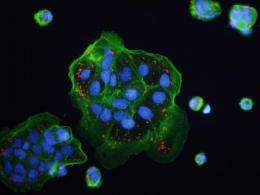
Shown in red are bacteria that have invaded host cells and escaped into the interior cytosolic compartment of the cell. Credit: Miao lab, UNC School of Medicine

Cells in the immune system called macrophages normally engulf and kill intruding bacteria, holding them inside a membrane-bound bag called a vacuole, where they kill and digest them.

Some bacteria thwart this effort by ripping the bag open and then escaping into the macrophage's nutrient-rich cytosol compartment, where they divide and could eventually go on to invade other cells.

But research from the University of North Carolina School of Medicine shows that have a suicide alarm system, a signaling to detect this escape into the cytosol. The pathway activates an enzyme, called caspase-11, that triggers a program in the macrophage to destroy itself.

"It's almost like a thief sneaking into the house not knowing an alarm will go off to knock down the walls and expose him to capture by the police," says study senior and corresponding author Edward Miao, PhD, assistant professor of microbiology and immunology at UNC. "In the macrophage, this , called pyroptosis, expels the from the cell, exposing it to other immune defense mechanisms."

A report of the research appears online in the journal Science on Thursday January 24, 2013.

Miao, also a member of the UNC Lineberger Comprehensive Cancer Center, says the new findings show that having this detection pathway protects mice from lethal infection with the type of vacuole-escaping species: B. thailandensis and B. pseudomallei.

Both are close relatives. But they differ in lethality. B. pseudomallei is potentially a . Used in a spray, it could potentially infect people via aerosol route, causing sickness and death. Moreover, it also could fall into a latent phase, "essentially turning into a 'sleeper' inside the lungs and hiding there for decades," Miao explains. In contrast, B. thailandensis, which shares many properties with its species counterpart, is not normally able to cause any disease or infection

These are ubiquitous throughout S.E. Asia, and were it not for the caspase-11 pathway defense system, that part of the world could be uninhabitable, Miao points out.

This grim possibility clearly emerged in the study. Mice that lack the caspase-11 detection pathway succumb to infection not only by B. pseudomallei, but also to the normally benign B. thailandensis. "Thus caspase-11 is critical for surviving exposure to ubiquitous environmental pathogens," the authors conclude.

Miao points to research elsewhere showing that the pathway's abnormal activation in people with septic shock, overwhelming bacterial infection of the blood, is associated with death. "We discovered what the pathway is supposed to do, which may help find ways to tone it down in people with that critical condition.

As to bioterrorism, the researcher says it may be possible to use certain drugs already on the market that safely induce the caspase-11 pathway. "Since this pathway requires pre-stimulation with interferon cytokines, it is conceivable that pre-treating people with interferon drugs could ameliorate a bioterror incident. This could be quite important in the case of Burkholderia, since these bacteria are naturally resistant to numerous antibiotics.

"But first we have to find out if they would work in animal models, and consider the logistics of interferon stockpiling, which are currently cost prohibitive."

More information: "Caspase-11 Protects Against Bacteria That Escape the Vacuole", Science, 2013.

Journal reference: Science search and more info website

Provided by University of North Carolina Health Care search and more info website

4.5 /5 (2 votes)  

Filter


Move the slider to adjust rank threshold, so that you can hide some of the comments.


Display comments: newest first

Vsha
Jan 25, 2013

Rank: 5 / 5 (1)
"It's almost like a thief sneaking into the house not knowing an alarm will go off to knock down the walls and expose him to capture by the police," - A better analogy is that the alarm triggers an explosion that kills the thief and destroys the house he came to burgle.
Rank 4.5 /5 (2 votes)
Relevant PhysicsForums posts

More news stories

Pollen count apps for smartphones are nothing to sneeze at

Kate O'Reilly's spring allergy survival kit includes the usual stuff - nasal sprays, allergy pills and a box of tissues. This season, she's added a new weapon to her line of defense: an app on her smartphone.

Immunology created 20 hours ago | popularity not rated yet | comments 0

Going live: Immune cell activation in multiple sclerosis

Biological processes are generally based on events at the molecular and cellular level. To understand what happens in the course of infections, diseases or normal bodily functions, scientists would need to ...

Immunology created 22 hours ago | popularity 5 / 5 (5) | comments 0 | with audio podcast

Vaccine blackjack: IL-21 critical to fight against viral infections

(Medical Xpress)—Scientists at Emory Vaccine Center have shown that an immune regulatory molecule called IL-21 is needed for long-lasting antibody responses in mice against viral infections.

Immunology created May 23, 2013 | popularity 5 / 5 (2) | comments 0 | with audio podcast

Fast-acting mothers' milk for healthier babies

Human breastmilk responds quickly to protect the child when there is an infection in mothers or babies, according to new international research led by The University of Western Australia.

Immunology created May 23, 2013 | popularity 5 / 5 (1) | comments 0

New immune system discovered

(Medical Xpress)—A research team, led by Jeremy Barr, a biology post-doctoral fellow, unveils a new immune system that protects humans and animals from infection.

Immunology created May 20, 2013 | popularity 4.8 / 5 (30) | comments 9 | with audio podcast


First drug to improve heart failure mortality in over a decade

Coenzyme Q10 decreases all cause mortality by half, according to the results of a multicentre randomised double blind trial presented today at Heart Failure 2013 congress. It is the first drug to improve heart failure mortality ...

Heart failure accelerates male 'menopause'

Heart failure accelerates the aging process and brings on early andropausal syndrome (AS), according to research presented today at the Heart Failure Congress 2013. AS, also referred to as male 'menopause', was four times ...

Hormone levels may provide key to understanding psychological disorders in women

Women at a particular stage in their monthly menstrual cycle may be more vulnerable to some of the psychological side-effects associated with stressful experiences, according to a study from UCL.

Researchers identify first drug targets in childhood genetic tumor disorder

Two mutations central to the development of infantile myofibromatosis (IM)—a disorder characterized by multiple tumors involving the skin, bone, and soft tissue—may provide new therapeutic targets, according to researchers ...

Feds fight morning-after pill age ruling in NY

(AP)—Department of Justice lawyers have again asked a federal appeals court in New York to delay lifting age restrictions and prescription requirements on an emergency contraceptive popularly known as the morning-after ...

Death highest in heart failure patients admitted in January, on Friday, and overnight

Mortality and length of stay are highest in heart failure patients admitted in January, on Friday, and overnight, according to research presented today at the Heart Failure Congress 2013. The analysis of nearly 1 million ...