Magnetically levitated tissues could speed toxicity tests
January 24, 2013 in Medical research
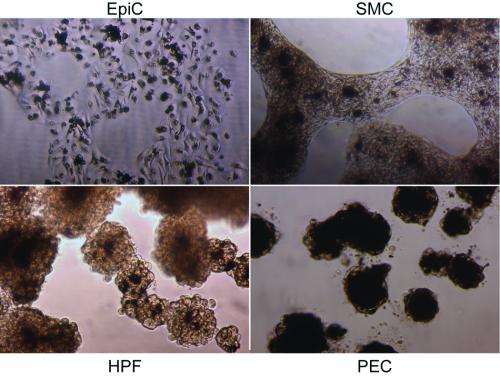
This composite shows 3-D cultures of four types of cells that Rice University scientists combined in vitro to create bronchiole lung tissue. The cells are: epithelial cells (EpiC), smooth muscle cells (SMC), pulmonary fibroblasts (HPF) and pulmonary endothelial cells (PEC). CREDIT: Hubert Tseng/Rice University
In a development that could lead to faster and more effective toxicity tests for airborne chemicals, scientists from Rice University and the Rice spinoff company Nano3D Biosciences have used magnetic levitation to grow some of the most realistic lung tissue ever produced in a laboratory.
The research is part of an international trend in biomedical engineering to create laboratory techniques for growing tissues that are virtually identical to those found in people's bodies. In the new study, researchers combined four types of cells to replicate tissue from the wall of the bronchiole deep inside the lung.
The research is available online and scheduled to appear in a future issue of the journal Tissue Engineering Part C: Methods.
"One of the unique things about the magnetic levitation technology is that it allows us to move cells around and arrange them the way that we want for a particular types of tissue," said study co-author Tom Killian, professor and department chair of physics and astronomy at Rice. "This is the first time anyone has arranged these four cell types in the same way that they are found in lung tissue."
In vitro laboratory tests have historically been conducted on 2-D cell cultures grown in flat petri dishes, but scientists have become increasingly aware that cells in flat cultures sometimes behave and interact differently than cells that are immersed in 3-D tissue.
Killian and fellow scientists from Rice and the University of Texas MD Anderson Cancer Center co-founded Nano3D Biosciences in 2009 after creating a technology that uses magnetism to levitate and grow 3-D cell cultures. The technology relies on inert, nontoxic magnetic nanoparticles that are inserted into the living cells. Researchers can then use magnets to lift and suspend the cells as they grow and divide.
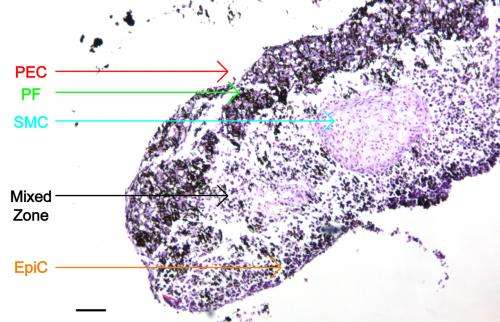
This microscopic image shows the structure and layers of in vitro bronchiole tissue created at Rice University and Nano3D Biosciences. The cell layers include epithelial cells (EpiC), smooth muscle cells (SMC), pulmonary fibroblasts (PF) and pulmonary endothelial cells (PEC). CREDIT: Hubert Tseng/Rice University
"Growing realistic lung tissues in vitro is a particular challenge," said study co-author Jane Grande-Allen, professor of bioengineering at Rice. "There are a number of technical obstacles, and scientific funding agencies have placed a particular emphasis on lung tissue because there's a large potential payoff in terms of reducing costs for pharmaceutical and toxicological testing."
Nano3D Biosciences won a Small Business Innovation Research (SBIR) grant from the National Science Foundation (NSF) in 2011 to create a four-layered lung tissue from endothelial cells, smooth muscle cells, fibroblasts and epithelial cells.
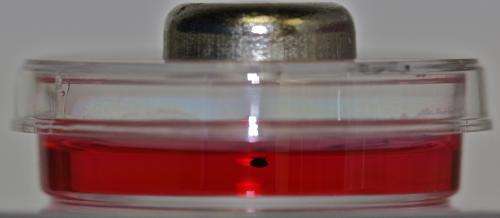
Rice University spinoff company Nano3D Biosciences uses magnetic levitation to grow three dimensional cell cultures. The technology uses inert, nontoxic nanoparticles and magnets to lift and suspend cells as they grow and divide. CREDIT: Nano3D Biosciences
Glauco Souza, the company's chief scientific officer and co-founder, said the project switched into high gear when Rice bioengineering graduate student Hubert Tseng joined the research team as an intern. Tseng was already a student in Grande-Allen's lab, one of Rice's leading laboratories for tissue-engineering research."Hubert's and Jane's expertise in tissue engineering was invaluable for tackling this problem," Souza said.
Another collaboration that paid off big was a partnership with a group of undergraduate students at Rice's Oshman Engineering Design Kitchen. The undergraduate team, Cells in 3-D, worked on a magnetic pen that could be used to grab, move and combine magnetized 3-D cell cultures. Souza said Tseng used a version of this tool to create layered bronchiole tissues for this new study.
Tseng said the new tissue resembles native bronchiole tissue more closely than any other tissue yet created in the lab.
"We conducted a number of tests, and the tissue has the same biochemical signature as native tissue," Tseng said. "We also used primary cells rather than engineered cells, which is important for toxicological testing because primary cells provide the closest possible match to native cells."
Souza said bronchiole tissue could solve another problem that's frequently encountered in testing the toxicity of airborne agents.
"With traditional 2-D cultures, it is very difficult to culture cells at the air-liquid interface, which is what you'd prefer for toxicity testing," he said. "With our technology, we can easily levitate the bronchiole tissue to the air-liquid interface so that airborne toxins are exposed to the epithelial layer of the tissue, just as it would occur in the lungs."
Grande-Allen said Tseng and other members of her group have already used the same methods pioneered in the bronchiole study to produce heart valve tissue; Souza said the NSF has awarded the company with a second phase of SBIR funding to further develop the technique for other types of tissue.
More information: A copy of the paper is available at: online.liebertpub.… EC.2012.0157
Provided by
Rice University
-
3-D cell culture: Making cells feel right at home
Mar 15, 2010 |
not rated yet |
0
-
Three-Dimensional Cell Culture: Making Cells Feel Right at Home
Apr 26, 2010 |
not rated yet |
0
-
US researchers identify first human lung stem cell
May 11, 2011 |
not rated yet |
0
-
Embryonic stem cells used to grow cartilage
Sep 06, 2007 |
not rated yet |
0
-
Tissue engineered scaffolding allows reproduction of cartilage tissue
May 09, 2007 |
not rated yet |
0
-
Motion perception revisited: High Phi effect challenges established motion perception assumptions
Apr 23, 2013 |
3 / 5 (2) |
2
-
Anything you can do I can do better: Neuromolecular foundations of the superiority illusion (Update)
Apr 02, 2013 |
4.5 / 5 (11) |
5
-
The visual system as economist: Neural resource allocation in visual adaptation
Mar 30, 2013 |
5 / 5 (2) |
9
-
Separate lives: Neuronal and organismal lifespans decoupled
Mar 27, 2013 |
4.9 / 5 (8) |
0
-
Sizing things up: The evolutionary neurobiology of scale invariance
Feb 28, 2013 |
4.8 / 5 (10) |
14
-
Why is zone 1 in liver more prone to ischemic injury?
May 23, 2013
-
How can there be villous adenoma in colon, if there are no villi there
May 22, 2013
-
How can there be a term called "intestinal metaplasia" of stomach
May 21, 2013
-
Pressure-volume curve: Elastic Recoil Pressure don't make sense
May 18, 2013
-
If you became brain-dead, would you want them to pull the plug?
May 17, 2013
-
MRI bill question
May 15, 2013
- More from Physics Forums - Medical Sciences
More news stories
Study reveals new mechanism for estrogen suppression of liver lipid synthesis
By discovering the new mechanism by which estrogen suppresses lipid synthesis in the liver, UC Irvine endocrinologists have revealed a potential new approach toward treating certain liver diseases.
Medical research
May 23, 2013 |
5 / 5 (1) |
0
|
MRI-based measurement helps predict vascular disease in the brain
Aortic arch pulse wave velocity, a measure of arterial stiffness, is a strong independent predictor of disease of the vessels that supply blood to the brain, according to a new study published in the June issue the journal ...
Medical research
May 23, 2013 |
not rated yet |
0
Antibiotics: A new understanding of sulfonamide nervous system side effects
Since the discovery of Prontosil in 1932, sulfonamide antibiotics have been used to combat a wide spectrum of bacterial infections, from acne to chlamydia and pneumonia. However, their side effects can include serious neurological ...
Medical research
May 23, 2013 |
not rated yet |
0
|
Scientists discover molecule triggers sensation of itch
Scientists at the National Institutes of Health report they have discovered in mouse studies that a small molecule released in the spinal cord triggers a process that is later experienced in the brain as ...
Medical research
May 23, 2013 |
5 / 5 (3) |
0
|
Discarded immune cells induce the relocation of stem cells
Spanish researchers have discovered that the daily clearance of neutrophils from the body stimulates the release of hematopoietic stem cells from the bone marrow into the bloodstream, according to a report published today ...
Medical research
May 23, 2013 |
5 / 5 (2) |
0
Engineered cytomegalovirus protects monkeys from HIV equivalent
(Medical Xpress)—A new study by researchers in the US has shown that an ancient virus can be modified to help in the fight against the simian immunodeficiency virus SIV, which is the equivalent in monkeys ...
Researchers identify first drug targets in childhood genetic tumor disorder
Two mutations central to the development of infantile myofibromatosis (IM)—a disorder characterized by multiple tumors involving the skin, bone, and soft tissue—may provide new therapeutic targets, according to researchers ...
Hormone levels may provide key to understanding psychological disorders in women
Women at a particular stage in their monthly menstrual cycle may be more vulnerable to some of the psychological side-effects associated with stressful experiences, according to a study from UCL.
Going live: Immune cell activation in multiple sclerosis
Biological processes are generally based on events at the molecular and cellular level. To understand what happens in the course of infections, diseases or normal bodily functions, scientists would need to ...
Help at hand for people with schizophrenia
How can healthy people who hear voices help schizophrenics? Finding the answer for this is at the centre of research conducted at the University of Bergen.
Alzheimer's disease, the soft target of the euthanasia debate
(Medical Xpress)—The way Alzheimer's disease is portrayed by advocacy groups and the media is having undue influence on the euthanasia debate, according to a Deakin University nursing ethics professor.


Jan 24, 2013
Rank: 1 / 5 (1)