Physical education requirement at 4-year universities at all-time low
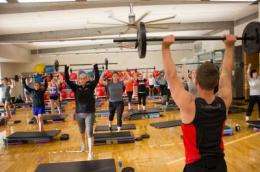
Even as policy makers and health experts point to an increased need for exercise, more than half of four-year colleges and universities in the United States have dropped physical education requirements compared to historic levels.
Almost every U.S. college student was required to take physical education and exercise requirements in the 1920s; today, that number is at an all-time low of 39 percent, according to a new study.
Oregon State University researcher Brad Cardinal, lead author of the study, examined data from 354 randomly selected four-year universities and colleges going back to 1920, a peak year with 97 percent of students required to take physical education. The results are in the current issue of Research Quarterly for Exercise and Sport.
"We see more and more evidence about the benefit of physical activity, not just to our bodies, but to our minds, yet educational institutions are not embracing their own research," Cardinal said. "It is alarming to see four-year institutions following the path that K-12 schools have already gone down, eliminating exercise as part of the curriculum even as obesity rates climb."
More than 34 percent of adolescents and teens ages 12-19 are overweight and more than 17 percent are obese. These rates have roughly doubled since 1980, according to the 2012 Shape of the Nation Report.
Cardinal, who is a professor of exercise and sport science at OSU and a national expert on the benefits of physical activity, said research shows that exercise not only improves human health, but it also improves cognitive performance.
"Brain scans have shown that physical activity improves the area of the brain involved with high-level decision making," he said. "In addition, we know employers often are concerned about employee health, in part because physically active employees attend work more and tend to perform better."
Cardinal's own university, Oregon State University, still requires physical education courses. He said requiring physical education sets the tone for students to understand that being active and healthy is as important as reading, writing and math. Cardinal believes even requiring just one or two exercise courses can at least jump-start a student into thinking about a healthy lifestyle as part of their overall college experience and later life.
"There is a remarkable disconnect in that we fund research as a nation showing that physical activity is absolutely critical to academic and life success, but we aren't applying that knowledge to our own students," he said.
While no research has conclusively shown why this downward trend is happening at universities, Cardinal said it is likely a result of shrinking budgets and an increased focus on purely academic courses, similar to what has happened at public elementary, middle, and high schools.
However, he noted that the median physical education budget for schools in the United States is only $764 per school year in K-12 and 61 percent of physical education teachers report an annual budget of less than $1,000. Yet, obesity will cost the United States $344 billion in medical-related expenses by 2018, about 21 percent of the nation's health-care spending.
While many universities offer recreation classes and fitness centers, Cardinal said, those facilities are often intimidating for first-year, international, and low-fitness or skill-level students. He said studies have shown that campus exercise facilities are often utilized by the healthiest population of the student body.
"The very people who want to work out, and likely would find a way to do so no matter what, are often the most frequent visitors to gyms and fitness centers," Cardinal said. "A public university should provide a way for people who may be intimidated by state-of-the-art facilities, or may be unfamiliar with even the basic concept of working out, a way to learn about basic health and physical activity."
He added that it may be up to researchers and experts in his own discipline of exercise science to turn the tide at universities, and bring the research into a policy arena.
"As health educators and exercise scientists, we need to get serious about our roles in advocating for and using research to bring physical education back to college campuses," Cardinal said. "College isn't too late to start influencing students and getting them on a healthy trajectory."
Spencer Sorensen of Portland State University and Marita Cardinal of Western Oregon University contributed to this study.


