Rainfall, brain infection linked in sub-Saharan Africa
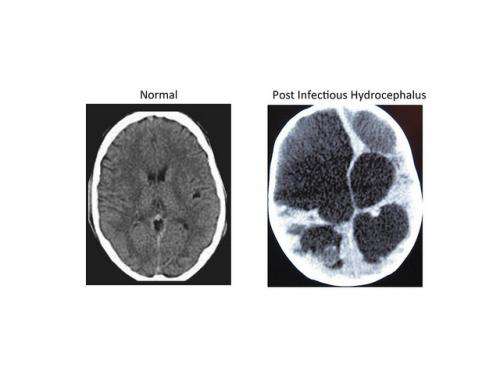
(Medical Xpress)—The amount of rainfall affects the number of infant infections leading to hydrocephalus in Uganda, according to a team of researchers who are the first to demonstrate that these brain infections are linked to climate.
Hydrocephalus—literally "water on the brain"—is characterized by the build-up of the fluid that is normally within and surrounding the brain, leading to brain swelling. The swelling will cause brain damage or death if not treated. Even if treated, there is only a one-third chance of a child maintaining a normal life after post-infectious hydrocephalus develops, and that chance is dependent on whether the child has received the best treatment possible.
"The most common need for a child to require neurosurgery around the world is hydrocephalus," said Steven J. Schiff, the Brush Chair Professor of Engineering, director of the Penn State Center for Neural Engineering and a team member.
In sub-Saharan Africa, upward of 100,000 cases of post-infectious hydrocephalus a year are estimated to occur. The majority of these cases occur after a newborn has suffered from neonatal sepsis, a blood infection that occurs within the first four weeks of life, the researchers reported in a recent issue of the Journal of Neurosurgery: Pediatrics.
Benjamin C. Warf, associate professor of neurosurgery, Harvard Medical School, Boston Children's Hospital, noticed that about three or four months after an infant in East Africa had an infection like neonatal sepsis, the child would often return to the clinic with a rapidly growing head—hydrocephalus. Schiff joined Warf to help figure out what caused this disease so frequently.
Schiff and colleagues tracked 696 hydrocephalus cases in Ugandan infants between the years 2000 and 2005. The researchers obtained localized rainfall data for the same time frame through NOAA (National Oceanic and Atmospheric Administration) weather satellites using the African Rainfall Estimation Algorithm developed at the U.S. NOAA Climate Prediction Center.
Uganda has two peak rainfall seasons, in spring and fall. By comparing the data from NOAA and the hydrocephalus cases, the researchers found that instances of the disorder rose significantly at four different times throughout the year—before and after the peak of each rainy season, when the amount of rainfall was at intermediate levels. In Uganda an intermediate rainfall is about 6 inches of rain per month.
Schiff and colleagues previously noted that different bacteria appear associated with post-infectious hydrocephalus at different seasons of the year. While the researchers have not yet characterized the full spectrum of bacteria causing hydrocephalus in so many infants, they note that environmental conditions affect conditions supporting bacterial growth, and that the amount of rain can quench bacterial infections. The moisture level clearly affects the number of cases of hydrocephalus in this region of East Africa.
"Hydrocephalus is the first major neurosurgical condition linked to climate," said Schiff, who is also professor of neurosurgery, engineering science and mechanics, and physics, and a faculty member of the Huck Institutes of the Life Sciences. "This means that a substantial component of these cases are almost certainly driven from the environmental conditions, and that means they are potentially preventable if we understand the routes and mechanisms of infection better."


