Shifting the balance between good fat and bad fat
January 4, 2013 in Medical research

Shifting the balance between good fat and bad fat

Enlarge

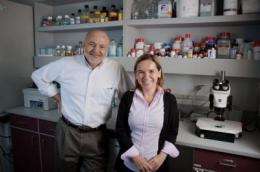
Sanford-Burnham professors Jorge Moscat, Ph.D., and Maria Diaz-Meco, Ph.D., co-authored a study on p62's role in fat metabolism. Credit: Sanford-Burnham Medical Research Institute

In many cases, obesity is caused by more than just overeating and a lack of exercise. Something in the body goes haywire, causing it to store more fat and burn less energy. But what is it? Researchers at Sanford-Burnham Medical Research Institute have a new theory—a protein called p62. According to a study the team published in the Journal of Clinical Investigation, when p62 is missing in fat tissue, the body's metabolic balance shifts—inhibiting "good" brown fat, while favoring "bad" white fat. These findings indicate that p62 might make a promising target for new therapies aimed at curbing obesity.

"Without p62 you're making lots of fat but not burning energy, and the body thinks it needs to store energy," said Jorge Moscat, Ph.D., Sanford-Burnham professor. "It's a ." Moscat led the study with collaborators at Helmholtz Zentrum München in Germany and the University of Cincinnati.

p62 and obesity

Moscat's team had previously produced mice that completely lack the p62 protein everywhere in their bodies. As a result, the animals were obese. They also had . In other words, as compared to mice with p62, mice lacking p62 weighed more, expended less energy, had diabetes and had a hyper- that's characteristic of .

While those results showed that the lack of p62 leads to obesity, "we didn't know which tissue was responsible for these effects, because p62 was missing in all of them," Moscat said.

Some researchers believe that , where energy is expended, controls obesity. Others suspect the liver is a key player, or that the brain's center is most responsible for obesity.

But then there's fat itself—both white fat and brown fat. White fat is the type we think of as unwanted body fat. Brown fat, on the other hand, is beneficial because it burns calories. Many researchers now believe that brown fat somehow malfunctions in obesity, but the details are unclear.

p62 shifts the balance between white fat and brown fat

In their latest study, Moscat and colleagues set out to pinpoint the specific tissue responsible for obesity when p62 is missing. They made several different mouse models, each missing p62 in just one specific organ system, such as the central nervous system, the liver, or muscle. In every case, the mice were normal. They weren't obese like the mice lacking p62 everywhere.

Then they made a mouse model lacking p62 only in their fat tissue. These mice were obese, just like the mice missing p62 in all tissues. Upon further study, the researchers found that p62 blocks the action of an enzyme called ERK while activating another enzyme called p38. When p62 is missing, the enzyme p38 is less active in brown fat, while ERK is more active in white fat. As a result, Moscat said, p62 is "a master regulator" in normal fat metabolism.

According to Moscat, the discovery of p62's role in tissue is encouraging, because fat tissue is much more accessible than other parts of the body—the brain, for example—for potential drug therapies. "This makes it easier to think about new strategies to control obesity," he said.

New methods for preventing or treating obesity, a major epidemic in the United States, are urgently needed. Drug therapies designed to minimize the intake of food have had limited success and also produce considerable side effects.

Journal reference: Journal of Clinical Investigation search and more info website

Provided by Sanford-Burnham Medical Research Institute search and more info website

5 /5 (4 votes)  

Rank 5 /5 (4 votes)
Relevant PhysicsForums posts

More news stories

Now we know why old scizophrenia medicine works on antibiotics-resistant bacteria

In 2008 researchers from the University of Southern Denmark showed that the drug thioridazine, which has previously been used to treat schizophrenia, is also a powerful weapon against antibiotic-resistant bacteria such as ...

Medical research created May 17, 2013 | popularity 3.7 / 5 (3) | comments 0 | with audio podcast

SUMO wrestling cells reveal new protective mechanism target for stroke

Scientists investigating the interaction of a group of proteins in the brain responsible for protecting nerve cells from damage have identified a new target that could increase cell survival.

Medical research created May 17, 2013 | popularity 5 / 5 (1) | comments 0

How serotonin receptors can shape drug effects, from LSD to migraine medication

New findings by researchers carrying out experiments at the U.S. Department of Energy Office of Science's Advanced Photon Source (APS) help explain why some drugs that interact with two kinds of human serotonin ...

Medical research created May 17, 2013 | popularity not rated yet | comments 0 | with audio podcast

Preventing blood poisoning

Peptide molecules derived from the body's natural immune system can help boost the body's defence against life-threatening blood poisoning, joint University research has uncovered.

Medical research created May 17, 2013 | popularity 4 / 5 (1) | comments 0 | with audio podcast

New mechanism to prevent type 2 diabetes in obese individuals

A new Montréal study conducted by Dr. May Faraj, associate research professor at the Université de Montréal and invited scientist at the IRCM, along with her research team and medical collaborators, shows ...

Medical research created May 17, 2013 | popularity not rated yet | comments 0 | with audio podcast


New research identifies risks, interventions for children's GI health

An increasing number of U.S. children are experiencing gastrointestinal issues that require interventions to resolve, according to research presented at Digestive Disease Week (DDW).

US psychiatry gets makeover in new manual

The latest makeover to a massive psychiatric tome honored by some, reviled by others and even called the "Bible" of mental disorders is being released Saturday with a host of new changes.

New case of SARS-like virus in Saudi: ministry

A new case of the deadly coronavirus has been detected in Saudi Arabia where 15 people have already died after contracting it, the health ministry announced on Saturday on its Internet website.

AIDS science at 30: 'Cure' now part of lexicon

Big names in medicine are set to give an upbeat assessment of the war on AIDS on Tuesday, 30 years after French researchers identified the virus that causes the disease.

For combat veterans suffering from post-traumatic stress disorder, 'fear circuitry' in the brain never rests

Chronic trauma can inflict lasting damage to brain regions associated with fear and anxiety. Previous imaging studies of people with post-traumatic stress disorder, or PTSD, have shown that these brain regions can over-or ...

New colonoscope provides ground-breaking view of colon

A ground-breaking advance in colonoscopy technology signals the future of colorectal care, according to research presented today at Digestive Disease Week(DDW). Additional research focuses on optimizing the minimal withdrawal ...