Study shows one in three children with MS has cognitive impairment
February 6, 2013 in Neuroscience
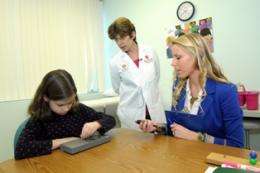
Dr. Lauren Krupp, center, and research coordinator Dana Serafin of the Lourie Center for Pediatric Multiple Sclerosis, administer the grooved peg board test, a measure of fine motor speed and coordination, part of a battery to test the cognitive abilities of patients.
(Medical Xpress)—Data from the largest multicenter study accessing cognitive functioning in children with multiple sclerosis (MS) reveals that one-third of these patients have cognitive impairment, according to a research paper published in the Journal of Child Neurology. Led by Lauren B. Krupp, MD, Director of the Lourie Center for Pediatric Multiple Sclerosis at Stony Brook Long Island Children's Hospital, the study indicates that patients experience a range of problems related to cognition.
In "Cognitive Impairment Occurs in Children and Adolescents with Multiple Sclerosis: Results from a United States Network," Dr. Krupp and colleagues from Stony Brook and five other national Pediatric MS Centers of Excellence measured the cognitive functioning of 187 children and adolescents with MS, and 44 who experienced their first neurologic episode (clinically isolated syndrome) indicative of MS. They found that 35 percent of the patients with MS and 18 percent of those with clinically isolated syndrome met criteria for cognitive impairment. All patients were under age 18 with an average disease duration of about two years.
"This study is important because it represents the largest study to date to apply a comprehensive neuropsychological battery of tests to evaluate the cognitive functioning of children with MS, and the results clearly show us that cognitive issues are widespread and can occur early on in the disease course of these patients," said Dr. Krupp, also a Professor of Neurology at Stony Brook University School of Medicine. "These are critically important findings that emphasize the need for prompt recognition of our patients' cognitive problems and for neurologists and other MS specialists to discover ways to intervene and help improve the cognitive abilities of these children while they are in school and beyond."
This video is not supported by your browser at this time.
The authors report that the network of Pediatric MS Centers of Excellence used a comprehensive battery of 11 tests where the scores addressed cognitive domains such as general ability, reading and language, attention, working memory and speed processing, executive functioning, verbal learning and recall, visual-motor integration, and fine motor speed and coordination. The testing took approximately 2.5 hours to complete, and a participant was considered impaired when the proportion of impaired scores from the categorized tests was greater than one-third.They found that the most frequent areas of impairment were fine motor coordination (54 percent), visual-motor integration (50 percent), and speeded information processing (35 percent). Among the various tests that showed the most frequent rate of impairment were the grooved peg board, a measure of fine motor speed and coordination, and a test for visual-motor integration, a measure that is dependent in part on fine motor coordination.
The researchers factored in clinical variables in the analysis, including disease duration, diagnosis status, age of disease onset, and disability. They found that a diagnosis of MS and overall neurologic disability were the only two independent predictors of cognitive impairment.
They also factored in sociodemographic variables such as age, gender and ethnicity, and leveraged the geographic diversity of the Pediatric Multiple Sclerosis Centers of Excellence network to create the sample. Centers participating in the study included: the Lourie Center for Pediatric Multiple Sclerosis at Stony Brook; the University of California, San Francisco; University of Alabama, Birmingham; the Jacobs Neurological Institute, SUNY Buffalo; Massachusetts General Hospital in Boston, and the Mayo Clinic in Rochester, Minn.
The authors point out that the next step for pediatric MS investigators within the network is to further the research "to develop strategies for prompt identification of children with multiple sclerosis at risk for cognitive problems so that treatment can be initiated."
More information: jcn.sagepub.com/co… 102.abstract
Provided by
Stony Brook University
-
Gingko biloba does not improve cognition in MS patients, study finds
Sep 14, 2012 |
not rated yet |
0
-
Researchers offer insight into cognitive changes in multiple sclerosis
Oct 10, 2012 |
not rated yet |
0
-
Study finds twenty percent of children with MS don't respond to first-line treatment
Jan 26, 2011 |
not rated yet |
0
-
Low Vitamin D Levels Are Related to MS Brain Atrophy, Cognitive Function, Studies Show
Apr 28, 2010 |
not rated yet |
0
-
Marijuana use may hurt intellectual skills in MS patients
Mar 28, 2011 |
not rated yet |
0
-
Motion perception revisited: High Phi effect challenges established motion perception assumptions
Apr 23, 2013 |
3 / 5 (2) |
2
-
Anything you can do I can do better: Neuromolecular foundations of the superiority illusion (Update)
Apr 02, 2013 |
4.5 / 5 (11) |
5
-
The visual system as economist: Neural resource allocation in visual adaptation
Mar 30, 2013 |
5 / 5 (2) |
9
-
Separate lives: Neuronal and organismal lifespans decoupled
Mar 27, 2013 |
4.9 / 5 (8) |
0
-
Sizing things up: The evolutionary neurobiology of scale invariance
Feb 28, 2013 |
4.8 / 5 (10) |
14
-
Pressure-volume curve: Elastic Recoil Pressure don't make sense
10 hours ago
-
If you became brain-dead, would you want them to pull the plug?
May 17, 2013
-
MRI bill question
May 15, 2013
-
Ratio of Hydrogen of Oxygen in Dessicated Animal Protein
May 13, 2013
-
Alcohol and acetaminophen
May 13, 2013
-
Marie Curie's leukemia
May 13, 2013
- More from Physics Forums - Medical Sciences
More news stories
For combat veterans suffering from post-traumatic stress disorder, 'fear circuitry' in the brain never rests
Chronic trauma can inflict lasting damage to brain regions associated with fear and anxiety. Previous imaging studies of people with post-traumatic stress disorder, or PTSD, have shown that these brain regions can over-or ...
Neuroscience
12 hours ago |
5 / 5 (1) |
0
|
Temporal processing in the olfactory system
The neural machinery underlying our olfactory sense continues to be an enigma for neuroscience. A recent review in Neuron seeks to expand traditional ideas about how neurons in the olfactory bulb might encode information about ...
Neuroscience
23 hours ago |
not rated yet |
0
|
Melon focus headband turns to Kickstarter for rollout plans
(Medical Xpress)—What if the quality of your work depends more on your focus on the piano keys or canvas or laptop than your musical or painting or computing skills? If target users can be convinced, they ...
Neuroscience
May 17, 2013 |
3.7 / 5 (3) |
0
|
Deep brain stimulation: A fix when the drugs don't work
Neurological disorders can have a devastating impact on the lives of sufferers and their families.
Neuroscience
May 17, 2013 |
5 / 5 (1) |
0
|
Brain makes call on which ear is used for cell phone
If you're a left-brain thinker, chances are you use your right hand to hold your cell phone up to your right ear, according to a newly published study from Henry Ford Hospital in Detroit.
Neuroscience
May 16, 2013 |
2 / 5 (2) |
0
|
New research identifies risks, interventions for children's GI health
An increasing number of U.S. children are experiencing gastrointestinal issues that require interventions to resolve, according to research presented at Digestive Disease Week (DDW).
US psychiatry gets makeover in new manual
The latest makeover to a massive psychiatric tome honored by some, reviled by others and even called the "Bible" of mental disorders is being released Saturday with a host of new changes.
New case of SARS-like virus in Saudi: ministry
A new case of the deadly coronavirus has been detected in Saudi Arabia where 15 people have already died after contracting it, the health ministry announced on Saturday on its Internet website.
New colonoscope provides ground-breaking view of colon
A ground-breaking advance in colonoscopy technology signals the future of colorectal care, according to research presented today at Digestive Disease Week(DDW). Additional research focuses on optimizing the minimal withdrawal ...
AIDS science at 30: 'Cure' now part of lexicon
Big names in medicine are set to give an upbeat assessment of the war on AIDS on Tuesday, 30 years after French researchers identified the virus that causes the disease.
Now we know why old scizophrenia medicine works on antibiotics-resistant bacteria
In 2008 researchers from the University of Southern Denmark showed that the drug thioridazine, which has previously been used to treat schizophrenia, is also a powerful weapon against antibiotic-resistant bacteria such as ...