How chronic pain disrupts short term memory
February 7, 2013 in Neuroscience
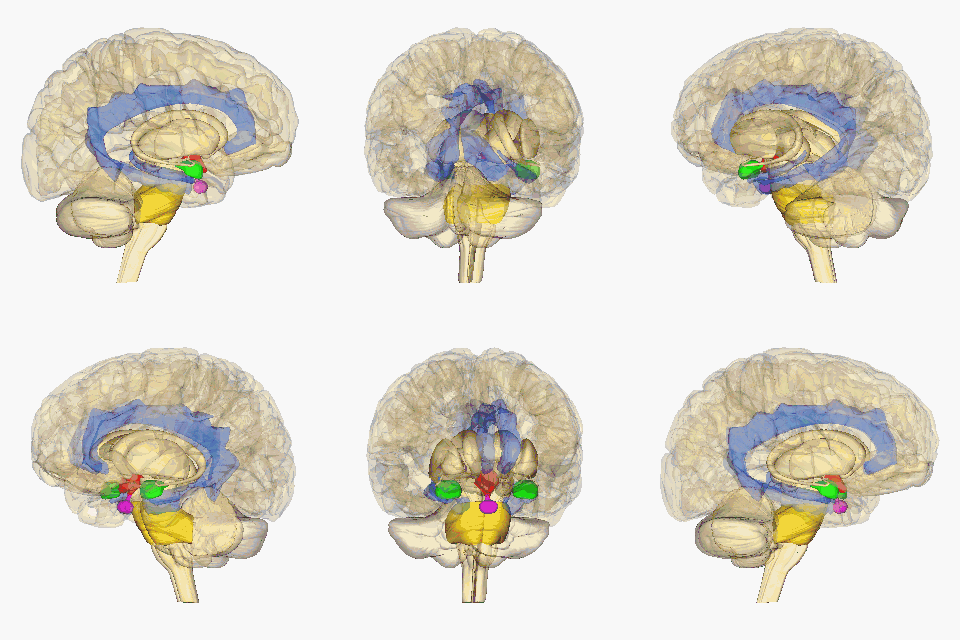
Human brain (hypothalamus=red, amygdala=green, hippocampus/fornix=blue, pons=gold, pituitary gland=pink. Credit: BrianMSweis
A group of Portuguese researchers from IBMC and FMUP at the University of Porto has found the reason why patients with chronic pain often suffer from impaired short –term memory. The study, to be published in the Journal of Neuroscience, shows how persistent pain disrupts the flow of information between two brain regions crucial to retain temporary memories.
Chronic pain suffers often complain of short term memory's problems. The neural mechanisms why this occurs are however not understood. Recent studies in animals showed that pain can disturb several cognitive processes as well as change the brain pathways for how we think and feel. Of the many cognitive disturbances observed the most important include problems in spatial memory, recognition memory, attention and even emotional and non-emotional decisions.
In the new article the team of researchers from the University of Porto led by Vasco Gallardo describes in a rat model of neuropathic pain how a neuronal circuit crucial for the processing of short-term memory is affected by pain. The circuit, established between the prefrontal cortex and the hippocampus, is essential for encoding and retaining temporary memories on spatial information. The researchers used multi-electrodes implanted in the brain to record neuronal activity during a behaviour dependent of spatial memory - the animals were trained in a maze where they had to choose between two alternative paths and then asked to recall their chosen path.
The results show that after a painful injury there is a significant reduction in the amount of information that passes through the circuit. This could mean a loss of ability to process information on spatial localization memory, or that those regions critical to memory are now "overwhelmed" by the painful stimuli disrupting the flow of information for memory.
According to Vasco Gallardo, the team " has already demonstrated that peripheral nerve injury induces an instability in the spatial coding capacity of hippocampus neurons ", where is seen "a clear reduction in their capacity to encode information on the location of the animal."
So to the author "this new work contributes to the demonstration that chronic pain induces alterations in the function of brain circuits that are not directly connected to tactile or painful processes". So as a result of chronic pain it is seen that "are also affected neuronal circuits linked to the processing of memories and emotions, what might mean a need for larger and more integrative strategies in the treatment of painful pathologies", says the researcher.
More information: Cardoso-Cruz, H., Lima, D. and Galhardo, V. (2012). Impaired spatial memory performance in a rat model of neuropathic pain is associated with reduced hippocampal-prefrontal cortex connectivity. Journal of Neurosciences.
Journal reference:
Journal of Neuroscience
Provided by
University of Porto
-
Neuron memory key to taming chronic pain
Feb 13, 2012 |
not rated yet |
0
-
Novel approach to chronic pain relief
Dec 02, 2010 |
not rated yet |
0
-
What Zen meditators don't think about won't hurt them
Dec 08, 2010 |
not rated yet |
0
-
Have we met before? Scientists show why the brain has the answer
Aug 04, 2011 |
not rated yet |
0
-
How connections in the brain must change to form memories could help to develop artificial cognitive computers
Nov 07, 2012 |
not rated yet |
0
-
Motion perception revisited: High Phi effect challenges established motion perception assumptions
Apr 23, 2013 |
3 / 5 (2) |
2
-
Anything you can do I can do better: Neuromolecular foundations of the superiority illusion (Update)
Apr 02, 2013 |
4.5 / 5 (11) |
5
-
The visual system as economist: Neural resource allocation in visual adaptation
Mar 30, 2013 |
5 / 5 (2) |
9
-
Separate lives: Neuronal and organismal lifespans decoupled
Mar 27, 2013 |
4.9 / 5 (8) |
0
-
Sizing things up: The evolutionary neurobiology of scale invariance
Feb 28, 2013 |
4.8 / 5 (10) |
14
-
Why is zone 1 in liver more prone to ischemic injury?
May 23, 2013
-
How can there be villous adenoma in colon, if there are no villi there
May 22, 2013
-
How can there be a term called "intestinal metaplasia" of stomach
May 21, 2013
-
Pressure-volume curve: Elastic Recoil Pressure don't make sense
May 18, 2013
-
If you became brain-dead, would you want them to pull the plug?
May 17, 2013
-
MRI bill question
May 15, 2013
- More from Physics Forums - Medical Sciences
More news stories
New neuron formation could increase capacity for new learning, at the expense of old memories
New research presented today shows that formation of new neurons in the hippocampus - a brain region known for its importance in learning and remembering - could cause forgetting of old memories by causing a reorganization ...
Neuroscience
May 24, 2013 |
4 / 5 (4) |
0
Help at hand for people with schizophrenia
How can healthy people who hear voices help schizophrenics? Finding the answer for this is at the centre of research conducted at the University of Bergen.
Neuroscience
May 24, 2013 |
4 / 5 (2) |
2
Japanese research organizations contribute to Human Brain Project
One of the major frontiers of modern science is a comprehensive understanding of the human brain and its functions to guide the development of new technologies in information and communication. In a major announcement for ...
Neuroscience
May 24, 2013 |
3.7 / 5 (3) |
0
Controlling mood through the motions of mitochondria
(Medical Xpress)—Regulating the distribution of power in neurons is done by a system that makes the national electric grid look simple by comparison. Each neuron has several thousand mitochondria confined ...
Neuroscience
May 23, 2013 |
4.9 / 5 (10) |
0
|
Brain uses internal 'average voice' prototype to identify who is talking
(Medical Xpress)—The human brain is able to identify individuals' voices by comparing them against an internal 'average voice' prototype, according to neuroscientists.
Neuroscience
May 23, 2013 |
3.7 / 5 (3) |
3
|
First drug to improve heart failure mortality in over a decade
Coenzyme Q10 decreases all cause mortality by half, according to the results of a multicentre randomised double blind trial presented today at Heart Failure 2013 congress. It is the first drug to improve heart failure mortality ...
Heart failure accelerates male 'menopause'
Heart failure accelerates the aging process and brings on early andropausal syndrome (AS), according to research presented today at the Heart Failure Congress 2013. AS, also referred to as male 'menopause', was four times ...
Seniors more likely to crash when driving with pet, study finds
(HealthDay)—Animals make great companions for senior citizens, but elderly people who always drive with a pet in the car are far more likely to crash than those who never drive with a pet, researchers have ...
New immune system discovered
(Medical Xpress)—A research team, led by Jeremy Barr, a biology post-doctoral fellow, unveils a new immune system that protects humans and animals from infection.
Brain can be trained in compassion, study shows
Until now, little was scientifically known about the human potential to cultivate compassion—the emotional state of caring for people who are suffering in a way that motivates altruistic behavior.
Death highest in heart failure patients admitted in January, on Friday, and overnight
Mortality and length of stay are highest in heart failure patients admitted in January, on Friday, and overnight, according to research presented today at the Heart Failure Congress 2013. The analysis of nearly 1 million ...