Researchers coat spinal polymer implants with bioactive film to improve bonding with bone
February 19, 2013 in Medical research

Researchers coat spinal polymer implants with bioactive film to improve bonding with bone

Enlarge

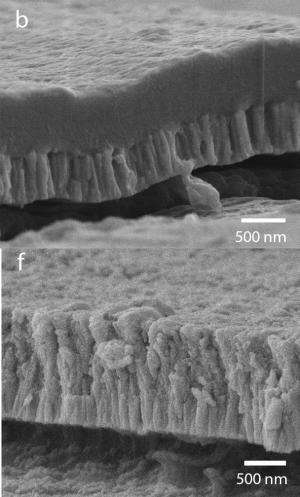
The top scanning electron microscope image (b) shows a cross section of the bioactive hydroxyapatite/YSZ coating without heat treatment. Note how the two layers are distinct. The bottom image (f) shows the coating after heat treatment. Note how the layers are now integrated.

Researchers from North Carolina State University have for the first time successfully coated polymer implants with a bioactive film. The discovery should improve the success rate of such implants – which are often used in spinal surgeries.

The polymer used in these implants, called PEEK, does not bond well with bone or other tissues in the body. This can result in the implant rubbing against surrounding tissues, which can lead to medical complications and the need for additional surgeries.

"We wanted to apply a bioactive coating that would allow the polymer implants to bond with surrounding tissues," says Dr. Afsaneh Rabiei, an associate professor of mechanical and aerospace engineering at NC State and lead author of a paper on the research. "The challenge was that these coatings need to be heated to 500 degrees Celsius, but the melts at 300 C. We've finally solved the problem."

The first step in the new technique coats the implant with a thin film of yttria-stabilized (YSZ). The second step applies a coating of , which is a calcium phosphate that bonds well with bone. The researchers then heat the hydroxyapatite layer using microwaves. The YSZ layer acts as a heat shield, preventing the PEEK from melting. Meanwhile, the heat gives the hydroxyapatite a that makes it more stable in the body, meaning that the will dissolve more slowly – promoting bonding with surrounding bone.

"We have received funding from the National Institutes of Health to proceed with animal testing to fine-tune this technique," Rabiei says. "Then we will move on to clinical testing."

More information: "Processing and Evaluation of bioactive coatings on polymeric implants"

Authors: Afsaneh Rabiei and Stefan Sandukas, North Carolina State University

Published: online Feb. 15 in Journal of Biomedical Materials Research: Part A

Abstract: Polyetheretherketone (PEEK) is a high performance polymer with advantages over metallic biomaterials for application in spinal implants. In this study, hydroxyapatite (HA) coatings were deposited onto PEEK substrates using radio-frequency magnetron sputtering for the purpose of improving bioactivity. An intermediate coating layer of Yttria-Stabilized Zirconia (YSZ) was first deposited onto the PEEK substrates in order to provide heat shielding during subsequent postdeposition heat treatment to prevent degradation of PEEK substrates and coating/substrate interface. Plasma activation of the PEEK substrate surfaces before deposition resulted in a significant increase in coating adhesion strength. Post-deposition heat treatments of microwave and hydrothermal annealing were studied with the goal of forming crystalline HA without the use of high temperatures required in conventional annealing. Microstructural and compositional analysis by scanning electron microscopy and X-ray diffraction revealed that the YSZ layer exhibited a crystalline structure as-deposited, with columnar shaped grains oriented along the growth direction, while the HA layer was shown to be amorphous as-deposited. After microwave annealing, the HA coating exhibited a columnar crystalline microstructure, similar to that of the underlying YSZ crystalline layer; XRD analysis confirmed a crystalline HA phase in the coating. It is suggested that the existence of the crystalline YSZ layer aids in the formation of the HA layer upon heating, possibly lowering the activation energy for crystallization by providing nucleation sites for HA grain formation. Cell culture tests showed a significant increase in initial cell attachment and growth on the microwave-annealed coatings, compared with uncoated PEEK and amorphous HA surfaces.

Provided by North Carolina State University search and more info website

not rated yet  

Rank not rated yet
Relevant PhysicsForums posts

More news stories

Study reveals new mechanism for estrogen suppression of liver lipid synthesis

By discovering the new mechanism by which estrogen suppresses lipid synthesis in the liver, UC Irvine endocrinologists have revealed a potential new approach toward treating certain liver diseases.

Medical research created 19 hours ago | popularity not rated yet | comments 0 | with audio podcast

MRI-based measurement helps predict vascular disease in the brain

Aortic arch pulse wave velocity, a measure of arterial stiffness, is a strong independent predictor of disease of the vessels that supply blood to the brain, according to a new study published in the June issue the journal ...

Medical research created 19 hours ago | popularity not rated yet | comments 0

Antibiotics: A new understanding of sulfonamide nervous system side effects

Since the discovery of Prontosil in 1932, sulfonamide antibiotics have been used to combat a wide spectrum of bacterial infections, from acne to chlamydia and pneumonia. However, their side effects can include serious neurological ...

Medical research created 20 hours ago | popularity not rated yet | comments 0 | with audio podcast

Scientists discover molecule triggers sensation of itch

Scientists at the National Institutes of Health report they have discovered in mouse studies that a small molecule released in the spinal cord triggers a process that is later experienced in the brain as ...

Medical research created 20 hours ago | popularity 5 / 5 (2) | comments 0 | with audio podcast

Discarded immune cells induce the relocation of stem cells

Spanish researchers have discovered that the daily clearance of neutrophils from the body stimulates the release of hematopoietic stem cells from the bone marrow into the bloodstream, according to a report published today ...

Medical research created 22 hours ago | popularity 5 / 5 (2) | comments 0


Saudi to send animal samples to US in coronavirus probe

Saudi Arabia said Friday it would send samples taken from animals possibly infected with a deadly SARS-like virus to the United States for testing in a bid to find the source of disease.

Engineered cytomegalovirus protects monkeys from HIV equivalent

(Medical Xpress)—A new study by researchers in the US has shown that an ancient virus can be modified to help in the fight against the simian immunodeficiency virus SIV, which is the equivalent in monkeys ...

New neuron formation could increase capacity for new learning, at the expense of old memories

New research presented today shows that formation of new neurons in the hippocampus - a brain region known for its importance in learning and remembering - could cause forgetting of old memories by causing a reorganization ...

Are there atheists in foxholes? Study says they're the minority

Ernie Pyle – an iconic war correspondent in World War II – reportedly said "There are no atheists in foxholes." A new joint study between two brothers at Cornell and Virginia Wesleyan found that only ...

Scientists put bowel cancer under the microscope

Researchers from London's Kingston University have begun a two-year study which could help prolong the lives of people with colorectal tumours.

Help at hand for people with schizophrenia

How can healthy people who hear voices help schizophrenics? Finding the answer for this is at the centre of research conducted at the University of Bergen.