Study of cocaine addiction reveals targets for treatment
February 13, 2013 in Neuroscience

UCSB study of cocaine addiction reveals targets for treatment

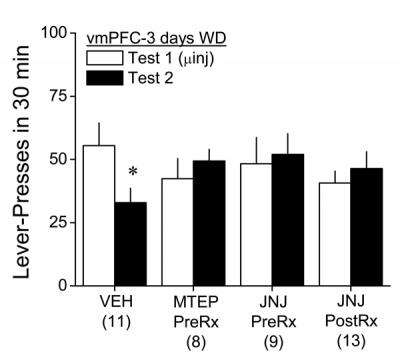
This shows a summary of cocaine-seeking behavior (lever-presses) during 30 minute sessions conducted on Days 3 and 4 of withdrawal (Test1 and 2, respectively) from daily high amounts of IV cocaine. When tested across days, vehicle-induced (VEH) controls exhibit a reduction in cocaine-seeking, indicating extinction. In contrast, rats infused intracranially into the ventromedial prefrontal cortex (vmPFC) with antagonists for mGluR5 (MTEP PreRx) or mGluR1 (JNJ PreRx) prior to Test 1 failed to show this learning. Similarly, rats injected intracranially with the mGluR1 blocker following Test 1 (to influence memory consolidation processes) also failed to exhibit learning. These data indicate that mimicking a cocaine-induced deficit in mGluR1/5 function within this frontal cortical region results in persistent cocaine-seeking behavior, reflecting a deficit in learning and memory processes. Credit: University of California - Santa Barbara

Scientists at UC Santa Barbara are researching cocaine addiction, part of a widespread problem, which, along with other addictions, costs billions of dollars in damage to individuals, families, and society.

Laboratory studies at UCSB have revealed that the diminished and learning impairment that result from can be treated—and that learning can be restored.

Karen Szumlinski, a professor in the Department of Psychological & Brain Sciences at UCSB, and her colleagues Osnat Ben-Shahar and Tod Kippin, have worked in the field of addiction for many years. Senior author of a paper on this topic published recently in The Journal of Neuroscience, Szumlinski is particularly interested in the part of the brain called the prefrontal cortex, where the process of "executive function" –– or decision-making –– is located. This area is involved in directing one's behavior in an appropriate manner, and in controlling behavior.

With her research team, Szumlinski discovered that a drug that stimulates a certain type of glutamate receptor –– when aimed at the prefrontal cortex—could restore learning impairment in rats with simulated cocaine addiction.

"Needless to say, this (the prefrontal cortex) is one of the last parts of the brain to develop, and, of relevance to our students, continues to develop through about age 25 to 28," said Szumlinski.

Szumlinski explained that in the prefrontal cortex there seems to be "hypo-frontality," or reduced functioning, in drug addicts, as well as in patients with a range of neuropsychiatric diseases, including schizophrenia, depression, and attention deficit disorder.

Szumlinski calls the prefrontal cortex a late-developing brain area that is critical for making proper decisions, and inhibiting behavior. "You damage this brain region and you lose the ability to self-regulate, you make impulsive decisions like engaging in risky sexual behavior or drug-taking, you basically go off the deep end in terms of function," she said. "So we were very much interested in how drugs of abuse impact the prefrontal cortex, given that human drug addicts show deficits in this brain area when you put them into a scanner. They show hypo-activity." She said this hypo-activity, or hypo-frontality, might relate to a neurotransmitter that scientists know is involved in exciting the brain.

A key question, according to Szumlinski, is this: "Was that hypo-frontality there in the first place, and that's why they became an addict; or did the drugs change their prefrontal cortext, to cause it to become hypo-functioning and thus they're not able to control their drug use? You can't parse that out in humans. So that's why we turn then to animal models of the disorder, and we do have this rat model that we use in the paper."

Szumlinski pointed out a key difficulty in the development of treatments for addiction: There is little money targeted to the study of this disease. Hence, in addition to studying the mechanisms that are involved, she is joining forces with researchers who study other neurological diseases that are well-funded, to help find cures. She hopes that government approval of new drugs for these other diseases would eventually make the drugs available for clinical trials to study their effects on cocaine addiction.

Szumlinski cited statistics, calculated by scientists M.K. Bird and A.J. Lawrence of Australia, indicating that addiction can cost up to 3.5 percent of gross domestic product in Western countries, equaling $485 billion in the U.S. in 2007. In that year, addiction research received less than 2 percent of public and private funding of all cancer research.

Journal reference: Journal of Neuroscience search and more info website

Provided by University of California - Santa Barbara search and more info website

not rated yet  

Rank not rated yet
Relevant PhysicsForums posts

More news stories

Neurons that can multitask greatly enhance the brain's computational power, study finds

Over the past few decades, neuroscientists have made much progress in mapping the brain by deciphering the functions of individual neurons that perform very specific tasks, such as recognizing the location ...

Neuroscience created 47 minutes ago | popularity not rated yet | comments 0 | with audio podcast

For combat veterans suffering from post-traumatic stress disorder, 'fear circuitry' in the brain never rests

Chronic trauma can inflict lasting damage to brain regions associated with fear and anxiety. Previous imaging studies of people with post-traumatic stress disorder, or PTSD, have shown that these brain regions can over-or ...

Neuroscience created May 18, 2013 | popularity 5 / 5 (1) | comments 0 | with audio podcast

Temporal processing in the olfactory system

The neural machinery underlying our olfactory sense continues to be an enigma for neuroscience. A recent review in Neuron seeks to expand traditional ideas about how neurons in the olfactory bulb might encode information about ...

Neuroscience created May 17, 2013 | popularity 4 / 5 (1) | comments 0 | with audio podcast report

Melon focus headband turns to Kickstarter for rollout plans

(Medical Xpress)—What if the quality of your work depends more on your focus on the piano keys or canvas or laptop than your musical or painting or computing skills? If target users can be convinced, they ...

Neuroscience created May 17, 2013 | popularity 3.7 / 5 (3) | comments 0 | with audio podcast weblog

Deep brain stimulation: A fix when the drugs don't work

Neurological disorders can have a devastating impact on the lives of sufferers and their families.

Neuroscience created May 17, 2013 | popularity 5 / 5 (1) | comments 0 | with audio podcast


Anabolic steroids may affect future mental health

There is a link between use of anabolic-androgenic steroids and reduced mental health later in life. This is the main conclusion of a new study on elite male strength athletes that researchers from the University of Gothenburg ...

Half time warm-ups boost athletic performance

High-intensity, short duration warm up activities at half time intervals boost athletic performance, a study of soccer players has found.

Youth bullying because of perceived sexual orientation widespread and damaging

(Medical Xpress)—Bullying because of perceived sexual orientation is prevalent among school-aged youths, according to a study led by Donald Patrick, professor of health services at the UW School of Public ...

Study finds improved CPR quality saves lives

(Medical Xpress)—Life-saving CPR has been a foundation of emergency medicine for more than a half century. But researchers at the University of Arizona College of Medicine-Phoenix are continuing to refine the procedure, ...

Team finds mechanism linking key inflammatory marker to cancer

In a new study described in the journal Oncogene, researchers reveal how a key player in cell growth, immunity and the inflammatory response can be transformed into a primary contributor to tumor growth.

New study identifies risk factors for depression among COPD patients

Patients suffering from chronic obstructive pulmonary disease (COPD) typically suffer from depression more frequently than those without COPD, resulting in higher levels of disability and illness and increasing the overall ...