Not all fat is packaged the same way, researchers find
February 15, 2013 in Overweight and Obesity
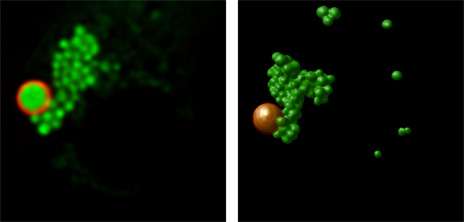
Expanding lipid droplets in cell, and enzymes which trigger expansion in red.
Fat is stored in the body in two distinct ways, Yale researchers have discovered. While the finding may not help people shed excess pounds, it may shed light on how to prevent health problems associated with weight gain.
"We need a better understanding of how cells actually package fat," said Tobias Walther, associate professor of cell biology at Yale and senior author of the study published online Feb. 14 in the journal Developmental Cell. "The cell's inability to process all the excess energy—not the fat itself—is what causes most health problems."
Unused metabolic energy triggers the production of triacylglycerol and the creation of fat in the form of lipid droplets. Mammals have developed specialized fat cells called adipose tissue to store this energy. It is the rapid expansion of these lipid droplets while storing excess calories that cause the bulging waists and thighs that plague dieters. Health problems occur when cells become overwhelmed with lipids and lose their ability to store energy. The result is inflammation, insulin resistance, fatty liver, and other health problems associated with obesity.
The Yale researchers working with Robert Farese at the University of California-San Francisco found that not all lipid droplets are the same. One type of lipid droplet was small and does not expand. A second type of lipid droplet, however, has triacylglycerol enzymes on its surface that allows it to expand.
"Dr. Walther's exciting finding that some lipid droplets can grow while others do not should lead to ways to prevent cells from storing excess fat and possibly to new approaches for treating obesity," said Jean Chin of the National Institutes of Health's National Institute of General Medical Sciences, which partly funded the work.
Walther said that exploring ways to prevent failure of cells' ability to accommodate excess energy may be a more an effective way to tackle the health problems associated with obesity than simply trying to get rid of fat itself.
"Historically, concentrating on just burning fat cells has not worked too well," he said.
Journal reference:
Developmental Cell
Provided by
Yale University
-
Researchers reveal one reason why fat cells fail
Oct 04, 2011 |
not rated yet |
0
-
Experiments suggest research avenues for treating excess fat storage and obesity
Oct 04, 2011 |
not rated yet |
0
-
Gladstone scientists reveal the genetics of fat storage in cells
May 21, 2008 |
not rated yet |
0
-
COPI complex is a regulator of lipid homeostasis
Nov 25, 2008 |
not rated yet |
0
-
Oversized fat droplets: Too much of a good thing
Aug 29, 2012 |
not rated yet |
0
-
Motion perception revisited: High Phi effect challenges established motion perception assumptions
Apr 23, 2013 |
3 / 5 (2) |
2
-
Anything you can do I can do better: Neuromolecular foundations of the superiority illusion (Update)
Apr 02, 2013 |
4.5 / 5 (11) |
5
-
The visual system as economist: Neural resource allocation in visual adaptation
Mar 30, 2013 |
5 / 5 (2) |
9
-
Separate lives: Neuronal and organismal lifespans decoupled
Mar 27, 2013 |
4.9 / 5 (8) |
0
-
Sizing things up: The evolutionary neurobiology of scale invariance
Feb 28, 2013 |
4.8 / 5 (10) |
14
-
Lagrangian of object with air resistance
1 hour ago
-
Does electromagnetic waves are generated by dc current?
1 hour ago
-
Please check what's in the Ulaby book regarding reflection.
6 hours ago
-
Question in reflection and transmission at oblique incidence.
10 hours ago
-
Is this plasma (picture in thread)
10 hours ago
-
Basic physics understanding. Could someone explain?
13 hours ago
- More from Physics Forums - Classical Physics
More news stories
Children of married parents less likely to be obese
Children living in households where the parents are married are less likely to be obese, according to new research from Rice University and the University of Houston.
Overweight and Obesity
May 22, 2013 |
not rated yet |
0
Overeating learned in infancy, study suggests
In the long run, encouraging a baby to finish the last ounce in their bottle might be doing more harm than good.
Overweight and Obesity
May 22, 2013 |
not rated yet |
0
|
Addiction to unhealthy foods could help explain the global obesity epidemic
Research presented today shows that high-fructose corn syrup can cause behavioural reactions in rats similar to those produced by drugs of abuse such as cocaine. These results, presented by addiction expert Francesco Leri, ...
Overweight and Obesity
May 22, 2013 |
4 / 5 (1) |
0
Genetic risk for obesity found in many Mexican young adults
As many as 35 percent of Mexican young adults may have a genetic predisposition for obesity, said a University of Illinois scientist who conducted a study at the Universidad Autónoma de San Luis Potosί.
Overweight and Obesity
May 21, 2013 |
not rated yet |
0
'Doctor shopping' by obese patients negatively affects health
Overweight and obese patients are significantly more likely than their normal-weight counterparts to repeatedly switch primary care doctors, a practice that disrupts continuity of care and leads to more emergency room visits, ...
Overweight and Obesity
May 21, 2013 |
not rated yet |
0
Engineered cytomegalovirus protects monkeys from HIV equivalent
(Medical Xpress)—A new study by researchers in the US has shown that an ancient virus can be modified to help in the fight against the simian immunodeficiency virus SIV, which is the equivalent in monkeys ...
Researchers identify first drug targets in childhood genetic tumor disorder
Two mutations central to the development of infantile myofibromatosis (IM)—a disorder characterized by multiple tumors involving the skin, bone, and soft tissue—may provide new therapeutic targets, according to researchers ...
Hormone levels may provide key to understanding psychological disorders in women
Women at a particular stage in their monthly menstrual cycle may be more vulnerable to some of the psychological side-effects associated with stressful experiences, according to a study from UCL.
Going live: Immune cell activation in multiple sclerosis
Biological processes are generally based on events at the molecular and cellular level. To understand what happens in the course of infections, diseases or normal bodily functions, scientists would need to ...
Help at hand for people with schizophrenia
How can healthy people who hear voices help schizophrenics? Finding the answer for this is at the centre of research conducted at the University of Bergen.
Alzheimer's disease, the soft target of the euthanasia debate
(Medical Xpress)—The way Alzheimer's disease is portrayed by advocacy groups and the media is having undue influence on the euthanasia debate, according to a Deakin University nursing ethics professor.