Iron in new maize strain gets absorbed more readily
February 14, 2013 by Luda Shtessel in Medical research

Iron in new maize strain gets absorbed more readily

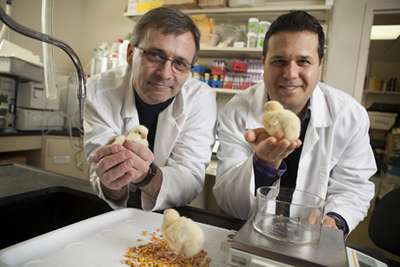
From left, Raymond Glahn and Elad Tako have produced a new maize variety that has more iron bioavailability. Credit: Lindsay France/University Photography

Researchers at Cornell have developed a strain of maize with a high iron bioavailability, meaning more of the iron that is present naturally in these maize lines can be absorbed.

The researchers, all from the U.S. Department of Agriculture - Agricultural Research Service's Robert Holley Center on the Cornell campus, tested more than 100 strains for differences in bioavailability. They did this by introducing simulated digestions of the individual maize strains to cultured human and measuring the iron bioavailability. Using a technique known as quantitative trait loci (QTL) mapping, they correlated this measure with areas of the , which helped guide the maize breeding.

Iron deficiency is the most prevalent nutritional deficiency and cause of anemia in the world. Although boosting the of iron in staple food crops can help, increasing iron concentrations in the crop does not guarantee increased .

"We had two options: to increase the concentration or to increase the bioavailability. Our maize breeder, Dr. Owen Hoekenga [a Cornell molecular biologist], chose to select for iron bioavailability as these regions appeared more easy to isolate," said food scientist Elad Tako, lead author of the study, which was published in the January issue of (12:20).

The results were validated by feeding the new maize, which harbored three QTLs predicted to promote iron bioavailability, to chickens. A diet of maize with high iron bioavailability maintained the iron status of chickens, but chickens fed the low bioavailable iron maize became anemic.

"While the up-front cost of improving the iron quality of is high, the cost of maintaining them is likely less and thus very sustainable," said food scientist Raymond Glahn, the senior author of the study.

As part of the study, the researchers developed techniques to test the results of the cell culture assay in a live animal—in this case, the broiler chicken. Such a model is "cost-effective, easy to handle, sensitive to dietary mineral deficiencies, including iron, and could consume the broad range of staple crops that we plan to test," said Tako.

In the future, the researchers hope to identify QTLs that govern the availability of other vital nutrients in crops. "We have done a lot with beans, lentils, sorghum, wheat—looking into factors that can affect the bioavailability of iron, but we are also interested in zinc bioavailability," said Tako.

"Biofortification of grains with iron and zinc not only gives better nutrition for the consumers but it's also an incentive for the farmers because they promote crop yield. Without that feature, the farmers wouldn't adopt it," said Glahn.

The World Health Organization reports that almost a quarter of the world's population is anemic, with prevalence rates at almost 70 percent in African countries, where maize is an integral part of the diet. "The ultimate game is to take this to an area where the population is iron-deficient," said Glahn, in hopes of curbing anemia.

However, "large-scale feeding studies in humans can be costly ... So before we can plan such a study, we must confirm that our enhanced maize can provide more bioavailable iron to humans. This will involve human volunteers … and would likely be performed here on the Cornell campus," said Glahn.

Journal reference: Nutrition Journal search and more info website

Provided by Cornell University search and more info website

not rated yet  

Rank not rated yet
Related Stories
Relevant PhysicsForums posts

More news stories

Baby's life saved with groundbreaking 3-D printed device that restored his breathing

Every day, their baby stopped breathing, his collapsed bronchus blocking the crucial flow of air to his lungs. April and Bryan Gionfriddo watched helplessly, just praying that somehow the dire predictions ...

Medical research created 10 hours ago | popularity 5 / 5 (2) | comments 0

Research shows how immune system peacefully co-exists with 'good' bacteria

The human gut is loaded with commensal bacteria – "good" microbes that, among other functions, help the body digest food. The gastrointestinal tract contains literally trillions of such cells, and yet the ...

Medical research created 14 hours ago | popularity 5 / 5 (3) | comments 0 | with audio podcast

Slowing the aging process—only with antibiotics

Swiss scientists reveal the mechanism responsible for aging hidden deep within mitochondria—and dramatically slow it down in worms by administering antibiotics to the young.

Medical research created 14 hours ago | popularity 4.9 / 5 (7) | comments 0 | with audio podcast

How healthy are you for your age?

On May 22, JoVE will publish details of a technique to measure the health of human genetic material in relation to a patient's age. The method is demonstrated by the laboratory of Dr. Gil Atzmon at New York's Albert Einste ...

Medical research created 17 hours ago | popularity not rated yet | comments 0

A molecular explanation for age-related fertility decline in women

(Medical Xpress)—Scientists supported by the National Institutes of Health have a new theory as to why a woman's fertility declines after her mid-30s. They also suggest an approach that might help slow ...

Medical research created 19 hours ago | popularity not rated yet | comments 0 | with audio podcast


Rate of bicycle-related fatalities significantly lower in states with helmet laws

Existing research shows that bicyclists who wear helmets have an 88 percent lower risk of brain injury, but researchers at Boston Children's Hospital found that simply having bicycle helmet laws in place showed a 20 percent ...

Researchers complete largest genetic sequencing study of human disease

Researchers from Queen Mary, University of London have led the largest sequencing study of human disease to date, investigating the genetic basis of six autoimmune diseases.

Brain can be trained in compassion, study shows

Until now, little was scientifically known about the human potential to cultivate compassion—the emotional state of caring for people who are suffering in a way that motivates altruistic behavior.

Having both migraines, depression may mean smaller brain

(HealthDay)—Migraines and depression can each cause a great deal of suffering, but new research indicates the combination of the two may be linked to something else entirely—a smaller brain.

Novel approach for influenza vaccination shows promise in early animal testing

A new approach for immunizing against influenza elicited a more potent immune response and broader protection than the currently licensed seasonal influenza vaccines when tested in mice and ferrets. The vaccine ...

Enzyme-activating antibodies revealed as marker for most severe form of rheumatoid arthritis

In a series of lab experiments designed to unravel the workings of a key enzyme widely considered a possible trigger of rheumatoid arthritis, researchers at Johns Hopkins have found that in the most severe ...