Reprogramming cells to fight diabetes
February 22, 2013 in Medical research

Reprogramming cells to fight diabetes

Enlarge

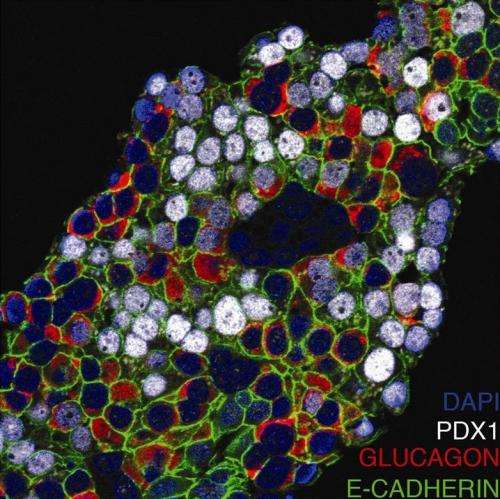
Treatment of human islets with the histone methyltransferase inhibitor Adox results in co-localization of the beta-cell specific transcription factor PDX1 (white) in a substantial sub-population of glucagon-positive cells (red), indicating partial endocrine cell-fate conversion. Credit: Nuria Bramswig, Perelman School of Medicine, University of Pennsylvania

For years researchers have been searching for a way to treat diabetics by reactivating their insulin-producing beta cells, with limited success. The "reprogramming" of related alpha cells into beta cells may one day offer a novel and complementary approach for treating type 2 diabetes. Treating human and mouse cells with compounds that modify cell nuclear material called chromatin induced the expression of beta cell genes in alpha cells, according to a new study that appears online in the Journal of Clinical Investigation.

"This would be a win-win situation for diabetics - they would have more insulin-producing beta cells and there would be fewer glucagon-producing alpha cells," says lead author Klaus H. Kaestner, Ph.D., professor of Genetics and member of the Institute of Diabetes, Obesity and Metabolism, Perelman School of Medicine, University of Pennsylvania. Type 2 diabetics not only lack insulin, but they also produce too much glucagon.

Both type 1 and type 2 diabetes are caused by insufficient numbers of insulin-producing beta cells. In theory, transplantation of healthy – for type 1 diabetics in combination with immunosuppression to control autoimmunity - should halt the disease, yet researchers have not yet been able to generate these cells in the lab at high efficiency, whether from or by reprogramming mature cell types.

Alpha cells are another type of endocrine cell in the pancreas. They are responsible for synthesizing and secreting the peptide hormone glucagon, which elevates glucose levels in the blood.

"We treated human with a chemical that inhibits a protein that puts methyl chemical groups on histones, which - among many other effects - leads to removal of some histone modifications that affect gene expression," says Kaestner. "We then found a high frequency of alpha cells that expressed beta-cell markers, and even produced some insulin, after drug treatment.

Histones are protein complexes around which DNA strands are wrapped in a cell's nucleus.

The team discovered that many genes in alpha cells are marked by both activating- and repressing-histone modifications. This included many genes important in beta-cell function. In one state, when a certain gene is turned off, the gene can be readily activated by removing a modification that represses the histone.

"To some extent human alpha cells appear to be in a 'plastic' epigenetic state," explains Kaestner. "We reasoned we might use that to reprogram towards the beta-cell phenotype to produce these much-needed insulin-producing cells."

Journal reference: Journal of Clinical Investigation search and more info website

Provided by University of Pennsylvania School of Medicine search and more info website

4.5 /5 (8 votes)  

Rank 4.5 /5 (8 votes)
Relevant PhysicsForums posts

More news stories

Now we know why old scizophrenia medicine works on antibiotics-resistant bacteria

In 2008 researchers from the University of Southern Denmark showed that the drug thioridazine, which has previously been used to treat schizophrenia, is also a powerful weapon against antibiotic-resistant bacteria such as ...

Medical research created 18 hours ago | popularity 3.7 / 5 (3) | comments 0 | with audio podcast

SUMO wrestling cells reveal new protective mechanism target for stroke

Scientists investigating the interaction of a group of proteins in the brain responsible for protecting nerve cells from damage have identified a new target that could increase cell survival.

Medical research created 23 hours ago | popularity 5 / 5 (1) | comments 0

How serotonin receptors can shape drug effects, from LSD to migraine medication

New findings by researchers carrying out experiments at the U.S. Department of Energy Office of Science's Advanced Photon Source (APS) help explain why some drugs that interact with two kinds of human serotonin ...

Medical research created May 17, 2013 | popularity not rated yet | comments 0 | with audio podcast

Preventing blood poisoning

Peptide molecules derived from the body's natural immune system can help boost the body's defence against life-threatening blood poisoning, joint University research has uncovered.

Medical research created May 17, 2013 | popularity 4 / 5 (1) | comments 0 | with audio podcast

New mechanism to prevent type 2 diabetes in obese individuals

A new Montréal study conducted by Dr. May Faraj, associate research professor at the Université de Montréal and invited scientist at the IRCM, along with her research team and medical collaborators, shows ...

Medical research created May 17, 2013 | popularity not rated yet | comments 0 | with audio podcast


New research identifies risks, interventions for children's GI health

An increasing number of U.S. children are experiencing gastrointestinal issues that require interventions to resolve, according to research presented at Digestive Disease Week (DDW).

New colonoscope provides ground-breaking view of colon

A ground-breaking advance in colonoscopy technology signals the future of colorectal care, according to research presented today at Digestive Disease Week(DDW). Additional research focuses on optimizing the minimal withdrawal ...

AIDS science at 30: 'Cure' now part of lexicon

Big names in medicine are set to give an upbeat assessment of the war on AIDS on Tuesday, 30 years after French researchers identified the virus that causes the disease.

For combat veterans suffering from post-traumatic stress disorder, 'fear circuitry' in the brain never rests

Chronic trauma can inflict lasting damage to brain regions associated with fear and anxiety. Previous imaging studies of people with post-traumatic stress disorder, or PTSD, have shown that these brain regions can over-or ...

Melon focus headband turns to Kickstarter for rollout plans

(Medical Xpress)—What if the quality of your work depends more on your focus on the piano keys or canvas or laptop than your musical or painting or computing skills? If target users can be convinced, they ...

Temporal processing in the olfactory system

The neural machinery underlying our olfactory sense continues to be an enigma for neuroscience. A recent review in Neuron seeks to expand traditional ideas about how neurons in the olfactory bulb might encode information about ...