New therapy for heart failure may enhance body's stem cell response at cardiovascular injury site
February 21, 2013 in Cardiology
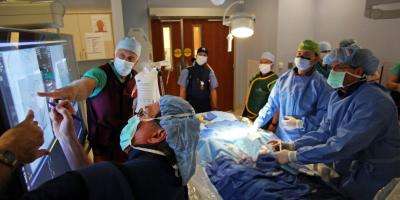
Dr. Leslie Miller (pointing), director of the University of South Florida Heart Institute, confirms the exact location of the catheter tip as an injection map is drawn precisely detailing gene therapy delivery sites in the heart. Credit: Photo by Daniel W. Baker, Florida Hospital Tampa
Cardiovascular disease specialists at Florida Hospital Pepin Heart Institute and Dr. Kiran C. Patel Research Institute affiliated with the University of South Florida announced they have enrolled their first patients into a clinical trial testing a novel gene therapy for the treatment of heart failure after ischemic injury. The therapy may promote the regeneration of heart tissue by encouraging the body to deploy more stem cells to the injury site.
Dr. Charles Lambert, Medical Director of Florida Hospital Pepin Heart Institute and Dr. Leslie Miller, Director of the USF Heart Institute, are leading the way for the randomized, placebo-controlled trial which spans 10 sites across the United States. The study, called the STOP-HF, will enroll 90 patients nationwide.
Heart failure (HF) can occur when the muscles of the heart become weakened and cannot pump blood sufficiently throughout the body. The injury is most often caused by inadequate blood flow to the heart resulting from chronic or acute cardiovascular disease, including heart attacks. Considerable scientific evidence has emerged over the past decade demonstrating the high therapeutic potential of regenerative medicine for a host of diseases. Heart failure is a leading cause of death, disability and hospitalization.
Dr. Charles Lambert is performing the gene therapy by direct injection into the heart using an investigational system in the catheterization laboratories at Florida Hospital Pepin Heart Institute.
"Pepin Heart and Dr. Kiran C. Patel Research Institute and USF are exploring and conducting leading-edge research to develop break-through treatments long before they are even available in other facilities," Dr. Lambert said. "Stem cells have the unique ability to develop into many different cell types, and in many tissues serve as an internal repair system, dividing essentially without limit to replenish other cells. This trial is unique in that it uses gene therapy to turn on a process leading to cell regeneration rather than simply administering stem cells directly."
The Pepin Heart Institute has a history of cardiovascular stem cell research as part of the NIH sponsored Cardiac Cell Therapy Research Network (CCTRN) as well as other active cell therapy trials. Locally, the STOP-HF trial is the first of several regenerative medicine clinical trials teaming the USF Heart Institute with Florida Hospital Pepin Heart Institute, which is adjacent to the USF Health campus.
"This is the beginning of a new era in cardiovascular therapies," said Dr. Leslie Miller, national principal investigator for the STOP-HF trial and professor of cardiovascualar sciences at the USF Health Morsani College of Medicine. "Targeted gene and cell therapies delivered directly into the heart hold promise for helping to regenerate tissue, reduce injury and restore heart function. USF Health, working with our partners, will find new ways to diagnose and treat patients, with the aim of reducing and ultimately harnessing the global impact of heart disease."
The trial, sponsored by Juventas Therapeutics, is a double blind, randomized, placebo-controlled Phase II study evaluating the safety and effectiveness of JVS-100 in patients with ischemic heart failure. JVS-100 is the name of the gene therapy that directs the heart muscle to produce Stromal cell-Derived Factor 1 (SDF-1), a protein that has been shown to repair damaged tissue in the body through the recruitment of circulating stem cells to the site of injury, prevention of ongoing cell death and restoration of blood flow.
Earlier this year, Juventas reported results from its Phase I study in Class III ischemic heart failure patients. In addition to meeting the primary safety endpoint, patients in the study who received the drug demonstrated clinically significant improvements in exercise levels at the 12 month mark.
Other prominent institutions participating in the multicenter trial include Columbia University Medical Center, The University of Utah, the Lindner Center for Research at the Christ Hospital, and the Minneapolis Heart Institute Foundation.
Provided by
University of South Florida
-
Researchers to use patient's own stem cells to treat heart failure
Nov 17, 2008 |
not rated yet |
0
-
Stem cells boost heart's natural repair mechanisms
Jan 30, 2013 |
not rated yet |
0
-
Helping the heart help itself: Research points to new use for stem cells
Apr 08, 2011 |
not rated yet |
0
-
Stem cells to repair damaged heart muscle
Jun 22, 2007 |
not rated yet |
0
-
Cell therapy using patient's own bone marrow may present option for heart disease
Mar 24, 2012 |
not rated yet |
0
-
Motion perception revisited: High Phi effect challenges established motion perception assumptions
Apr 23, 2013 |
3 / 5 (2) |
2
-
Anything you can do I can do better: Neuromolecular foundations of the superiority illusion (Update)
Apr 02, 2013 |
4.5 / 5 (11) |
5
-
The visual system as economist: Neural resource allocation in visual adaptation
Mar 30, 2013 |
5 / 5 (2) |
9
-
Separate lives: Neuronal and organismal lifespans decoupled
Mar 27, 2013 |
4.9 / 5 (8) |
0
-
Sizing things up: The evolutionary neurobiology of scale invariance
Feb 28, 2013 |
4.8 / 5 (10) |
14
-
Learning curve of Electromagnetism?
4 hours ago
-
thin glass in liquid
5 hours ago
-
How many joules expended for a push up?
8 hours ago
-
force to keep the folding doors
8 hours ago
-
Confusion regarding direction of kinetic friction on inclined plane.
9 hours ago
-
Mage hand
15 hours ago
- More from Physics Forums - Classical Physics
More news stories
Free fatty acids linked to cardiac risk in late adulthood
(HealthDay)—Blood levels of free fatty acids are associated with insulin resistance during young adulthood and cardiovascular risk factors in later adulthood, according to a study published online May 13 ...
Cardiology
May 17, 2013 |
not rated yet |
0
|
Diagnosing heart attacks: There's an app for that
An experimental, inexpensive iPhone application transmitted diagnostic heart images faster and more reliably than emailing photo images, according to a research study presented at the American Heart Association's Quality ...
Cardiology
May 17, 2013 |
not rated yet |
0
Study suggests new role for ECMO in treating patients with cardiac arrest and profound shock
Extracorporeal membrane oxygenation (ECMO), a procedure traditionally used during cardiac surgeries and in the ICU that functions as an artificial replacement for a patient's heart and lungs, has also been used to resuscitate ...
Cardiology
May 17, 2013 |
not rated yet |
0
Stroke patients respond similarly to after-stroke care, despite age difference
Age has little to do with how patients should be treated after suffering a stroke, according to new research from the University of Georgia.
Cardiology
May 17, 2013 |
not rated yet |
0
|
Depression linked to almost doubled stroke risk in middle-aged women
Depressed middle-aged women have almost double the risk of having a stroke, according to research published in Stroke: Journal of the American Heart Association.
Cardiology
May 16, 2013 |
not rated yet |
0
New research identifies risks, interventions for children's GI health
An increasing number of U.S. children are experiencing gastrointestinal issues that require interventions to resolve, according to research presented at Digestive Disease Week (DDW).
US psychiatry gets makeover in new manual
The latest makeover to a massive psychiatric tome honored by some, reviled by others and even called the "Bible" of mental disorders is being released Saturday with a host of new changes.
New case of SARS-like virus in Saudi: ministry
A new case of the deadly coronavirus has been detected in Saudi Arabia where 15 people have already died after contracting it, the health ministry announced on Saturday on its Internet website.
AIDS science at 30: 'Cure' now part of lexicon
Big names in medicine are set to give an upbeat assessment of the war on AIDS on Tuesday, 30 years after French researchers identified the virus that causes the disease.
For combat veterans suffering from post-traumatic stress disorder, 'fear circuitry' in the brain never rests
Chronic trauma can inflict lasting damage to brain regions associated with fear and anxiety. Previous imaging studies of people with post-traumatic stress disorder, or PTSD, have shown that these brain regions can over-or ...
New colonoscope provides ground-breaking view of colon
A ground-breaking advance in colonoscopy technology signals the future of colorectal care, according to research presented today at Digestive Disease Week(DDW). Additional research focuses on optimizing the minimal withdrawal ...