Vision restored with total darkness
February 14, 2013 in Neuroscience
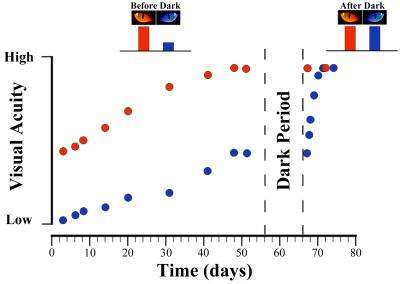
Depriving normal visual experience in one eye early in life produces a reduction in visual acuity (amblyopia) for that eye (blue circles) while the acuity of the other eye is normal (red). The visual acuity of the amblyopic eye remains low compared to the fellow eye, but after immersion in complete darkness the amblyopic eye very quickly recovers to match the visual acuity attained by the normal eye. Credit: Current Biology, Duffy et al.
Restoring vision might sometimes be as simple as turning out the lights. That's according to a study reported on February 14 in Current Biology, a Cell Press publication, in which researchers examined kittens with a visual impairment known as amblyopia before and after they spent 10 days in complete darkness.
Researchers Kevin Duffy and Donald Mitchell of Dalhousie University in Canada believe that exposure to darkness causes some parts of the visual system to revert to an early stage in development, when there is greater flexibility.
"There may be ways to increase brain plasticity and recover from disorders such as amblyopia without drug intervention," Duffy says. "Immersion in total darkness seems to reset the visual brain to enable remarkable recovery."
Amblyopia affects about four percent of the general population and is thought to develop when the two eyes do not see equally well in early life, as the connections from the eyes to visual areas in the brain are still being refined. Left untreated, that imbalance of vision can lead to permanent vision loss.
In the new study, the researchers examined kittens with amblyopia induced by experimentally depriving them of visual input to one eye. After those animals were plunged into darkness, their vision made a profound and rapid recovery. Further examination suggested that the restoration of vision depends on the loss of neurofilaments that hold the visual system in place. With those stabilizing elements gone, the visual system becomes free to correct itself.
Darkness therapy holds promise for the treatment of children with amblyopia, the researchers say, but don't try this at home. They think that the darkness must be absolute to work, with no stray light at any time. It is also important to address the original cause of the amblyopia first, and to ensure that a period of darkness will not harm an individual's good eye.
The researchers are still working out just how much darkness is required, and for how long. Regardless, they say it is unlikely that a drug could ever adequately mimic the effects of darkness that they've seen.
"The advantage of a simple nonpharmacological sensory manipulation, such as a period of darkness, is that it may initiate changes in a constellation of molecules in a beneficial temporal order and in appropriate brain regions," they write.
More information: doi: 10.1016/j.cub.2013.01.017
Journal reference:
Current Biology
Provided by
Cell Press
-
Test allows early detection of vision problems in infants with hemangiomas of eyelids
Apr 01, 2009 |
not rated yet |
0
-
Researchers identify new neurological deficit behind lazy eye
Sep 10, 2010 |
not rated yet |
0
-
Abnormal involuntary eye movements in amblyopia linked to changes in subcortical regions of brain
Oct 16, 2012 |
not rated yet |
0
-
Old eyes can learn new tricks; findings offer hope for adults with 'lazy eye'
Jul 17, 2008 |
not rated yet |
0
-
Lazy eye treatment times could be drastically reduced, new research shows
Dec 09, 2008 |
not rated yet |
0
-
Motion perception revisited: High Phi effect challenges established motion perception assumptions
Apr 23, 2013 |
3 / 5 (2) |
2
-
Anything you can do I can do better: Neuromolecular foundations of the superiority illusion (Update)
Apr 02, 2013 |
4.5 / 5 (11) |
5
-
The visual system as economist: Neural resource allocation in visual adaptation
Mar 30, 2013 |
5 / 5 (2) |
9
-
Separate lives: Neuronal and organismal lifespans decoupled
Mar 27, 2013 |
4.9 / 5 (8) |
0
-
Sizing things up: The evolutionary neurobiology of scale invariance
Feb 28, 2013 |
4.8 / 5 (10) |
14
-
Pressure-volume curve: Elastic Recoil Pressure don't make sense
May 18, 2013
-
If you became brain-dead, would you want them to pull the plug?
May 17, 2013
-
MRI bill question
May 15, 2013
-
Ratio of Hydrogen of Oxygen in Dessicated Animal Protein
May 13, 2013
-
Alcohol and acetaminophen
May 13, 2013
-
Marie Curie's leukemia
May 13, 2013
- More from Physics Forums - Medical Sciences
More news stories
For combat veterans suffering from post-traumatic stress disorder, 'fear circuitry' in the brain never rests
Chronic trauma can inflict lasting damage to brain regions associated with fear and anxiety. Previous imaging studies of people with post-traumatic stress disorder, or PTSD, have shown that these brain regions can over-or ...
Neuroscience
May 18, 2013 |
5 / 5 (1) |
0
|
Temporal processing in the olfactory system
The neural machinery underlying our olfactory sense continues to be an enigma for neuroscience. A recent review in Neuron seeks to expand traditional ideas about how neurons in the olfactory bulb might encode information about ...
Neuroscience
May 17, 2013 |
4 / 5 (1) |
0
|
Melon focus headband turns to Kickstarter for rollout plans
(Medical Xpress)—What if the quality of your work depends more on your focus on the piano keys or canvas or laptop than your musical or painting or computing skills? If target users can be convinced, they ...
Neuroscience
May 17, 2013 |
3.7 / 5 (3) |
0
|
Deep brain stimulation: A fix when the drugs don't work
Neurological disorders can have a devastating impact on the lives of sufferers and their families.
Neuroscience
May 17, 2013 |
5 / 5 (1) |
0
|
Brain makes call on which ear is used for cell phone
If you're a left-brain thinker, chances are you use your right hand to hold your cell phone up to your right ear, according to a newly published study from Henry Ford Hospital in Detroit.
Neuroscience
May 16, 2013 |
2 / 5 (2) |
0
|
Alzheimer's leaves bilingual victims stranded in Canada
The devastating effect of Alzheimer's disease on bilingual people has been thrown into focus in Canada, where the sudden loss of a second language can leave sufferers feeling like strangers in their own country.
'Gap' for HIV vaccine efforts after latest setback
The hunt for an HIV vaccine has gobbled up $8 billion in the past decade, and the failure of the most recent efficacy trial has delivered yet another setback to 26 years of efforts.
Consuming coffee linked to lower risk of detrimental liver disease, study finds
Regular consumption of coffee is associated with a reduced risk of primary sclerosing cholangitis (PSC), an autoimmune liver disease, Mayo Clinic research shows. The findings were being presented at the Digestive Disease ...
Ketamine shows significant therapeutic benefit in people with treatment-resistant depression
Patients with treatment-resistant major depression saw dramatic improvement in their illness after treatment with ketamine, an anesthetic, according to the largest ketamine clinical trial to-date led by researchers from the ...
Research examines new methods for managing digestive health
Research presented at Digestive Disease Week (DDW) explores new methods for managing digestive health through diet and lifestyle.
New smartphone application improves colonoscopy preparation
The use of a smartphone application significantly improves patients' preparation for a colonoscopy, according to new research presented today at Digestive Disease Week (DDW). The preparation process, which begins days in ...
Feb 14, 2013
Rank: not rated yet