Institutional betrayal magnifies post-trauma effects of unwanted sexual activity
March 8, 2013 in Psychology & Psychiatry
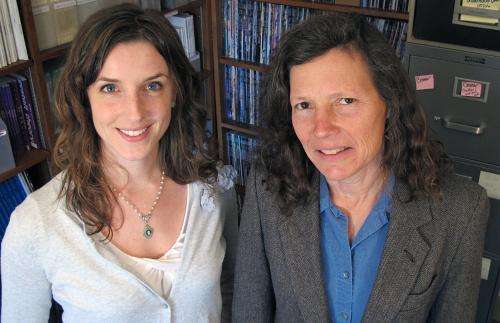
Doctoral student Carly P. Smith, left, and Jennifer Freyd, professor of psychology, both of the University of Oregon, have designed a new research tool for evaluating institutional betrayal. Using it, they found heightened effects of post-traumatic trauma in women reporting unwanted sexual experiences. Credit: University of Oregon
A study of 345 female university students found that 233 of them had experienced at least one unwanted sexual experience in their lifetime, and 46 percent of those victims also experienced betrayal by the institution where incidents occurred. In the final analysis, researchers found, those who experienced institutional betrayal suffered the most in four post-trauma measurement categories, including anxiety and dissociation.
The study by the University of Oregon's doctoral student Carly Parnitzke Smith and Jennifer J. Freyd, professor of psychology, introduces a 10-item analysis tool—the Institutional Betrayal Questionnaire—designed to assess institutional betrayal and involvement. The study appears in the Journal of Traumatic Stress and comes in the same month that "Blind to Betrayal," a new book co-authored by Freyd and UO psychologist Pamela Birrell, was published.
"Our work on institutional betrayal has coincided with increased public awareness of the harm inflicted by unresponsive institutions surrounding traumatic events," Freyd said. "In describing the form and effects of this type of betrayal, we hope to eventually turn the dialogue towards opportunities for institutions to protect and nurture their members."
The study, Freyd said, takes the focus beyond the usual research on emotional, physical and sexual abuse in one-on-one situations to include the idea that victimization within institutions—a university, including residence halls, fraternities and sororities, the military and organized religion—that individuals trust adds a layer of trauma through the betrayal. Because the study surveyed the participants' lifetime, not all of the incidents occurred while at college, and many were no longer affiliated with the specific institutions where the betrayals occurred.
"Our results suggest that organizations need to widen the scope of their institutional actions and policies to both prevent and respond to sexual assaults," Freyd said. "This is a national problem. The findings at this one university reach well beyond it, and, we believe, are consistent with what would be found at universities across the country."
Originally, the study pool included 514 male and female students, who were unaware of the project's topic. The subject matter was disguised to avoid students' self-selecting into the research. Only experiences of the women, whose average age was 19.67, were included in the analysis.
The unwanted sexual experiences noted in the study were drawn from a 12-point scale in which higher scores involved verbal, physical and alcohol/drug coercion. Also included were unwanted sexual experiences without overt coercion but that involved sexual partners whose insistence or arousal led to the women feeling unable to prevent intercourse. On average, women reported three instances of unwanted sexual experiences.
An institution's role in such abuse if often indirect and occurs around individual acts of sexual violence, the authors wrote. It is within these large institutions where individuals expect to be safe.
The Institutional Betrayal Questionnaire created by Smith and Freyd surveys situations within organizational settings: experience seemed like no big deal; experience seemed more likely; not taking proactive steps; making it difficult to report an experience; covering up the experience, responding inadequately; and punishing you in some way. Victims responded to each item using a seven-point scale. The tool measure a participant's experience rather than underlying traits.
The experiences of institutional betrayal did not differ significantly across the types of unwanted sexual involvement, supporting the notion that institutional betrayal is an independent construct rather than an indicator of the perceived severity of an experience, the authors wrote in their conclusion. Those reporting a sense of institutional betrayal were found to have more severe post-traumatic symptoms of sexual abuse trauma, anxiety, sexual dysfunction and dissociation.
Provided by
University of Oregon
-
Book by University of Oregon psychologists opens eyes on betrayal
Feb 27, 2013 |
not rated yet |
0
-
Policy: Sex abuse by doctors 'profound betrayal'
Jul 19, 2011 |
not rated yet |
0
-
Physical and sexual assault linked to increased suicide risk in military
Jan 18, 2013 |
not rated yet |
0
-
Study examines how women label abuse
Dec 12, 2007 |
not rated yet |
0
-
Women in prison: An issue of blaming the individual for social problems
Oct 12, 2011 |
not rated yet |
0
-
Motion perception revisited: High Phi effect challenges established motion perception assumptions
Apr 23, 2013 |
3 / 5 (2) |
2
-
Anything you can do I can do better: Neuromolecular foundations of the superiority illusion (Update)
Apr 02, 2013 |
4.5 / 5 (11) |
5
-
The visual system as economist: Neural resource allocation in visual adaptation
Mar 30, 2013 |
5 / 5 (2) |
9
-
Separate lives: Neuronal and organismal lifespans decoupled
Mar 27, 2013 |
4.9 / 5 (8) |
0
-
Sizing things up: The evolutionary neurobiology of scale invariance
Feb 28, 2013 |
4.8 / 5 (10) |
14
-
Pressure-volume curve: Elastic Recoil Pressure don't make sense
May 18, 2013
-
If you became brain-dead, would you want them to pull the plug?
May 17, 2013
-
MRI bill question
May 15, 2013
-
Ratio of Hydrogen of Oxygen in Dessicated Animal Protein
May 13, 2013
-
Alcohol and acetaminophen
May 13, 2013
-
Marie Curie's leukemia
May 13, 2013
- More from Physics Forums - Medical Sciences
More news stories
Ketamine shows significant therapeutic benefit in people with treatment-resistant depression
Patients with treatment-resistant major depression saw dramatic improvement in their illness after treatment with ketamine, an anesthetic, according to the largest ketamine clinical trial to-date led by researchers from the ...
Psychology & Psychiatry
May 19, 2013 |
4.8 / 5 (5) |
1
|
US psychiatry gets makeover in new manual
The latest makeover to a massive psychiatric tome honored by some, reviled by others and even called the "Bible" of mental disorders is being released Saturday with a host of new changes.
Psychology & Psychiatry
May 18, 2013 |
not rated yet |
1
Study reviews readmissions in inpatient psychiatric facilities
(HealthDay)—Most Medicare beneficiaries treated in inpatient psychiatric facilities (IPFs) exhibit characteristics associated with hospital readmission, according to a report prepared for the National Association ...
Psychology & Psychiatry
May 17, 2013 |
not rated yet |
0
Skydiving is never plane sailing
Skydivers show the same level of physical stress before every jump whether a first-timer or experienced jumper, say Northumbria researchers.
Psychology & Psychiatry
May 17, 2013 |
not rated yet |
0
|
Kids, especially boys, perceive sadness of depressed parents
Children of depressed parents pick up on their parents' sadness—whether mom or dad realizes their mood or not.
Psychology & Psychiatry
May 17, 2013 |
4.5 / 5 (2) |
1
|
Commonly used catheters double risk of blood clots in ICU and cancer patients
Touted for safety, ease and patient convenience, peripherally inserted central catheters have become many clinicians' go-to for IV delivery of antibiotics, nutrition, chemotherapy, and other medications.
New theory on genesis of osteoarthritis comes with successful therapy in mice
Scientists at Johns Hopkins have turned their view of osteoarthritis (OA) inside out. Literally. Instead of seeing the painful degenerative disease as a problem primarily of the cartilage that cushions joints, ...
Computational tool translates complex data into simplified 2-dimensional images
In their quest to learn more about the variability of cells between and within tissues, biomedical scientists have devised tools capable of simultaneously measuring dozens of characteristics of individual ...
Researchers identify a potential new risk for sleep apnea: Asthma
Researchers at the University of Wisconsin have identified a potential new risk factor for obstructive sleep apnea: asthma. Using data from the National Institutes of Health (Heart, Lung, and Blood Institute)-funded Wisconsin ...
Study finds that sleep apnea and Alzheimer's are linked
A new study looking at sleep-disordered breathing (SDB) and markers for Alzheimer's disease (AD) risk in cerebrospinal fluid (CSF) and neuroimaging adds to the growing body of research linking the two.
'Gap' for HIV vaccine efforts after latest setback
The hunt for an HIV vaccine has gobbled up $8 billion in the past decade, and the failure of the most recent efficacy trial has delivered yet another setback to 26 years of efforts.
Mar 09, 2013
Rank: 1.5 / 5 (2)
Mar 09, 2013
Rank: not rated yet
Mar 11, 2013
Rank: 1 / 5 (1)
http://mensnewsda...re-made/ "During my time as a prosecutor who made case filing decisions, I was amazed to see all the false rape allegations that were made to the Denver Police Department. It was remarkable and surprising to me. You would have to see it to believe it. Any honest veteran sex assault investigator will tell you that rape is one of the most falsely reported crimes that there is. A command officer in the Denver Police sex assaults unit recently told me he placed the false rape numbers at approximately 45 percent." Colorado prosecutor Craig Silverman
http://blog.lib.u...ions.pdf Eugene J. Kanin, Ph.D. These false rape allegations constitute 41% the total forcible rape cases (n = 109) reported during this period. These false allegations appear to serve three major functions for the complainants: providing an alibi, seeking revenge, and obtaining sympathy and attention.