Learning from Lassa virus: Researchers discover gene mutations that can result in a congenital disorder
March 22, 2013 in Medical research

Learning from Lassa Virus

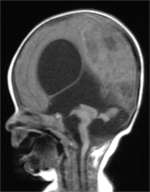
An MRI of a child with Walker-Warburg syndrome shows abnormal brain features. Credit: Hans van Bokhoven of Radboud University Medical Center

(Medical Xpress)—Researchers have known that two seemingly distant human maladies—a devastating set of hereditary disorders called Walker-Warburg syndrome and infection with the virus that causes hemorrhagic Lassa fever—both involve a cellular protein involving sugar.

Now an international team has discovered new that cause the severe brain, muscle and eye defects found in children with Walker-Warburg syndrome but also make cells insensitive to the Lassa virus.

The scientists found all known and identified new mutations in critical for coupling sugar groups to a particular for Lassa virus, called glycosylated alpha-dystroglycan.

The team, which includes Sean Whelan, HMS professor of microbiology and immunobiology; Hans van Bokhoven of Radboud University Medical Center; and Thijn Brummelkamp of the Netherlands Cancer Institute, published their findings this week in Science.

Defects in how sugar modifies the dystroglycan complex causes Walker-Warburg syndrome, in which affected children usually die at an early age. The Lassa virus is one of many pathogens that hijacks this protein complex in order to enter cells.

Studying Lassa leads to syndrome clues

Viruses need to get inside host cells to amplify and cause disease. The Lassa virus gains entry by binding to dystroglycan, a protein complex on the outside of the cell. This is heavily decorated with sugars that anchor the cell to its surroundings.

To generate a detailed map of how Lassa virus enters , as well as to identify genes required for successful infection, the scientists infected a unique human cell line in a lab dish. Because these genes are present only in a single copy, they can be readily inactivated. Until recently this genetic trick was possible only in model organisms, such as yeast and .

Using the genetic approach of inactivating host gene function by inserting new genetic material, a technique called insertional mutagenesis, the team found human cells that were resistant to Lassa virus infection.

The scientists were able to do the Lassa work safely by replacing the surface protein on another non-lethal virus with the surface protein of Lassa and then testing the ability of that virus to infect and kill the haploid cell-line in which genes had been inactivated by insertional mutagenesis. Only those cells that lacked the components essential for Lassa virus entry survived the infection, whereas others died.

Walker-Warburg mutations identified

The identity of the genes associated with resistance was revealed by deep genetic sequencing of the surviving cells. Among them were genes that encode the known Lassa virus receptor alpha-dystroglycan as well as machinery required to add sugars to this receptor. Mutations in several of these genes are associated with Walker-Warburg syndrome, but not all of the genes had previously been linked with the syndrome.

Based on these findings, researchers scanned the genome of Walker-Warburg patients for defects in these newly discovered genes. Strikingly, several families affected by hereditary Walker-Warburg syndrome of previously unknown cause carried mutations in these genes.

Lassa virus is endemic in regions of Africa and causes thousands of deaths every year. The researchers said it will be interesting to see if, in communities exposed to Lassa , the human genome shows traces of the ongoing struggle in the sections encoding the identified host factors that are involved in building the sugar trees on the dystroglycan protein.

More information: www.sciencemag.org… 675.abstract

Journal reference: Science search and more info website

Provided by Harvard Medical School search and more info website

not rated yet  

Rank not rated yet
Relevant PhysicsForums posts

More news stories

Study reveals new mechanism for estrogen suppression of liver lipid synthesis

By discovering the new mechanism by which estrogen suppresses lipid synthesis in the liver, UC Irvine endocrinologists have revealed a potential new approach toward treating certain liver diseases.

Medical research created May 23, 2013 | popularity 5 / 5 (1) | comments 0 | with audio podcast

MRI-based measurement helps predict vascular disease in the brain

Aortic arch pulse wave velocity, a measure of arterial stiffness, is a strong independent predictor of disease of the vessels that supply blood to the brain, according to a new study published in the June issue the journal ...

Medical research created May 23, 2013 | popularity not rated yet | comments 0

Antibiotics: A new understanding of sulfonamide nervous system side effects

Since the discovery of Prontosil in 1932, sulfonamide antibiotics have been used to combat a wide spectrum of bacterial infections, from acne to chlamydia and pneumonia. However, their side effects can include serious neurological ...

Medical research created May 23, 2013 | popularity 3 / 5 (1) | comments 0 | with audio podcast

Scientists discover molecule triggers sensation of itch

Scientists at the National Institutes of Health report they have discovered in mouse studies that a small molecule released in the spinal cord triggers a process that is later experienced in the brain as ...

Medical research created May 23, 2013 | popularity 5 / 5 (3) | comments 0 | with audio podcast

Discarded immune cells induce the relocation of stem cells

Spanish researchers have discovered that the daily clearance of neutrophils from the body stimulates the release of hematopoietic stem cells from the bone marrow into the bloodstream, according to a report published today ...

Medical research created May 23, 2013 | popularity 5 / 5 (2) | comments 0


First drug to improve heart failure mortality in over a decade

Coenzyme Q10 decreases all cause mortality by half, according to the results of a multicentre randomised double blind trial presented today at Heart Failure 2013 congress. It is the first drug to improve heart failure mortality ...

Seniors more likely to crash when driving with pet, study finds

(HealthDay)—Animals make great companions for senior citizens, but elderly people who always drive with a pet in the car are far more likely to crash than those who never drive with a pet, researchers have ...

Heart failure accelerates male 'menopause'

Heart failure accelerates the aging process and brings on early andropausal syndrome (AS), according to research presented today at the Heart Failure Congress 2013. AS, also referred to as male 'menopause', was four times ...

Death highest in heart failure patients admitted in January, on Friday, and overnight

Mortality and length of stay are highest in heart failure patients admitted in January, on Friday, and overnight, according to research presented today at the Heart Failure Congress 2013. The analysis of nearly 1 million ...

Feds fight morning-after pill age ruling in NY

(AP)—Department of Justice lawyers have again asked a federal appeals court in New York to delay lifting age restrictions and prescription requirements on an emergency contraceptive popularly known as the morning-after ...

New immune system discovered

(Medical Xpress)—A research team, led by Jeremy Barr, a biology post-doctoral fellow, unveils a new immune system that protects humans and animals from infection.