News tagged with human brain
Do salamanders hold the solution to regeneration?
Salamanders' immune systems are key to their remarkable ability to regrow limbs, and could also underpin their ability to regenerate spinal cords, brain tissue and even parts of their hearts, scientists have ...
Medical research
May 20, 2013 |
4.9 / 5 (7) |
4
|
Human brain frontal lobes not relatively large, not sole center of intelligence
Human intelligence cannot be explained by the size of the brain's frontal lobes, say researchers.
Neuroscience
May 13, 2013 |
4.9 / 5 (9) |
4
|
Hit a 95 mph baseball? Scientists pinpoint how we see it coming
(Medical Xpress)—How does San Francisco Giants slugger Pablo Sandoval swat a 95 mph fastball, or tennis icon Venus Williams see the oncoming ball, let alone return her sister Serena's 120 mph serves? For ...
Neuroscience
May 08, 2013 |
3.2 / 5 (6) |
0
|
Neuroscientists use statistical model to draft fantasy teams of neurons
This past weekend teams from the National Football League used statistics like height, weight and speed to draft the best college players, and in a few weeks, armchair enthusiasts will use similar measures ...
Neuroscience
Apr 29, 2013 |
4 / 5 (5) |
0
|
Brain uses internal 'average voice' prototype to identify who is talking
(Medical Xpress)—The human brain is able to identify individuals' voices by comparing them against an internal 'average voice' prototype, according to neuroscientists.
Neuroscience
13 hours ago |
1 / 5 (1) |
0
|
Common food supplement fights degenerative brain disorders
Widely available in pharmacies and health stores, phosphatidylserine is a natural food supplement produced from beef, oysters, and soy. Proven to improve cognition and slow memory loss, it's a popular treatment for older ...
Medical research
May 21, 2013 |
5 / 5 (3) |
0
|
Finding a family for a pair of orphan receptors in the brain
Researchers at Emory University have identified a protein that stimulates a pair of "orphan receptors" found in the brain, solving a long-standing biological puzzle and possibly leading to future treatments for neurological ...
Medical research
May 21, 2013 |
5 / 5 (1) |
0
|
Study shows where scene context happens in our brain
In a remote fishing community in Venezuela, a lone fisherman sits on a cliff overlooking the southern Caribbean Sea. This man –– the lookout –– is responsible for directing his comrades on the water, ...
Neuroscience
May 21, 2013 |
4 / 5 (1) |
0
|
White matter imaging provides insight into human and chimpanzee aging
(Medical Xpress)—The instability of "white matter" in humans may contribute to greater cognitive decline during the aging of humans compared with chimpanzees, scientists from Yerkes National Primate Research ...
Neuroscience
May 14, 2013 |
5 / 5 (4) |
2
|
Researchers identify how cells control calcium influx
(Medical Xpress)—When brain cells are overwhelmed by an influx of too many calcium molecules, they shut down the channels through which these molecules enter the cells. Until now, the "stop" signal mechanism that cells ...
Neuroscience
May 09, 2013 |
5 / 5 (4) |
0
|
Laughter perception networks in brain different for mocking, joyful or ticklish laughter
A laugh may signal mockery, humor, joy or simply be a response to tickling, but each kind of laughter conveys a wealth of auditory and social information. These different kinds of laughter also spark different connections ...
Neuroscience
May 08, 2013 |
5 / 5 (1) |
0
|
Human brain cells developed in lab, grow in mice
A key type of human brain cell developed in the laboratory grows seamlessly when transplanted into the brains of mice, UC San Francisco researchers have discovered, raising hope that these cells might one day be used to treat ...
Medical research
May 08, 2013 |
5 / 5 (2) |
0
|
Research determines how the brain computes tool use
(Medical Xpress)—With a goal of helping patients with spinal cord injuries, Jason Gallivan and a team of researchers at Queen's University's Department of Psychology and Centre for Neuroscience Studies are probing deep ...
Neuroscience
May 08, 2013 |
not rated yet |
0
Turning Alzheimer's fuzzy signals into high definition
Scientists at the Virginia Tech Carilion Research Institute have discovered how the predominant class of Alzheimer's pharmaceuticals might sharpen the brain's performance.
Neuroscience
May 07, 2013 |
4.5 / 5 (2) |
0
|
Debunking the IQ myth
(Medical Xpress)—You may be more than a single number, according to a team of Western-led researchers. Considered a standard gauge of intelligence, an intelligence quotient (IQ) score doesn't actually provide ...
Psychology & Psychiatry
May 07, 2013 |
3 / 5 (27) |
29
|
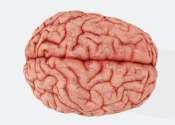
Human brain
The human brain is the center of the human nervous system and is a highly complex organ. Enclosed in the cranium, it has the same general structure as the brains of other mammals, but is over three times as large as the brain of a mammal with an equivalent body size. Most of the expansion comes from the cerebral cortex, a convoluted layer of neural tissue that covers the surface of the forebrain. Especially expanded are the frontal lobes, which are involved in executive functions such as self-control, planning, reasoning, and abstract thought. The portion of the brain devoted to vision is also greatly enlarged in humans.
Brain evolution, from the earliest shrewlike mammals through primates to hominids, is marked by a steady increase in encephalization, or the ratio of brain to body size. The human brain has been estimated to contain 50–100 billion (1011) neurons[citation needed], of which about 10 billion (1010) are cortical pyramidal cells.[citation needed] These cells pass signals to each other via approximately 100 trillion (1014)[citation needed] synaptic connections.
In spite of the fact that it is protected by the thick bones of the skull, suspended in cerebrospinal fluid, and isolated from the bloodstream by the blood-brain barrier, the delicate nature of the human brain makes it susceptible to many types of damage and disease. The most common forms of physical damage are closed head injuries such as a blow to the head, a stroke, or poisoning by a wide variety of chemicals that can act as neurotoxins. Infection of the brain is rare because of the barriers that protect it, but is very serious when it occurs. More common are genetically based diseases[citation needed], such as Parkinson's disease, multiple sclerosis, and many others. A number of psychiatric conditions, such as schizophrenia and depression, are widely thought to be caused at least partially by brain dysfunctions, although the nature of such brain anomalies is not well understood.
For more information about Human brain, read the full article at
Wikipedia.
This text uses material from Wikipedia and is available under the GNU Free Documentation License.