Glioblastoma

New drug enhances radiation treatment for brain cancer in preclinical studies

A novel drug may help increase the effectiveness of radiation therapy for the most deadly form of brain cancer, report scientists at Virginia Commonwealth University Massey Cancer Center. In mouse models of human glioblastoma ...

Cancer created May 14, 2013 | popularity 5 / 5 (2) | comments 0

Scientists find mutation driving pediatric brain tumors

A type of low-grade but sometimes lethal brain tumor in children has been found in many cases to contain an unusual mutation that may help to classify, diagnose and guide the treatment of the tumors, report scientists at ...

Genetics created Apr 30, 2013 | popularity 5 / 5 (1) | comments 0 | with audio podcast

Reseach reveals genomic similarities between breast cancer, ovarian cancers

One subtype of breast cancer shares many genetic features with high-grade serous ovarian cancer, a cancer that is very difficult to treat, according to researchers supported by the National Institutes of ...

Cancer created Sep 23, 2012 | popularity 5 / 5 (2) | comments 0 | with audio podcast

New study finds brain tumors can arise from neurons

(Medical Xpress)—Researchers from the US and Japan have shown that an aggressive type of brain tumor can arise from normal cells in the central nervous system such as neurons. The cells revert to an earlier, ...

Cancer created Oct 19, 2012 | popularity 5 / 5 (2) | comments 1 | with audio podcast report

Hundreds of alterations and potential drug targets to starve cancer tumors identified

A massive study analyzing gene expression data from 22 tumor types has identified multiple metabolic expression changes associated with cancer. The analysis, conducted by researchers at Columbia University Medical Center, ...

Cancer created Apr 21, 2013 | popularity 5 / 5 (4) | comments 0 | with audio podcast

New immune therapy treats brain tumors in mice

Using an artificial protein that stimulates the body's natural immune system to fight cancer, a research team at Duke Medicine has engineered a lethal weapon that kills brain tumors in mice while sparing ...

Immunology created Dec 17, 2012 | popularity 5 / 5 (7) | comments 3 | with audio podcast

Genetic master controls expose cancers' Achilles' heel

In a surprising finding that helps explain fundamental behaviors of normal and diseased cells, Whitehead Institute scientists have discovered a set of powerful gene regulators dubbed "super-enhancers" that control cell state ...

Cancer created Apr 11, 2013 | popularity 4.8 / 5 (6) | comments 0 | with audio podcast

Immortality gene mutation identifies brain tumors, other cancers

Newly identified mutations in a gene that makes cells immortal appear to play a pivotal role in three of the most common types of brain tumors, as well as cancers of the liver, tongue and urinary tract, according to research ...

Cancer created Mar 18, 2013 | popularity 5 / 5 (3) | comments 0 | with audio podcast

Definition of lung squamous cell carcinoma genome opens doors to better, more targeted therapies

A new paper published online in Nature holds out hope that people with the second most common type of lung cancer may one day benefit from targeted therapies that have transformed treatments for other lung cancer patients.

Cancer created Sep 09, 2012 | popularity not rated yet | comments 0 | with audio podcast

Study finds mutations tied to aggressive childhood brain tumors

Researchers studying a rare, lethal childhood tumor of the brainstem discovered that nearly 80 percent of the tumors have mutations in genes not previously tied to cancer. Early evidence suggests the alterations play a unique ...

Genetics created Jan 29, 2012 | popularity not rated yet | comments 0 | with audio podcast

Novel combination therapy shuts down escape route, killing glioblastoma tumor cells

Glioblastoma, the most common and lethal form of brain tumor in adults, is challenging to treat because the tumors rapidly become resistant to therapy. As cancer researchers are learning more about the causes of tumor cell ...

Cancer created Feb 26, 2013 | popularity 5 / 5 (1) | comments 2 | with audio podcast

Researchers use a type of stem cells from human adipose tissue to chase migrating cancer cells

In laboratory studies, Johns Hopkins researchers say they have found that stem cells from a patient's own fat may have the potential to deliver new treatments directly into the brain after the surgical removal of a glioblastoma, ...

Cancer created Mar 12, 2013 | popularity 5 / 5 (2) | comments 0 | with audio podcast

Discovery predicts patient sensitivity to important drug target in deadly brain cancer

A recent discovery by Van Andel Research Institute (VARI) scientists enables the prediction of patient sensitivity to proposed drug therapies for glioblastoma – the most common and most aggressive malignant brain tumor ...

Cancer created Feb 06, 2012 | popularity 4 / 5 (2) | comments 0 | with audio podcast

Healing hormone provides hope for brain injury

If Don Stein were the kind of man who listened to what others said, he would have shut down his lab years ago. The Emory neuroscientist spent more than two decades investigating progesterone as a treatment ...

Medical research created Apr 24, 2013 | popularity 4.3 / 5 (4) | comments 0

Detection, analysis of 'cell dust' may allow diagnosis, monitoring of brain cancer

A novel miniature diagnostic platform using nuclear magnetic resonance (NMR) technology is capable of detecting minuscule cell particles known as microvesicles in a drop of blood. Microvesicles shed by cancer ...

Medical research created Nov 11, 2012 | popularity 5 / 5 (1) | comments 0 | with audio podcast


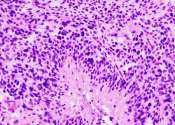
Glioblastoma multiforme (GBM) is the most common and most aggressive malignant primary brain tumor in humans, involving glial cells and accounting for 52% of all functional tissue brain tumor cases and 20% of all intracranial tumors. Despite being the most prevalent form of primary brain tumor, GBMs occur in only 2–3 cases per 100,000 people in Europe and North America. According to the WHO classification of the tumors of the central nervous system‎, the standard name for this brain tumor is "glioblastoma"; it presents two variants: giant cell glioblastoma and gliosarcoma. Glioblastomas are also an important brain tumor in canines, and research continues to use this as a model for developing treatments in humans.

Treatment can involve chemotherapy, radiation, radiosurgery, corticosteroids, antiangiogenic therapy, surgery and experimental approaches such as gene transfer.

With the exception of the brainstem gliomas, glioblastoma has the worst prognosis of any central nervous system (CNS) malignancy, despite multimodality treatment consisting of open craniotomy with surgical resection of as much of the tumor as possible, followed by concurrent or sequential chemoradiotherapy, antiangiogenic therapy with bevacizumab, gamma knife radiosurgery, and symptomatic management with corticosteroids. Prognosis is poor, with a median survival time of approximately 14 months.

This text uses material from Wikipedia and is available under the GNU Free Documentation License.

Latest Spotlight News

AIDS science at 30: 'Cure' now part of lexicon

Big names in medicine are set to give an upbeat assessment of the war on AIDS on Tuesday, 30 years after French researchers identified the virus that causes the disease.

For combat veterans suffering from post-traumatic stress disorder, 'fear circuitry' in the brain never rests

Chronic trauma can inflict lasting damage to brain regions associated with fear and anxiety. Previous imaging studies of people with post-traumatic stress disorder, or PTSD, have shown that these brain regions can over-or ...

Melon focus headband turns to Kickstarter for rollout plans

(Medical Xpress)—What if the quality of your work depends more on your focus on the piano keys or canvas or laptop than your musical or painting or computing skills? If target users can be convinced, they ...

Temporal processing in the olfactory system

The neural machinery underlying our olfactory sense continues to be an enigma for neuroscience. A recent review in Neuron seeks to expand traditional ideas about how neurons in the olfactory bulb might encode information about ...

Now we know why old scizophrenia medicine works on antibiotics-resistant bacteria

In 2008 researchers from the University of Southern Denmark showed that the drug thioridazine, which has previously been used to treat schizophrenia, is also a powerful weapon against antibiotic-resistant bacteria such as ...

Individuals who drink heavily and smoke may show 'early aging' of the brain

Treatment for alcohol use disorders works best if the patient actively understands and incorporates the interventions provided in the clinic. Multiple factors can influence both the type and degree of neurocognitive abnormalities ...

College women exceed NIAAA drinking guidelines more frequently than college men

In order to avoid harms associated with alcohol consumption, in 2009 the National Institute on Alcohol Abuse and Alcoholism issued guidelines that define low-risk drinking. These guidelines differ for men and women: no more ...

Study identifies new approach to improving treatment for MS and other conditions

(Medical Xpress)—Working with lab mice models of multiple sclerosis (MS), UC Davis scientists have detected a novel molecular target for the design of drugs that could be safer and more effective than current FDA-approved ...

Little evidence for prediction rules for low back pain

(HealthDay)—Few randomized clinical trials have been done to assess clinical prediction rules for patients with lower back pain, and the trials that have been done are of low quality and do not provide ...

Skydiving is never plane sailing

Skydivers show the same level of physical stress before every jump whether a first-timer or experienced jumper, say Northumbria researchers.