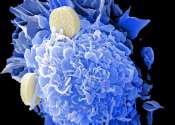
Squamous Cell Carcinoma
Genetic diversity within tumors predicts outcome in head and neck cancer
A new measure of the heterogeneity – the variety of genetic mutations – of cells within a tumor appears to predict treatment outcomes of patients with the most common type of head and neck cancer. In the May 20 issue ...
Cancer
May 20, 2013 |
not rated yet |
0
Risk factors ID'd for poor cutaneous cell CA outcomes
(HealthDay)—The risks of metastasis and death associated with cutaneous squamous cell carcinoma (CSCC) are low, but significant, and risk factors for poor outcome include tumor diameter, invasion beyond ...
Cancer
May 17, 2013 |
not rated yet |
0
|
Researchers discover possible trigger for spread of head and neck cancer cells
(Medical Xpress)—Very little has been known about the epigenetic events—developmental and environmental factors affecting genes—that occur prior to the invasive growth of head and neck squamous cell carcinomas and their ...
Cancer
May 08, 2013 |
not rated yet |
0
HPV leaves its mark in oropharyngeal squamous cell carcinoma
Oropharyngeal squamous cell carcinoma (OPSCC) is a form of cancer that affects the cells lining the middle part of the throat, including the soft palate, the base of the tongue, the tonsils, and the pharynx.
Cancer
May 01, 2013 |
not rated yet |
0
Surgery for nonfatal skin cancers might not be best for elderly patients
Surgery is often recommended for skin cancers, but older, sicker patients can endure complications as a result and may not live long enough to benefit from the treatment.
Cancer
Apr 29, 2013 |
not rated yet |
1
Researchers observe an increased risk of cancer in people with history of non-melanoma skin cancer
A prospective study by researchers at Brigham and Women's Hospital (BWH) observed an association between risk of second primary cancer and history of non-melanoma skin cancer in white men and women.
Cancer
Apr 23, 2013 |
not rated yet |
0
Misregulated genes common to tobacco-related cancers offer potential new prognostic tool
Believe it or not, while researchers have explored which genes are mutated in each type of tobacco-associated cancer, until now no one had thought to look across these types for common genes that might predict patient outcomes. ...
Cancer
Apr 09, 2013 |
not rated yet |
0
Researchers show that a promising drug can help prevent head and neck cancers
Head and neck cancers typically begin in squamous cells that line moist surfaces inside the mouth, nose and throat. Squamous cell carcinoma of the head and neck (HNSCC) is the sixth most common type of cancer in the United ...
Cancer
Apr 09, 2013 |
not rated yet |
0
Researchers design drug to restore cell suicide in HPV-related head and neck cancer
Researchers have discovered a new mechanism by which the human papilloma virus (HPV) causes head and neck cancer, and they have designed a drug to block that mechanism. Though further research is needed, the new agent might ...
Cancer
Apr 08, 2013 |
5 / 5 (1) |
0
Comprehensive genomic analysis identifies alterations in head and neck cancer that could lead to targeted therapy
Not all head and neck squamous cell carcinomas (HNSCCs) have the same pattern of genomic alterations, but those cancers with certain distinctive patterns could be amenable to specific targeted therapies, according to a researcher ...
Cancer
Apr 08, 2013 |
not rated yet |
0
Study tracks patterns of US cases of anal canal carcinoma
(HealthDay)—Available screening and identification of human papillomavirus likely contributed to the increased incidences of squamous cell carcinoma of the anal canal (SCCA) and anal carcinoma in situ (CIS) ...
Cancer
Apr 02, 2013 |
5 / 5 (2) |
0
Immortality gene mutation identifies brain tumors, other cancers
Newly identified mutations in a gene that makes cells immortal appear to play a pivotal role in three of the most common types of brain tumors, as well as cancers of the liver, tongue and urinary tract, according to research ...
Cancer
Mar 18, 2013 |
5 / 5 (3) |
0
|
Comparing combination therapies for advanced head and neck cancer shows no improvement
Locally advanced squamous cell carcinoma of the head and neck is a potentially curable disease in nearly every patient at the time of diagnosis, yet despite the most aggressive efforts, up to 30-50 percent ...
Cancer
Mar 07, 2013 |
1 / 5 (1) |
0
AAD: Complications of tattoos and tattoo ink discussed
(HealthDay)—Complications linked to tattoos and tattoo inks include allergic reactions, serious infections, and reactions that can be mistaken for skin cancer, according to information presented at the ...
Diseases, Conditions, Syndromes
Mar 01, 2013 |
not rated yet |
0
'Where you're treated matters' in terms of cancer survival
A study of older patients with advanced head and neck cancers has found that where they were treated significantly influenced their survival. The study, led by researchers at Fred Hutchinson Cancer Research Center and published ...
Cancer
Mar 01, 2013 |
not rated yet |
0
Squamous cell carcinoma (SCC or SqCC) is a form of skin cancer. Skin cancers fall into two groups, melanoma and non-melanoma; squamous cell carcinoma is a non-melanoma cancer. It is one of the most common cancers in humans and other animals.
Squamous cells are a type of epithelium cell forming the outermost layers of the skin and some organs in the body. Squamous cell carcinoma usually occurs on the skin, especially portions commonly exposed to the Sun, the face, ears, neck, hands, or arm. The main symptom is a growing bump that may have a rough, scaly surface and flat reddish patches. It may also occur inside the body wherever squamous cells are found, including the esophagus, urinary bladder, prostate, lung, vagina, and cervix, among others.
Despite the common name, squamous cell carcinomas arising in different body sites can show tremendous differences in their presenting signs and symptoms, natural history, prognosis, and response to treatment.
Though the use of these terms has been decreasing in the literature, SqCC is still sometimes referred to as "epidermoid carcinoma" and "squamous cell epithelium". During its earliest stages, it is sometimes known as "Bowen's disease".
This text uses material from Wikipedia and is available under the GNU Free Documentation License.
Latest Spotlight News
If you can remember it, you can remember it wrong
(Medical Xpress)—Native peoples in regions where cameras are uncommon sometimes react with caution when their picture is taken. The fear that something must have been stolen from them to create the photo ...
Insight into the dazzling impact of insulin in cells
Australian scientists have charted the path of insulin action in cells in precise detail like never before. This provides a comprehensive blueprint for understanding what goes wrong in diabetes.
Estimates reveal low population immunity to new bird flu virus H7N9 in humans
The level of immunity to the recently circulating H7N9 influenza virus in an urban and rural population in Vietnam is very low, according to the first population level study to examine human immunity to the virus, which was ...
Study finds vitamin C can kill drug-resistant TB (w/ video)
In a striking, unexpected discovery, researchers at Albert Einstein College of Medicine of Yeshiva University have determined that vitamin C kills drug-resistant tuberculosis (TB) bacteria in laboratory culture. The finding ...
Study shows where scene context happens in our brain
In a remote fishing community in Venezuela, a lone fisherman sits on a cliff overlooking the southern Caribbean Sea. This man –– the lookout –– is responsible for directing his comrades on the water, ...
New immune system discovered
(Medical Xpress)—A research team, led by Jeremy Barr, a biology post-doctoral fellow, unveils a new immune system that protects humans and animals from infection.
Genetic predictors of postpartum depression uncovered
Johns Hopkins researchers say they have discovered specific chemical alterations in two genes that, when present during pregnancy, reliably predict whether a woman will develop postpartum depression.
The compound in the Mediterranean diet that makes cancer cells 'mortal'
New research suggests that a compound abundant in the Mediterranean diet takes away cancer cells' "superpower" to escape death. By altering a very specific step in gene regulation, this compound essentially re-educates cancer ...
Do salamanders hold the solution to regeneration?
Salamanders' immune systems are key to their remarkable ability to regrow limbs, and could also underpin their ability to regenerate spinal cords, brain tissue and even parts of their hearts, scientists have ...
Losing weight may ease chronic heartburn
(HealthDay)—Obese and overweight men and women who suffer from heartburn often report relief when they lose weight, a new study shows.