Autism changes molecular structure of the brain, study finds
May 25, 2011 in Genetics
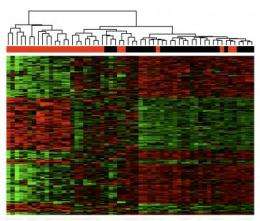
UCLA scientists measured the expression levels of more than 20,000 genes in tissue samples from autistic and healthy brains. When the samples were grouped by expression patterns, most autistic brains (red bar at top) showed a striking overlap. Image: UCLA
For decades, autism researchers have faced a baffling riddle: how to unravel a disorder that leaves no known physical trace as it develops in the brain.
Now a UCLA study is the first to reveal how the disorder makes its mark at the molecular level, resulting in an autistic brain that differs dramatically in structure from a healthy one. Published May 25 in the advance online edition of Nature, the findings provide new insight into how genes and proteins go awry in autism to alter the mind.
The discovery also identifies a new line of attack for researchers, who currently face a vast array of potential fronts for tackling the neurological disease and identifying its diverse causes.
"If you randomly pick 20 people with autism, the cause of each person's disease will be unique," said principal investigator Dr. Daniel Geschwind, the Gordon and Virginia MacDonald Distinguished Chair in Human Genetics and a professor of neurology and psychiatry at the David Geffen School of Medicine at UCLA. "Yet when we examined how genes and proteins interact in autistic people's brains, we saw well-defined shared patterns. This common thread could hold the key to pinpointing the disorder's origins."
The research team, led by Geschwind, included scientists from the University of Toronto and King's College London. They compared brain tissue samples obtained after death from 19 autism patients and 17 healthy volunteers. After profiling three brain areas previously linked to autism, the group zeroed in on the cerebral cortex, the most evolved part of the human brain.
The researchers focused on gene expression how a gene's DNA sequence is copied into RNA, which directs the synthesis of cellular molecules called proteins. Each protein is assigned a specific task by the gene to perform in the cell.
By measuring gene-expression levels in the cerebral cortex, the team uncovered consistent differences in how genes in autistic and healthy brains encode information.
"We were surprised to see similar gene expression patterns in most of the autistic brains we studied," said first author Irina Voineagu, a UCLA postdoctoral fellow in neurology. "From a molecular perspective, half of these brains shared a common genetic signature. Given autism's numerous causes, this was an unexpected and exciting finding."
The researchers' next step was to identify the common patterns. To do this, they looked at the cerebral cortex's frontal lobe, which plays a role in judgment, creativity, emotions and speech, and at its temporal lobes, which regulate hearing, language and the processing and interpreting of sounds.
When the scientists compared the frontal and temporal lobes in the healthy brains, they saw that more than 500 genes were expressed at different levels in the two regions.
In the autistic brains, these differences were virtually non-existent.
"In a healthy brain, hundreds of genes behave differently from region to region, and the frontal and temporal lobes are easy to tell apart," Geschwind said. "We didn't see this in the autistic brain. Instead, the frontal lobe closely resembles the temporal lobe. Most of the features that normally distinguish the two regions had disappeared."
Two other clear-cut patterns emerged when the scientists compared the autistic and healthy brains. First, the autistic brain showed a drop in the levels of genes responsible for neuron function and communication. Second, the autistic brain displayed a jump in the levels of genes involved in immune function and inflammatory response.
"Several of the genes that cropped up in these shared patterns were previously linked to autism," said Geschwind. "By demonstrating that this pathology is passed from the genes to the RNA to the cellular proteins, we provide evidence that the common molecular changes in neuron function and communication are a cause, not an effect, of the disease."
The next step will be for the research team to expand its search for the genetic and related causes of autism to other regions of the brain.
Autism is a complex brain disorder that strikes in early childhood. The disease disrupts a child's ability to communicate and develop social relationships and is often accompanied by acute behavioral challenges. In the United States, autism spectrum disorders are diagnosed in one in 110 children and one in 70 boys. Diagnoses have expanded tenfold in the last decade.
Provided by University of California - Los Angeles
-
First common genetic risk factors for autism demonstrated
Apr 28, 2009 |
not rated yet |
0
-
DNA scan for familial autism finds variants that disrupt gene activity in autistic kids
Jun 09, 2010 |
not rated yet |
0
-
Autism study reveals how genetic changes rewire the brain
Nov 03, 2010 |
not rated yet |
0
-
New study of autism reveals a 'DNA tag' (methylation) amenable to treatment
Apr 08, 2010 |
not rated yet |
0
-
Why can't chimps speak? Study links evolution of single gene to human capacity for language
Nov 11, 2009 |
not rated yet |
0
-
Limits to growth: Scientists identify key metastasis-enabling enzyme
19 hours ago |
5 / 5 (3) |
0
-
Seeing is as seeing does: Spatially-structured retinal input in early development of cortical maps
Apr 26, 2012 |
5 / 5 (4) |
1
-
Dreamless nights: Brain activity during nonrapid eye movement sleep
Apr 09, 2012 |
4.4 / 5 (12) |
0
-
Take your time: Neurobiology sheds light on the superiority of spaced vs. massed learning
Mar 28, 2012 |
4.5 / 5 (21) |
3
-
Your brain on 'shrooms: fMRI elucidates neural correlates of psilocybin psychedelic state
Feb 29, 2012 |
4.9 / 5 (42) |
45
-
Classical and Quantum Mechanics via Lie algebras
Apr 15, 2011
- More from Physics Forums - Independent Research
More news stories
Researchers unravel the relation between DNA methylomes and obesity
In a highlighted paper published online in Nature Communications, researchers from Sichuan Agricultural University and BGI reported the atlas of DNA methylomes in porcine adipose and muscle tissues, providing a valuable epigen ...
Genetics
16 hours ago |
not rated yet |
0
Elimination of two ribosome subunits activates cell cycle control
Alterations in the formation of ribosomes (the elements of the cell where proteins are made) cause the induction of p53 protein and cell cycle disruption. This process is crucial to understand fundamental biological processes ...
Genetics
18 hours ago |
not rated yet |
0
Distinct molecular subtype of prostate cancer identified
A collaborative expedition into the deep genetics of prostate cancer has uncovered a distinct subtype of the disease, one that appears to account for up to 15 percent of all cases, say researchers at Weill Cornell Medical ...
Genetics
May 20, 2012 |
5 / 5 (1) |
0
|
Gene mapping reveals architecture that controls expression of genes responsible for our sense of smell
Within the nasal cavity, millions of sensory neurons in a postage-stamp-sized patch of tissue called the olfactory epithelium control our sense of smell. Thanks to the exquisitely controlled expression of ...
Genetics
May 18, 2012 |
5 / 5 (1) |
1
'Rare' genetic variants are surprisingly common, life scientists report
(Medical Xpress) -- A large survey of human genetic variation, published today in the online version of the journal Science, shows that rare genetic variants are not so rare after all and offers insights into h ...
Genetics
May 18, 2012 |
5 / 5 (4) |
0
|
Scientists turn patients' skin cells into heart muscle cells to repair their damaged hearts
For the first time scientists have succeeded in taking skin cells from heart failure patients and reprogramming them to transform into healthy, new heart muscle cells that are capable of integrating with existing heart tissue.
Scientists start explaining Fat Bastard's vicious cycle
Fat Bastard's revelation "I eat because I'm depressed and I'm depressed because I eat" in the Austin Powers film series may be explained by sophisticated neuroscience research being undertaken by scientists affiliated with ...
Socioeconomics may affect toddlers' exposure to flame retardants
A Duke University-led study of North Carolina toddlers suggests that exposure to potentially toxic flame-retardant chemicals may be higher in nonwhite toddlers than in white toddlers.
Pathological aging brains contain the same amyloid plaques as Alzheimer's disease
Pathological aging (PA) is used to describe the brains of people which have Alzheimer's disease (AD)-like pathology but where the person showed no signs of cognitive impairment whilst they were alive. New research, published ...
Breast MRI helps predict chemotherapy's effectiveness
Magnetic resonance imaging (MRI) provides an indication of a breast tumor's response to pre-surgical chemotherapy significantly earlier than possible through clinical examination, according to a new study published online ...
Kids suffer long-term from parents' smoking: study
Children exposed to their parents' cigarette smoke are at greater risk of suffering serious cardiovascular health problems later in life, a study showed Wednesday.
May 25, 2011
Rank: 3.5 / 5 (2)
May 26, 2011
Rank: 3 / 5 (1)
May 26, 2011
Rank: not rated yet
May 31, 2011
Rank: not rated yet
Wait until the research and article is translated to English.
Then hope someone understands and comments.
Actually, "a disorder that leaves no known physical trace as it develops in the brain." is science that can not be falsified.