Researchers determine region of the brain necessary for making decisions about economic value
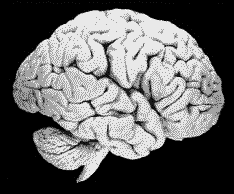
Neuroeconomic research at the University of Pennsylvania has conclusively identified a part of the brain that is necessary for making everyday decisions about value. Previous functional magnetic imaging studies, during which researchers use a powerful magnet to determine which parts of a subjects brain are most active while doing a task, have suggested that the ventromedial frontal cortex, or VMF, plays an evaluative role during decision making.
Now, Joseph Kable, an assistant professor of psychology in Penn's School of Arts and Sciences, has demonstrated the causal relationship between the VMF and such decisions.
"When you're doing functional imaging and looking at the relationship between brain activity and a decision," Kable said, "you don't know that the brain activity is causally important in that decision. They could be correlated for different reasons."
Kable and his colleagues, which included Penn undergraduate Khoi Vo and researchers from McGill University, addressed the limitations of imaging studies by recruiting experimental subjects who had suffered damage to that part of their brains, often from strokes, aneurysms or brain tumors.
"People with damage to their ventromedial frontal cortex should be less able to choose things that are most valuable and they should be less consistent in their choices," Kable said.
"That's exactly what we found."
Their research was published today in The Journal of Neuroscience.
Kable's experiment involved a simple questionnaire, where people with and without VMF damage were asked to pick between groupings of juice boxes and chocolate bars, based on which they liked more.
The subjects were sequentially given 11 sheets of paper, which listed two or more groups they could choose. As an incentive for them to pick the one they truly wanted more, the researchers promised to give each subject one of the 11 groups he or she selected at the end of the experiment. The subjects were also able to pick what kind of juice and chocolate they preferred before the experiment began.
While there were no price tags on any of the items, the grouped items on each sheet had a fixed value relative to one another and the total amount that could be spent. A subject could pick between a group with six juice boxes and two chocolate bars, a group with three juice boxes and three chocolate bars and a group with no juice boxes and four chocolate bars, implying that the chocolate was three times as expensive as the juice.
Crucially, the relative values and amount that could be spent changed between each of the 11 sheets. By choosing in the different contexts and being given an opportunity to review and change their previous selections, the subjects revealed how much they preferred one item to another.
"We wanted to give people the best chance possible to be consistent," Kable said. "But on the flip side we didn't want to make it obvious how you would be consistent."
Consistency was key. If subjects made selections that contradicted their previously revealed preference, it indicated they couldn't properly assign a value to the items they were presented with. For example, a subject who chose no juices and two chocolates rather than six juices and no chocolates should not then choose two juices and no chocolates over no juices and six chocolates.
"Most of the control group didn't make any inconsistent choices, and all but one of the people who have VMF damage made at least one," Kable said. Many of the subjects with VMF damage made multiple inconsistent choices.
The strength of the findings of this kind of neuroeconomic experiment opens the door to more complex experiments dealing with real monetary value and to investigations into other parts of the brain that are associated with economic decision making.
Provided by
University of Pennsylvania
-
The science of decisions
Nov 18, 2010 |
not rated yet |
0
-
Chocolate is a 'super fruit'
Feb 07, 2011 |
not rated yet |
0
-
Researchers find similarities in brain activity for both habits and goals
Mar 23, 2011 |
not rated yet |
0
-
People Use Separate Brain Mechanisms to Make Ambiguous and Risky Choices
Mar 02, 2006 |
not rated yet |
0
-
Should I stay or should I go? Neural mechanisms of strategic decision making
May 27, 2009 |
not rated yet |
0
-
Motion perception revisited: High Phi effect challenges established motion perception assumptions
Apr 23, 2013 |
3 / 5 (2) |
2
-
Anything you can do I can do better: Neuromolecular foundations of the superiority illusion (Update)
Apr 02, 2013 |
4.5 / 5 (11) |
5
-
The visual system as economist: Neural resource allocation in visual adaptation
Mar 30, 2013 |
5 / 5 (2) |
9
-
Separate lives: Neuronal and organismal lifespans decoupled
Mar 27, 2013 |
4.9 / 5 (8) |
0
-
Sizing things up: The evolutionary neurobiology of scale invariance
Feb 28, 2013 |
4.8 / 5 (10) |
14
-
Why is zone 1 in liver more prone to ischemic injury?
May 23, 2013
-
How can there be villous adenoma in colon, if there are no villi there
May 22, 2013
-
How can there be a term called "intestinal metaplasia" of stomach
May 21, 2013
-
Pressure-volume curve: Elastic Recoil Pressure don't make sense
May 18, 2013
-
If you became brain-dead, would you want them to pull the plug?
May 17, 2013
-
MRI bill question
May 15, 2013
- More from Physics Forums - Medical Sciences
More news stories
Controlling mood through the motions of mitochondria
(Medical Xpress)—Regulating the distribution of power in neurons is done by a system that makes the national electric grid look simple by comparison. Each neuron has several thousand mitochondria confined ...
Neuroscience
13 hours ago |
4.8 / 5 (6) |
0
|
Brain uses internal 'average voice' prototype to identify who is talking
(Medical Xpress)—The human brain is able to identify individuals' voices by comparing them against an internal 'average voice' prototype, according to neuroscientists.
Neuroscience
17 hours ago |
1 / 5 (1) |
0
|
Depression common among children with temporal lobe epilepsy
A new study determined that children and adolescents with seizures involving the temporal lobe are likely to have clinically significant behavioral problems and psychiatric illness, especially depression. Findings published ...
Neuroscience
17 hours ago |
not rated yet |
0
The secret lives, and deaths, of neurons
As the human body fine-tunes its neurological wiring, nerve cells often must fix a faulty connection by amputating an axon—the "business end" of the neuron that sends electrical impulses to tissues or other ...
Neuroscience
19 hours ago |
5 / 5 (2) |
0
|
Regenerating spinal cord fibers may be treatment for stroke-related disabilities
A study by researchers at Henry Ford Hospital found "substantial evidence" that a regenerative process involving damaged nerve fibers in the spinal cord could hold the key to better functional recovery by most stroke victims.
Neuroscience
19 hours ago |
not rated yet |
0
|
Obesity weighs down on top soda guzzler Mexico
Artemio Martinez balanced his corpulent frame on a stool in a Mexico City street taco stand, downing a sweet soda and eating a final pork-filled corn tortilla.
WHO voices deep concern over spread of SARS-like virus
The World Health Organization voiced deep concern Thursday over the SARS-like virus that has killed 22 people in less than a year, saying it might potentially spread more widely between humans.
Study: No higher cancer rate at Conn. Pratt plant
(AP)—Researchers examining the incidence of brain cancer at jet engine manufacturer Pratt & Whitney in Connecticut say they have found no statistically significant elevations in the rate of cancer among workers.
Hormone replacement therapy—clarity at last
The British Menopause Society and Women's Health Concern have today released updated guidelines on Hormone Replacement Therapy (HRT) to provide clarity around the role of HRT, the benefits and the risks. The new guidelines ...
Motion quotient: IQ predicted by ability to filter motion (w/ video)
A brief visual task can predict IQ, according to a new study. This surprisingly simple exercise measures the brain's unconscious ability to filter out visual movement. The study shows that individuals whose ...
Multiple research teams unable to confirm high-profile Alzheimer's study
Teams of highly respected Alzheimer's researchers failed to replicate what appeared to be breakthrough results for the treatment of this brain disease when they were published last year in the journal Science.