Autism blurs distinctions between brain regions
Autism blurs the molecular differences that normally distinguish different brain regions, a new study suggests. Among more than 500 genes that are normally expressed at significantly different levels in the front versus the lower middle part of the brain’s outer mantle, or cortex, only 8 showed such differences in brains of people with autism, say researchers funded in part by the National Institutes of Health.
"Such blurring of normally differentiated brain tissue suggests strikingly less specialization across these brain areas in people with autism," explained Daniel Geschwind, M.D., Ph.D., of the University of California, Los Angeles, a grantee of the NIH’s National Institute of Mental Health. "It likely reflects a defect in the pattern of early brain development."
He and his colleagues published their study online May 26, 2011 in the journal Nature. The research was based on postmortem comparisons of brains of people with the disorder and healthy controls.
In fetal development, different mixes of genes turn on in different parts of the brain to create distinct tissues that perform specialized functions. The new study suggests that the pattern regulating this gene expression goes awry in the cortex in autism, impairing key brain functions.
"This study provides the first evidence of a common signature for the seemingly disparate molecular abnormalities seen in autism," said NIMH director Thomas R. Insel, M.D. "It also points to a pathway-based framework for understanding causes of other brain disorders stemming from similar molecular roots, such as schizophrenia and ADHD."
In an earlier study, the researchers showed that genes that turn on and off together at the same time hold clues to the brain’s molecular instructions. These modules of co-expressed genes can reveal genetic co-conspirators in human illness, through what Geschwind and colleagues call "guilt by association." A gene is suspect if its expression waxes and wanes in sync with others in an illness-linked module.
Using this strategy, the researchers first looked for gene expression abnormalities in brain areas implicated in autism – genes expressed at levels different than in brains of healthy people. They found 444 such differently expressed genes in the cortexes of postmortem brains of people with autism.
Most of the same genes turned out to be abnormally expressed in the frontal cortex as in the temporal cortex (lower middle) of autistic brains. Of these, genes involved in synapses, the connections between neurons, tended to be under-expressed when compared with healthy brains. Genes involved in immune and inflammatory responses tended to be over-expressed. Significantly, the same pattern held in a separate sample of autistic and control brains examined as part of the study.
Autistic and healthy control brains were similarly organized -- modules of co-expressed genes correlated with specific cell types and biological functions.
Yet normal differences in gene expression levels between the frontal and temporal cortex were missing in the modules of autistic brains. This suggests that the normal molecular distinctions — the tissue differences — between these regions are nearly erased in autism, likely affecting how the brain works. Strikingly, among 174 genes expressed at different levels between the two regions in two healthy control brains, none were expressed at different levels in brains of people with autism.
An analysis of gene networks revealed two key modules of co-expressed genes highly correlated with autism.
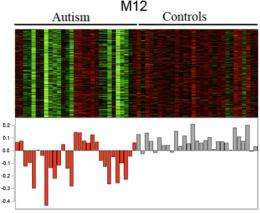
One module was made up of genes in a brain pathway involved in neuron and synapse development, which were under-expressed in autism. Many of these genes were also implicated in autism in previous, genome-wide studies. So, several different lines of evidence now converge, pointing to genes in this M12 module (see picture below) as genetic causes of autism.
A second module of co-expressed genes, involved in development of other types of brain cells, was over-expressed in autism. These were determined not to be genetic causes of the illness, but likely gene expression changes related to secondary inflammatory, immune, or possible environmental factors involved in autism.
This newfound ability to see genes in the context of their positions in these modules, or pathways, provides hints about how they might work to produce illness, according to Geschwind and colleagues. For example, from its prominent position in the M12 module, the researchers traced a potential role in creating defective synapses to a gene previously implicated in autism.
Follow-up studies should explore whether the observed abnormalities in the patterning of gene expression might also extend to other parts of the brain in autism, say the researchers.
More information: Transcriptomic analysis of autistic brain reveals convergent molecular pathology. Voineagu I, Wang X, Johnston P, Lowe JK, Tian Y, Horvath S, Mill J, Cantor RM, Blencowe BJ, Geschwind DH. Nature. 2011 May 25. PMID:21614001


