FSU scientist leads research on AIDS-related cancer
June 3, 2011 in HIV & AIDS
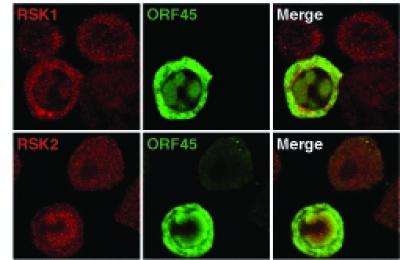
KSHV ORF45 activates cellular ribosomal S6 kinases 1 (RSK1) and RSK2, and recruits them to the viral replication compartment in the nucleus. Credit: Courtesy Fanxiu Zhu
In the early days of the AIDS epidemic, a once-rare form of cancer known as Kaposi's sarcoma (KS) emerged as a frequent harbinger of HIV. Its stigma was best illustrated by Tom Hanks, who portrayed a gay man trying to conceal the cancerous skin lesions from his co-workers in the 1993 movie "Philadelphia."
A few years after the movie's release, Fanxiu Zhu was a young virologist searching for a postdoctoral position. He found one, in Philadelphia, at a university laboratory investigating a newly identified virus linked to KS.
Today, Zhu is an assistant professor at Florida State University and a nationally recognized expert on KS. This spring, he won a new, five-year, $1.5 million grant from the National Institutes of Health (NIH) that will support the continuation of his widely published work, which could contribute to the development of more effective drug therapies.
"Kaposi's sarcoma has become the defining symptom of AIDS, so studying the virus that causes KS is obviously important for understanding AIDS and AIDS-related cancers," Zhu said.
Already Zhu's body of research has generated findings that may speed the development of more effective, targeted therapies for KS, which is caused by a human cancer virus now known as human herpesvirus 8 (HHV-8) or KS-associated herpesvirus (KSHV).
Zhu has become a leader in the study of KSHV by focusing on viral proteins that he and his Florida State research team have identified as crucial to the life cycle of the virus.
The protein they study extensively is called ORF45, short for "open reading frame 45." Zhu and his team found that the ORF45 protein has a wide variety of functions in infection.
"In fact, Dr. Zhu has discovered that the protein is 'packaged' with each new virus, meaning that it is present when a virus infects a new cell," said biologist P. Bryant Chase, chairman of FSU's Department of Biological Science.
"Infectious agents and infected cells are typically recognized and then eliminated by our immune system," Chase explained. "But Dr. Zhu's group has shown that the KSHV ORF45 protein plays a role in preventing the immune system from recognizing infected cells and removing them."
Gaining a better understanding of just how that happens is a key component of the new NIH grant.
An earlier study by Zhu's research team found that the KSHV ORF45 protein "hijacks" the signaling pathways within cells that are critical for a cell's regulation of its multiple processes including what genes are expressed when and at what level, as well as what metabolic pathways will be turned on at any given time, and to what extent.
Now, Zhu's latest grant will help him to clarify the KSHV ORF45 protein's role not only within cellular signaling pathways but also in immune evasion the process by which an invading organism avoids or suppresses the host's immune responses to it.
Unlocking what once were the mysteries of the KSHV infection and replication are crucial to developing effective therapies because, despite the success of highly active antiretroviral therapy against HIV, KS remains a serious disease and the most common cancer among HIV/AIDS patients. KSHV also is associated with other human cancers such as primary effusion lymphoma and multicentric Castleman's disease.
In Africa, KS accounts for nearly half of the reported cancers and is the leading cause of cancer death in some areas. Current treatments for KSHV-associated diseases are not optimal because they don't attack the viral agent specifically.
"Dr. Zhu's work on KSHV ORF45 aims to give us a drug target that is specific to the virus," Chase said. "The newly funded studies should take him even closer to that goal."
Since 2008, nine papers coauthored by Zhu's research team have been featured in leading peer-reviewed publications, including the Journal of Virology, PLoS Pathogens, Journal of Biological Chemistry and Journal of Immunology. To learn more, visit Zhu's Florida State University Web page at www.bio.fsu.edu/faculty-zhu.
Provided by
Florida State University
-
DNA damage response confers a barrier for viral tumorigenesis
Sep 28, 2007 |
not rated yet |
0
-
Penn researchers discover new mechanism for viral replication
Aug 16, 2007 |
not rated yet |
0
-
Scientists tackle viral mysteries
Jun 29, 2009 |
not rated yet |
0
-
Potential new drug target to combat Kaposi's sarcoma
May 06, 2010 |
not rated yet |
0
-
Major Kaposi's sarcoma discovery announced
Apr 06, 2006 |
not rated yet |
0
-
Limits to growth: Scientists identify key metastasis-enabling enzyme
May 22, 2012 |
5 / 5 (3) |
0
-
Seeing is as seeing does: Spatially-structured retinal input in early development of cortical maps
Apr 26, 2012 |
5 / 5 (4) |
1
-
Dreamless nights: Brain activity during nonrapid eye movement sleep
Apr 09, 2012 |
4.4 / 5 (12) |
0
-
Take your time: Neurobiology sheds light on the superiority of spaced vs. massed learning
Mar 28, 2012 |
4.5 / 5 (21) |
3
-
Your brain on 'shrooms: fMRI elucidates neural correlates of psilocybin psychedelic state
Feb 29, 2012 |
4.9 / 5 (42) |
45
-
Classical and Quantum Mechanics via Lie algebras
Apr 15, 2011
- More from Physics Forums - Independent Research
More news stories
Mortality rates decrease, chronic disease rates increase among HIV+ ICU patients
The expanded use of antiretrovirals, potent drugs used to treat retroviral infections such as human immunodeficiency virus (HIV), has been linked to significant decreases in hospital mortality rates among severely ill HIV-positive(HIV+) ...
HIV & AIDS
May 23, 2012 |
not rated yet |
0
Newly discovered breast milk antibodies help neutralize HIV
Antibodies that help to stop the HIV virus have been found in breast milk. Researchers at Duke University Medical Center isolated the antibodies from immune cells called B cells in the breast milk of infected mothers in Malawi, ...
HIV & AIDS
May 22, 2012 |
5 / 5 (3) |
1
|
Reactions to HIV drug have autoimmune cause, reports AIDS journal
Potentially severe hypersensitivity reactions to the anti-HIV drug abacavir occur through an autoimmune mechanism, resulting from the creation of drug-induced immunogens that are attacked by the body's immune system, according ...
HIV & AIDS
May 22, 2012 |
not rated yet |
0
Is the U.S. ready for home HIV tests?
At the pharmacy, you can buy anything from tea kettles to Tylenol. But what if you could buy a rapid HIV test over the counter and test yourself in the privacy of your own home?
HIV & AIDS
May 21, 2012 |
not rated yet |
0
|
Clergy can fight HIV on faith-friendly terms
The public health community has long struggled with how best to reduce HIV infection rates among black Americans, which is seven times that of whites. In a new paper in the journal PLoS ONE, a team of phy ...
HIV & AIDS
May 16, 2012 |
not rated yet |
0
'Personality genes' may help account for longevity
"It's in their genes" is a common refrain from scientists when asked about factors that allow centenarians to reach age 100 and beyond. Up until now, research has focused on genetic variations that offer a physiological advantage ...
Study provides compelling evidence for an effective new treatment for tinnitus
According to new research, a multidisciplinary approach to treating tinnitus that combines cognitive behaviour therapy with sound-based tinnitus retraining therapy is significantly more effective than currently available ...
Brentuximab vedotin effective in large-cell lymphoma
(HealthDay) -- More than half of patients with relapsed or refractory systemic anaplastic large-cell lymphoma (ALCL) treated with the CD30-directed antibody-drug conjugate brentuximab vedotin achieve a complete ...
Autism often not diagnosed until age 5 or older: U.S. report
(HealthDay) -- Even though autism symptoms typically emerge before age 3, most children with autism are diagnosed when they're 5 or older, a new snapshot of autism in America shows.
Doctors report rise in kids eating detergent packs
(AP) -- Miniature laundry detergent packets arrived on store shelves in recent months as an alternative to bulky bottles and messy spills. But doctors across the country say children are confusing the tiny, brightly colored ...
Gene discovery points towards non-hormonal male contraceptive
A new type of male contraceptive could be created thanks to the discovery of a key gene essential for sperm development.