Researchers can predict future actions from human brain activity
June 29, 2011 in Neuroscience

Researchers can predict future actions from human brain activity

Enlarge

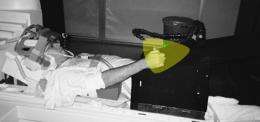
A volunteer completes tasks while in the functional magnetic imaging (fMRI) machine. This research project focuses on understanding how the human brain plans actions.

(PhysOrg.com) -- Bringing the real world into the brain scanner, researchers at The University of Western Ontario from The Centre for Brain and Mind can now determine the action a person was planning, mere moments before that action is actually executed.

The findings were published this week in the prestigious , in the paper, "Decoding Action Intentions from Preparatory Brain Activity in Human Parieto-Frontal Networks."

"This is a considerable step forward in our understanding of how the human brain plans actions," says Jason Gallivan, a Western Neuroscience PhD student, who was the first author on the paper.

This video is not supported by your browser at this time.

University of Western Ontario researchers Jody Culham and Jason Gallivan describe how they can use a fMRI to determine the action a person was planning, mere moments before that action is actually executed. Credit: The University of Western Ontario

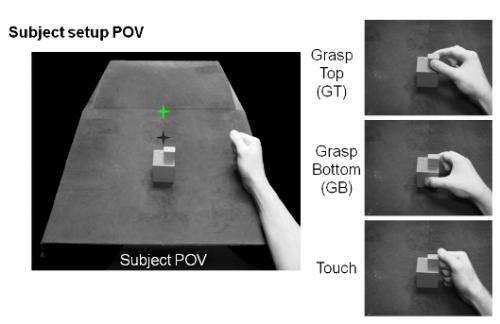
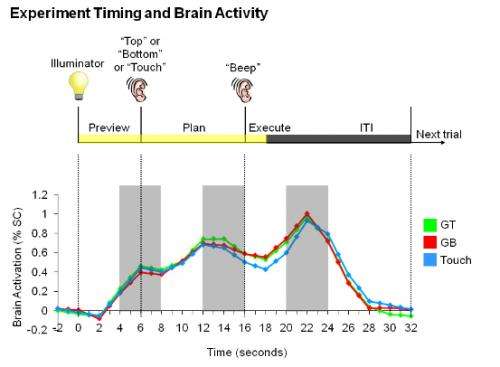
Over the course of the one-year study, human subjects had their brain activity scanned using (fMRI) while they performed one of three hand movements: grasping the top of an object, grasping the bottom of the object, or simply reaching out and touching the object. The team found that by using the signals from many , they could predict, better than chance, which of the actions the volunteer was merely intending to do, seconds later.
Researchers can predict future actions from human brain activity
Enlarge


"Neuroimaging allows us to look at how action planning unfolds within human brain areas without having to insert electrodes directly into the human brain. This is obviously far less intrusive," explains Western Psychology professor Jody Culham, who was the paper's senior author.
Researchers can predict future actions from human brain activity
Enlarge


Gallivan says the new findings could also have important clinical implications: "Being able to predict a human's desired movements using takes us one step closer to using those signals to control prosthetic limbs in movement-impaired patient populations, like those who suffer from or locked-in syndrome."

This video is not supported by your browser at this time.

Brain timecourse video of subject's fMRI image during experiment


Provided by University of Western Ontario

5 /5 (6 votes)  

Rank 5 /5 (6 votes)
Relevant PhysicsForums posts

More news stories

Controlling mood through the motions of mitochondria

(Medical Xpress)—Regulating the distribution of power in neurons is done by a system that makes the national electric grid look simple by comparison. Each neuron has several thousand mitochondria confined ...

Neuroscience created 13 hours ago | popularity 4.8 / 5 (6) | comments 0 | with audio podcast report

Brain uses internal 'average voice' prototype to identify who is talking

(Medical Xpress)—The human brain is able to identify individuals' voices by comparing them against an internal 'average voice' prototype, according to neuroscientists.

Neuroscience created 17 hours ago | popularity 1 / 5 (1) | comments 0 | with audio podcast

Depression common among children with temporal lobe epilepsy

A new study determined that children and adolescents with seizures involving the temporal lobe are likely to have clinically significant behavioral problems and psychiatric illness, especially depression. Findings published ...

Neuroscience created 17 hours ago | popularity not rated yet | comments 0

The secret lives, and deaths, of neurons

As the human body fine-tunes its neurological wiring, nerve cells often must fix a faulty connection by amputating an axon—the "business end" of the neuron that sends electrical impulses to tissues or other ...

Neuroscience created 19 hours ago | popularity 5 / 5 (2) | comments 0 | with audio podcast

Regenerating spinal cord fibers may be treatment for stroke-related disabilities

A study by researchers at Henry Ford Hospital found "substantial evidence" that a regenerative process involving damaged nerve fibers in the spinal cord could hold the key to better functional recovery by most stroke victims.

Neuroscience created 19 hours ago | popularity not rated yet | comments 0 | with audio podcast


Obesity weighs down on top soda guzzler Mexico

Artemio Martinez balanced his corpulent frame on a stool in a Mexico City street taco stand, downing a sweet soda and eating a final pork-filled corn tortilla.

WHO voices deep concern over spread of SARS-like virus

The World Health Organization voiced deep concern Thursday over the SARS-like virus that has killed 22 people in less than a year, saying it might potentially spread more widely between humans.

Study: No higher cancer rate at Conn. Pratt plant

(AP)—Researchers examining the incidence of brain cancer at jet engine manufacturer Pratt & Whitney in Connecticut say they have found no statistically significant elevations in the rate of cancer among workers.

Hormone replacement therapy—clarity at last

The British Menopause Society and Women's Health Concern have today released updated guidelines on Hormone Replacement Therapy (HRT) to provide clarity around the role of HRT, the benefits and the risks. The new guidelines ...

Motion quotient: IQ predicted by ability to filter motion (w/ video)

A brief visual task can predict IQ, according to a new study. This surprisingly simple exercise measures the brain's unconscious ability to filter out visual movement. The study shows that individuals whose ...

Multiple research teams unable to confirm high-profile Alzheimer's study

Teams of highly respected Alzheimer's researchers failed to replicate what appeared to be breakthrough results for the treatment of this brain disease when they were published last year in the journal Science.