Researchers discover potential cause of chronic painful skin
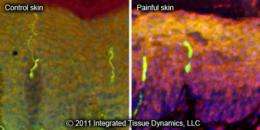
A new study may explain why only 50% of patients experiencing chronic nerve pain achieve even partial relief from existing therapeutics. The study, published in the June 6 online version of the international research journal PAIN, reveals that certain types of chronic pain may be caused by signals from the skin itself, rather than damage to nerves within the skin, as previously thought.
A Medical Mystery
For years, researchers have known that increased amounts of a molecule called Calcitonin Gene-Related Peptide (CGRP) is found in the skin of chronic pain patients. The source of the increased CGRP was thought to be certain types of sensory nerve fibers in the skin that normally make and release a type or "isoform" called CGRP-alpha. Curiously, however, the authors of the current study found that nerve fibers containing CGRP-alpha are actually reduced under painful conditions – leading them to investigate where the increased CGRP in the skin came from.
The answer, surprisingly, was that the skin cells themselves generate increased amounts of a lesser-known "beta" isoform of CGRP. This skin cell-derived CGRP-beta is increased in painful conditions and may be sending pain signals to remaining sensory nerve fibers in the skin. The discovery of CGRP-beta as a therapeutic target presents a potentially important new treatment approach.
"Since CGRP-alpha normally plays an important role in both the regulation of blood flow and normal inflammatory responses, targeting this molecule as a treatment for chronic pain could cause undesired side-effects on circulation," said the paper's corresponding author, Phillip J. Albrecht, Ph.D., Assistant Professor of Neuroscience at Albany Medical College and Vice President at Integrated Tissue Dynamics, LLC, whose team conducted the research. "However, since we know that these two forms of CGRP are derived from separate genes, we may be able to selectively manipulate the beta isoform without affecting the alpha, and dramatically reduce unwanted toxicities -- a common problem limiting the successful development of novel pain therapeutics. This is really a two-for-one discovery: a novel mechanism we can specifically target in a novel skin location."
The discovery that CGRP-beta from keratinocyte cells of skin may be causing pain has profound implications for the treatment and study of a host of chronic neuropathic pain conditions such as shingles, diabetic neuropathy, and physical injury, which altogether affect approximately 30 million people in the U.S. who collectively spend more than $4.5 billion each year to treat chronic nerve pain.
A New Translational Research Platform
The present study was a comprehensive translational research project that integrated results from cell culture, animal models of chronic pain and human pain condition tissues to confirm that CRGP is generated in keratinocytes in each of those systems. The study also demonstrates how a translational research platform can be utilized to discover novel targets and provide drug companies with better predictive data that can be used to make time- and cost-reducing decisions early in the drug discovery process.
To observe differences between CGRP in healthy and inflamed or painful skin, the researchers used an imaging methodology called chemomorphometric analysis (CMA), a technique they use to observe, quantify, and characterize molecules like CGRP in the microscopic structure of skin samples half the size of a pencil eraser. A commercially expanded version of the technique, pioneered by Integrated Tissue Dynamics, LLC, interpreted those results and integrated them with assessments of the genetic activity for each CGRP isoform, which led to the discovery that the beta molecule, not the alpha, predominated in keratinocytes.
"We are especially excited by our translational research results because the identification of beta CGRP in keratinocytes will have immediate value in the clinical setting, and also demonstrates how our CMA technology can deliver on the promise of translational medicine," said Frank L. Rice, Ph.D., Professor of Neuroscience at Albany Medical College and CEO at Integrated Tissue Dynamics, LLC. "Furthermore, the identification of beta CGRP in skin keratinocytes may become a useful independent biomarker for the therapeutic effectiveness of chronic neuropathic pain treatments."
The initial discovery stems from the Ph.D. dissertation research of Albany Medical College graduate student Quanzhi Hou, M.D., who is being co-mentored by Drs. Albrecht and Rice, in conjunction with research by Travis Barr, Ph.D., a former graduate student in the lab. Dr. Hou's research was made possible with the support of an international network of researchers and clinicians from Albany Medical College, the Feinberg School of Medicine of Northwestern University, Boston College, the University at Albany, the University of Brescia (Italy), the Israel Institute of Technology, and companies Vertex Pharmaceuticals and Integrated Tissue Dynamics. Dr. Rice noted that "As a co-discovery in the labs of Albany Medical College and Integrated Tissue Dynamics, we are filing a patent to develop our research and commercialization options."
About the Study
The present study found CGRP levels increased in keratinocytes of painful skin from humans with postherpetic neuralgia (PHN) and complex regional pain syndrome type 1 (CRPS). Elevated CGRP levels were also found in skin keratinocytes from monkeys infected with the equivalent of HIV, and in rats with nerve injury and inflammatory pain conditions similar to those caused by accidents and shingles. CGRP was also found in human keratinocyte cell cultures, and the beta isoform predominated.
Previous research has documented abnormally increased levels of CGRP in the skin, blood, and cerebral spinal fluid under a variety of human and animal chronic pain conditions, and CGRP has consequently become a leading target for chronic pain therapeutics. However, prior research has largely not distinguished between the two isoforms and it has been assumed that the increased CGRP seen in previous studies was the alpha isoform generated by nerves that supply sensory innervation to the skin.
Recently, members of the Intidyn and the Medical College group also published a pioneering study demonstrating that CGRP (likely alpha) innervation to the blood vessels plays a previously unknown role in normal skin sensation. The current findings now add to that story, the role of a second (beta) isoform produced in a unique location (keratinocytes) - which likely also plays a critical role in both normal sensation and chronic painful conditions.
More information: Hou Q, Barr TP, Gee LE, Vickers JT, Wymer JP, Borsani E, Rodella LF, Getsios S, Burdo TH, Eisenberg E, Guha U, Kessler JA, Lavker RM, Chittur S, Fiorino DF, Rice FL, Albrecht PJ. (2011) Keratinocyte Expression of CGRP beta: Implications for Neuropathic and Inflammatory Pain Mechanisms. Pain. 06 June 2011 (10.1016/j.pain.2011.04.033).


