Potential treatment for deadly E. coli disease
June 7, 2011 in Diseases, Conditions, Syndromes

Potential treatment for deadly E. coli disease

Enlarge

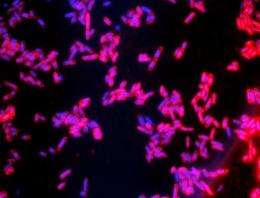
The probiotic bacterium (blue) with E. coli Shiga toxin (red) bound all over its surface

A potential life-saving treatment for severe E. coli food poisoning outbreaks - developed more than a decade ago - hasn't gone forward into clinical trials because of lack of commercial interest.

University of Adelaide researchers produced a "designer" probiotic which binds and neutralises the toxin produced by E. coli, which causes life-threatening attack on the kidneys and blood vessels.

The team of scientists - Dr Adrienne Paton, Associate Professor Renato Morona and Professor James Paton - showed that mice infected with a highly of E. coli were completely protected by the probiotic bacterium.

The research was published in the prestigious journal Nature Medicine in 2000 and generated ongoing interest from the scientific and medical community - but the commercial sector hasn't taken up its development for progress into clinical trials in humans.

"Severe E. coli food poisoning outbreaks such as that currently occurring in Europe are becoming increasingly common," said Professor Paton, Director, Research Centre for in the School of Molecular and Biomedical Science.

"They have the potential to cause widespread disease and many patients develop life-threatening complications including .

"The probiotic bacterium could be produced cheaply on a large scale. However, in spite of on-going attention from the scientific and medical community, there has been a lack of interest from the commercial sector in taking this product forward into clinical trials.

"If this had been done, and the probiotic had been proven to be safe and efficacious in humans, it could have been deployed during the current European outbreak. This would undoubtedly have saved lives, as well as millions of dollars in current and future ."

The researchers engineered a harmless bacterium to mimic binding receptors for the potentially fatal Shiga toxin on its surface.

Professor Paton said after diagnosis of E. coli infection there was a window of opportunity for therapeutic intervention before kidneys started to fail. Antibiotics are not used because they can increase the amount of toxin released in the gut.

Provided by University of Adelaide search and more info website

5 /5 (1 vote)  

Filter


Move the slider to adjust rank threshold, so that you can hide some of the comments.


Display comments: newest first

neiorah
Jun 08, 2011

Rank: not rated yet
The dullards thought there was not a big enough profit margin to manufacture it on it's important health benefits alone. Capitalism at its best.
Rank 5 /5 (1 vote)
Related Stories
Relevant PhysicsForums posts

More news stories

UN reports 22 deaths worldwide from coronavirus

A new coronavirus has now claimed 22 lives worldwide out of 44 lab-confirmed cases, mostly in Saudi Arabia, World Health Organization officials said Thursday.

Diseases, Conditions, Syndromes created 1 hour ago | popularity not rated yet | comments 0

Researchers suggest boosting body's natural flu killers

A known difficulty in fighting influenza (flu) is the ability of the flu viruses to mutate and thus evade various medications that were previously found to be effective. Researchers at the Hebrew University of Jerusalem have ...

Diseases, Conditions, Syndromes created 2 hours ago | popularity not rated yet | comments 0 | with audio podcast

Swine flu pandemic of 2009 more deadly for younger adults, study finds

As the world prepares for what may be the next pandemic strain of influenza virus, in the H7N9 bird flu, a new UC Irvine study reveals that the 2009 H1N1 swine flu pandemic was deadliest for people under the age of 65, while ...

Diseases, Conditions, Syndromes created 21 hours ago | popularity not rated yet | comments 0

Polio cases found in Kenya and Somalia, WHO says

The World Health Organization says the Horn of Africa is experiencing an outbreak of polio with cases confirmed in Kenya and Somalia.

Diseases, Conditions, Syndromes created 21 hours ago | popularity not rated yet | comments 0

SARS-like virus claims new life in Saudi

A man who had contracted the coronavirus has died in Saudi Arabia, raising the death toll in the kingdom from the SARS-like virus to 17, the health ministry announced on its website on Wednesday.

Diseases, Conditions, Syndromes created 21 hours ago | popularity not rated yet | comments 0


Researchers find common childhood asthma unconnected to allergens or inflammation

Little is known about why asthma develops, how it constricts the airway or why response to treatments varies between patients. Now, a team of researchers at Weill Cornell Medical College, Columbia University Medical Center ...

Scientists discover molecule triggers sensation of itch

Scientists at the National Institutes of Health report they have discovered in mouse studies that a small molecule released in the spinal cord triggers a process that is later experienced in the brain as the sensation of ...

Multiple research teams unable to confirm high-profile Alzheimer's study

Teams of highly respected Alzheimer's researchers failed to replicate what appeared to be breakthrough results for the treatment of this brain disease when they were published last year in the journal Science.

Brain uses internal 'average voice' prototype to identify who is talking

(Medical Xpress)—The human brain is able to identify individuals' voices by comparing them against an internal 'average voice' prototype, according to neuroscientists.

Antibiotics: A new understanding of sulfonamide nervous system side effects

Since the discovery of Prontosil in 1932, sulfonamide antibiotics have been used to combat a wide spectrum of bacterial infections, from acne to chlamydia and pneumonia. However, their side effects can include serious neurological ...

Economic incentives increase blood donation without negative consequences

Can economic incentives such as gift cards, T-shirts, and time off from work motivate members of the public to increase their donations of blood?