Creating precursor liver cells from stem cells
June 8, 2011 in Medical research
Bath scientists in stem cell breakthrough

Enlarge

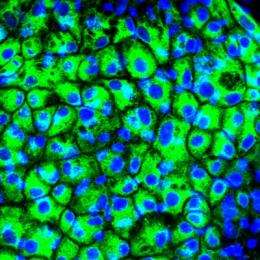
Bath scientists have developed a more simple process to create precursor liver cells, allowing the scale on which they can be created to be increased.

(Medical Xpress) -- Scientists from the Departments of Biology & Biochemistry and Pharmacy & Pharmacology have discovered a new way to create precursor liver cells from stem cells, with the potential to impact on the testing of new medicines.

Stem cells are able to develop into more specialised cells and scientists believe they have huge potential to treat diseases or injuries that don’t currently have a cure.

The current method for developing precursor involves many different steps and uses a variety of biological agents.


The new process is much simpler, relying on just one small molecule, called 1M, being added to stem cell cultures. This treatment causes the stem cells to turn into precursors of liver cells.

Professor Melanie Welham and Dr David Tosh co-supervise the research. Professor Welham said: “The new method we have defined through our research is much simpler than previous procedures, so should reduce the cost of turning stem cells into precursor liver cells.

“This will allow the scale on which precursor liver cells are created to be more easily increased.”

Scientists are keen to develop liver cells that can be used to test the safety of new medical drugs. Even everyday painkillers are known to have toxic effects on the liver if taken in the wrong quantity, and the tests currently used don’t always accurately predict what will happen in humans.

Therefore, an improved supply of liver cells that can be used in testing the safety of new medicines will allow pharmaceutical companies to improve and strengthen the testing of drugs for human use.

Dr Tosh said: “This is a significant breakthrough in the field of stem cell research and will impact on the pharmaceutical industry and the way in which medicines are tested.

“There is, however, a great deal of work to still be done. Until now our research has focused on the early stages of liver cell development and there is still a lot of research to do to expand what has been found so far and to generate fully functioning liver cells.”

The research team has received funding from a public-private partnership called ‘ for Safer Medicines’, a consortium of public funding bodies including the Medical Research Council, the Biotechnology and Biological Sciences Research Council, the Technology Strategy Board and the Department of Health, along with four pharmaceutical companies GlaxoSmithKline, AstraZeneca, Roche Healthcare and UCB Celltech.

More information: See the full paper in the Journal of Cell Science – ‘Let there be liver’.

Provided by Bath University

not rated yet  

Rank not rated yet
Related Stories
Relevant PhysicsForums posts
  • A question about drug tolerance
    createdMay 23, 2012
  • Poor nutrition leading to overeating?
    createdMay 23, 2012
  • Math and dyslexia?
    createdMay 21, 2012
  • portable metabolism meter?
    createdMay 21, 2012
  • Rare medical conditions on 20/20 tonight
    createdMay 18, 2012
  • "Good" Cholesterol in Doubt
    createdMay 17, 2012
  • More from Physics Forums - Medical Sciences

More news stories

Like curry? New biological role identified for compound used in ancient medicine

Scientists have just identified a new reason why some curry dishes, made with spices humans have used for thousands of years, might be good for you.

Medical research created 2 hours ago | popularity 4.5 / 5 (2) | comments 1 | with audio podcast

The cells' petrol pump is finally identified

The oxygen and food we consume are converted into energy by tiny organelles present in each cell, the mitochondria. These 'power plants' must be continuously supplied with fuel, to maintain all vital functions. A team led ...

Medical research created 13 hours ago | popularity 5 / 5 (1) | comments 0

Researchers identify protein necessary for behavioral flexibility

Researchers have identified a protein necessary to maintain behavioral flexibility, which allows us to modify our behaviors to adjust to circumstances that are similar, but not identical, to previous experiences. Their findings, ...

Medical research created 15 hours ago | popularity 5 / 5 (2) | comments 1 | with audio podcast

From stem cell to brain cell - new technique mimics the brain

A new technique that converts stem cells into brain cells has been developed by researchers at Lund University. The method is simpler, quicker and safer than previous research has shown and opens the doors to a shorter route ...

Medical research created 17 hours ago | popularity 5 / 5 (1) | comments 0

A revealing hand

What did you have for lunch yesterday? How many times a month do you eat nuts? How about your kids -- how many servings of vegetables did they consume today?

Medical research created 21 hours ago | popularity 5 / 5 (2) | comments 0


Amino acid consumption associated with how fast cancer cells divide

For almost a century, researchers have known that cancer cells have peculiar appetites, devouring glucose in ways that normal cells do not. But glucose uptake may tell only part of cancer's metabolic story. Researchers from ...

Thioridazine kills cancer stem cells in human while avoiding toxic side-effects of conventional cancer treatments

A team of scientists at McMaster University has discovered a drug, thioridazine, successfully kills cancer stem cells in the human while avoiding the toxic side-effects of conventional cancer treatments.

'Personality genes' may help account for longevity

"It's in their genes" is a common refrain from scientists when asked about factors that allow centenarians to reach age 100 and beyond. Up until now, research has focused on genetic variations that offer a physiological advantage ...

Gene discovery points towards non-hormonal male contraceptive

A new type of male contraceptive could be created thanks to the discovery of a key gene essential for sperm development.

Cyber exercise partners help you go the distance: Motivation gains can double

A new study testing the benefits of a virtual exercise partner shows the presence of a moderately more capable cycling partner can significantly boost the motivation – by as much as 100 percent – ...

New test shows potential for detecting active cases of Lyme disease

George Mason University researchers can find out if a tick bite means Lyme disease well before the bite victim begins to show symptoms.