Stem cell model offers clues to cause of inherited ALS
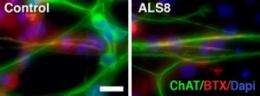
This image shows motor neurons (green) derived from ALS induced pluripotent stem cells forming neuromuscular junctions (red). Credit: Image courtesy of Alysson Muotri, UCSD.
An international team of scientists led by researchers at the University of California, San Diego School of Medicine have used induced pluripotent stem cells (iPSCs) derived from patients with amyotrophic lateral sclerosis (ALS) to reveal for the first time how reduced levels of a specific protein may play a central role in causing at least one inherited form of the disease.
The work, published in the June 2011 online issue of the journal Human Molecular Genetics, could help scientists overcome a major hurdle in the study and treatment of ALS, an incurable neuromuscular disorder also known as Lou Gehrig's disease. ALS is universally fatal, with a median age of onset of 55 years and survival of two to five years after symptoms appear. Past research efforts have long been stymied by difficulties in translating successful drug tests in animal models of ALS to humans.
"There is an urgent need for ALS human models that can be translated into clinical trials to verify therapeutic targets in the human genetic background," said Alysson R. Muotri, PhD, assistant professor in the UCSD Departments of Pediatrics and Cellular and Molecular Medicine, and one of the study's senior authors. "Rodents have been used in the past and still have a critical impact in unveiling the complexity of ALS, but the vast majority of drugs that have demonstrated efficacy in rodent models have not done the same in preclinical and clinical human trials."
In the new work, Muotri and colleagues turned to iPSCs derived from the skin cells of patients with a familial form of ALS called ALS8 to create motor neurons that provided a novel in vitro model of the disease. iPSCs from ALS patients have been described before, but finding cellular and molecular phenotypes has proved to be a continuing challenge. The use of a familial form of ALS offered an advantage since the mutated gene could be tracked during motor neuron differentiation.
"We don't know what causes most cases of ALS, but for roughly 10 percent of patients with ALS, the disease is the result of inherited genetic mutations," Muotri said. "One of these familial forms is ALS8, which results from mutations in the VAPB gene. Using iPSCs from several patients from two independent families, we found that VAPB protein levels are reduced in ALS8-derived motor neurons compared to similar cells from non-carrier siblings of ALS8 patients."
Muotri said the finding suggests reduced VAPB protein levels may be a key to the development of ALS8 and perhaps other forms of the disease as well, including sporadic or non-hereditary ALS, where reduced VAPB protein levels have also been documented.
"The VAPB protein is involved in many cellular processes, so it seems likely it contributes to the pathogenesis of other forms of ALS," Muotri said. "We don't yet know how the loss of VAPB is involved in causing familial or sporadic ALS, but the new ability to study this disease in human cells provides an unprecedented opportunity to answer that question, to develop new early diagnostic tools and to identify new targets for future drugs and therapies."
Provided by
University of California - San Diego
-
Researchers discover genetic link between both types of ALS
May 05, 2010 |
not rated yet |
0
-
International ALS gene search begins
May 16, 2006 |
not rated yet |
0
-
Genetics of ALS progression
Jun 01, 2008 |
not rated yet |
0
-
Researchers identify a gene responsible for Lou Gehrig's disease
Mar 31, 2008 |
not rated yet |
0
-
Mutation linked to protein degradation underlies inherited ALS
Dec 08, 2010 |
not rated yet |
0
-
Motion perception revisited: High Phi effect challenges established motion perception assumptions
Apr 23, 2013 |
3 / 5 (2) |
2
-
Anything you can do I can do better: Neuromolecular foundations of the superiority illusion (Update)
Apr 02, 2013 |
4.5 / 5 (11) |
5
-
The visual system as economist: Neural resource allocation in visual adaptation
Mar 30, 2013 |
5 / 5 (2) |
9
-
Separate lives: Neuronal and organismal lifespans decoupled
Mar 27, 2013 |
4.9 / 5 (8) |
0
-
Sizing things up: The evolutionary neurobiology of scale invariance
Feb 28, 2013 |
4.8 / 5 (10) |
14
-
Classical and Quantum Mechanics via Lie algebras
Apr 15, 2011
- More from Physics Forums - Independent Research
More news stories
Researchers complete largest genetic sequencing study of human disease
Researchers from Queen Mary, University of London have led the largest sequencing study of human disease to date, investigating the genetic basis of six autoimmune diseases.
Genetics
May 22, 2013 |
4.5 / 5 (4) |
0
|
Researchers develop model for better testing, targeting of malignant peripheral nerve sheath tumors
University of Minnesota Medical School researchers from the Masonic Cancer Center, University of Minnesota, in partnership with the University's Brain Tumor Program, have developed a new mouse model of malignant peripheral ...
Genetics
May 20, 2013 |
5 / 5 (1) |
0
|
Researchers identify new circadian clock component
Northwestern University scientists have shown a gene involved in neurodegenerative disease also plays a critical role in the proper function of the circadian clock.
Genetics
May 16, 2013 |
3 / 5 (1) |
1
|
Returning genetic incidental findings without patient consent violates basic rights, experts say
Informed consent is the backbone of patient care. Genetic testing has long required patient consent and patients have had a "right not to know" the results. However, as 21st century medicine now begins to use the tools of ...
Genetics
May 16, 2013 |
5 / 5 (1) |
3
|
Ethicists provide framework supporting new recommendations on reporting incidental findings in gene sequencing
In a paper published in Science Express, a group of experts led by bioethicists in the Center for Medical Ethics and Health Policy at Baylor College of Medicine provide a framework for the new American College of Medical Geneti ...
Genetics
May 16, 2013 |
not rated yet |
0
Ferrets, pigs susceptible to H7N9 avian influenza virus
Chinese and U.S. scientists have used virus isolated from a person who died from H7N9 avian influenza infection to determine whether the virus could infect and be transmitted between ferrets. Ferrets are often used as a mammalian ...
Scientists discover molecule triggers sensation of itch
Scientists at the National Institutes of Health report they have discovered in mouse studies that a small molecule released in the spinal cord triggers a process that is later experienced in the brain as the sensation of ...
Multiple research teams unable to confirm high-profile Alzheimer's study
Teams of highly respected Alzheimer's researchers failed to replicate what appeared to be breakthrough results for the treatment of this brain disease when they were published last year in the journal Science.
Motion quotient: IQ predicted by ability to filter motion (w/ video)
A brief visual task can predict IQ, according to a new study. This surprisingly simple exercise measures the brain's unconscious ability to filter out visual movement. The study shows that individuals whose ...
Researchers find common childhood asthma unconnected to allergens or inflammation
Little is known about why asthma develops, how it constricts the airway or why response to treatments varies between patients. Now, a team of researchers at Weill Cornell Medical College, Columbia University Medical Center ...
Drug reverses Alzheimer's disease deficits in mice, research confirms
An anti-cancer drug reverses memory deficits in an Alzheimer's disease mouse model, University of Pittsburgh Graduate School of Public Health researchers confirm in the journal Science.